

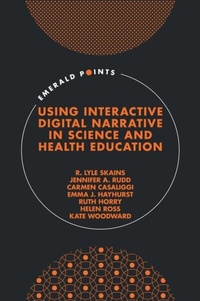
Using Interactive Digital Narrative in Science and Health Education
1st Edition
Published on 24. May 2021
152 pages
978-1-83909-760-7 (ISBN)
Description

Both the United Nations and the World Health Organization stress the need to address numerous increasingly urgent 'global challenges', including climate change and ineffectiveness of medication for communicable diseases.
Despite climate change resulting from human activity, most humans feel their contribution is minimal; thus any effort made toward reducing individual carbon footprint is futile. Likewise, individual patients feel their health is their own problem; current increases in outbreaks of formerly controllable diseases like measles and tuberculosis show that this is not the case. There is a dire need to instil a stronger sense of personal responsibility, to act as individuals to resolve global issues, and the pilot studies presented in Using Interactive Digital Narrative in Science and Health Education offer an entertainment-as-education approach: interactive digital narrative.
The researchers on these teams cross diverse disciplinary boundaries, with backgrounds in chemical engineering, microbiology, romantic studies, film studies, digital design, pedagogy, and psychology. Their approach in Using Interactive Digital Narrative in Science and Health Education to interdisciplinary research is discussed herein, as is the practice-based approach to crafting the interactive narratives for health and science communication and for specific audiences and contexts.
Despite climate change resulting from human activity, most humans feel their contribution is minimal; thus any effort made toward reducing individual carbon footprint is futile. Likewise, individual patients feel their health is their own problem; current increases in outbreaks of formerly controllable diseases like measles and tuberculosis show that this is not the case. There is a dire need to instil a stronger sense of personal responsibility, to act as individuals to resolve global issues, and the pilot studies presented in Using Interactive Digital Narrative in Science and Health Education offer an entertainment-as-education approach: interactive digital narrative.
The researchers on these teams cross diverse disciplinary boundaries, with backgrounds in chemical engineering, microbiology, romantic studies, film studies, digital design, pedagogy, and psychology. Their approach in Using Interactive Digital Narrative in Science and Health Education to interdisciplinary research is discussed herein, as is the practice-based approach to crafting the interactive narratives for health and science communication and for specific audiences and contexts.
More details
Series
Language
English
Place of publication
Bingley
United Kingdom
Target group
Professional and scholarly
File size
2,33 MB
ISBN-13
978-1-83909-760-7 (9781839097607)
Copyright in bibliographic data and cover images is held by Nielsen Book Services Limited or by the publishers or by their respective licensors: all rights reserved.
Schweitzer Classification
Other editions
Additional editions
R. Lyle Skains | Jennifer A. Rudd | Carmen Casaliggi
Using Interactive Digital Narrative in Science and Health Education
Book
05/2021
Emerald Publishing Limited
€71.30
Shipment within 3-4 weeks
Persons
R. Lyle Skains, Senior Lecturer in Health & Science Communication, Bournemouth University
Jennifer A. Rudd, Senior Lecturer and Programme Manager, Circular Economy Innovation Communities (CEIC), Swansea University
Carmen Casaliggi, Reader in English, Cardiff Metropolitan University
Emma J. Hayhurst, Senior Lecturer in Microbiology, University of South Wales
Ruth Horry, Senior Lecturer in Psychology, Swansea University
Helen Ross, Special Educational Needs & Dyslexia Researcher-Practitioner, Helen's Place
Kate Woodward, Lecturer in Film Studies, Aberystwyth University
Jennifer A. Rudd, Senior Lecturer and Programme Manager, Circular Economy Innovation Communities (CEIC), Swansea University
Carmen Casaliggi, Reader in English, Cardiff Metropolitan University
Emma J. Hayhurst, Senior Lecturer in Microbiology, University of South Wales
Ruth Horry, Senior Lecturer in Psychology, Swansea University
Helen Ross, Special Educational Needs & Dyslexia Researcher-Practitioner, Helen's Place
Kate Woodward, Lecturer in Film Studies, Aberystwyth University
Content
Chapter 1. Introduction
Chapter 2. Pilot Case Study: You and CO2
Chapter 3. Pilot Case Study: Infectious Storytelling
Chapter 4. Entertaining to Educate: Creative and Pedagogical Insights
Chapter 5. Bridging Research Silos: Approaches to Arts-Science Collaboration
Chapter 6. Lessons Learned: Researcher Reflections
Chapter 7. Conclusions: Moving Forward
Chapter 2. Pilot Case Study: You and CO2
Chapter 3. Pilot Case Study: Infectious Storytelling
Chapter 4. Entertaining to Educate: Creative and Pedagogical Insights
Chapter 5. Bridging Research Silos: Approaches to Arts-Science Collaboration
Chapter 6. Lessons Learned: Researcher Reflections
Chapter 7. Conclusions: Moving Forward
