

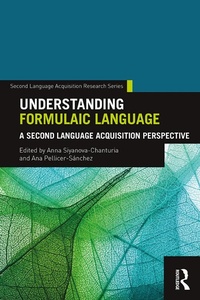
Understanding Formulaic Language
A Second Language Acquisition Perspective
1st Edition
Published on 3. September 2018
290 pages
978-1-351-79757-3 (ISBN)
Description

Understanding Formulaic Language: A Second Language Acquisition Perspective brings together leading scholars to provide a state-of-the-art, interdisciplinary account of the acquisition, processing, and use of formulaic language. Contributors present three distinct but complementary perspectives on the study of formulaic language - cognitive/psycholinguistic, socio-cultural/pragmatic, and pedagogical - to highlight new work as well as directions for future work. This book is an essential resource for established researchers and graduate students in second language acquisition and pedagogy, corpus and cognitive linguistics, psycholinguistics, sociolinguistics, and pragmatics.
Reviews / Votes
"The most complete discussion of the different facets of formulaic language to date. With so much research on formulaic language having been conducted in recent years, Understanding Formulaic Language provides a much-needed account of cognitive and psycholinguistic, socio-cultural and pragmatic, and pedagogical perspectives on formulaic language. In-depth discussion of the topic by an impressive group of contributors will make the volume a valuable resource for graduate students and researchers."Stuart Webb, Professor of Applied Linguistics, University of Western Ontario, Canada
"This landmark volume gathers state-of-the-art reviews of research into formulaic language. The chapters are written by leading researchers in the fields of second-language acquisition, processing, transfer, pragmatics, corpus linguistics, humor, prosody, language instruction, instructional technologies, language testing, and EAP. Each contribution addresses key theoretical, methodological, and empirical issues. A must-read for anyone interested in the acquisition, processing, and use of formulaic sequences."
Nick Ellis, Professor of Linguistics, University of Michigan, USA
"Understanding Formulaic Language is a timely book, bringing together some of the best formulaic language scholars to draw together disparate strands within the field into a unified and comprehensive whole. Its particular strength is its succinct presentation of the past, the present, and the future of the field. It is likely to become a standard reference in the area."
Brent Wolter, Professor of English, Idaho State University, USA
More details
Series
Edition
1. Auflage
Language
English
Place of publication
London
United Kingdom
Publishing group
Taylor & Francis Ltd
Target group
College/higher education
Illustrations
1 Tables, black and white; 7 Line drawings, black and white; 9 Halftones, black and white; 16 Illustrations, black and white
File size
2,76 MB
ISBN-13
978-1-351-79757-3 (9781351797573)
Copyright in bibliographic data and cover images is held by Nielsen Book Services Limited or by the publishers or by their respective licensors: all rights reserved.
Schweitzer Classification
Other editions
Additional editions
Anna Siyanova-Chanturia | Ana Pellicer-Sanchez
Understanding Formulaic Language
A Second Language Acquisition Perspective
Book
10/2018
1st Edition
Routledge
€76.80
Shipment within 10-20 days
Anna Siyanova-Chanturia | Ana Pellicer-Sanchez
Understanding Formulaic Language
A Second Language Acquisition Perspective
Book
08/2018
1st Edition
Routledge
€206.70
Shipment within 10-20 days
Persons
Anna Siyanova-Chanturia is Senior Lecturer in Applied Linguistics at Victoria University of Wellington, New Zealand.
Ana Pellicer-Sanchez is Senior Lecturer in Applied Linguistics and TESOL at the UCL Institute of Education, UK.
Ana Pellicer-Sanchez is Senior Lecturer in Applied Linguistics and TESOL at the UCL Institute of Education, UK.
Content
Table of Contents
Formulaic language: Setting the scene - Anna Siyanova-Chanturia and Ana Pellicer-Sanchez
I. Cognitive and psycholinguistic perspectives on formulaic language
1. Acquisition of formulaic language from a usage-based perspective - Stefanie Wulff
2. What on-line processing tells us about formulaic language - Anna Siyanova-Chanturia and Diana Van Lancker Sidtis
3. First language influence on the processing of formulaic language in a second language - Kathy Conklin and Gareth Carrol
4. Formulaic language and speech prosody - Phoebe Lin
II. Socio-cultural and pragmatic perspectives on formulaic language
5. Formulaic language in second language pragmatics research - Kathleen Bardovi-Harlig
6. Humour and formulaic language in second language learning - Nancy Bell and Stephen Skalicky
7. Formulaic language and its place in intercultural pragmatics - Istvan Kecskes
III. Pedagogical perspectives on formulaic language
8. Pedagogical approaches to the teaching and learning of formulaic language - Ana Pellicer-Sanchez and Frank Boers
9. Testing formulaic language - Henrik Gyllstad and Norbert Schmitt
10. From corpus to CALL: The use of technology in teaching and learning formulaic language - Tom Cobb
11. Formulaic language in English for Academic Purposes - Phil Durrant
12. Formulaic sequences in learner corpora: Collocations and lexical bundles - Sylviane Granger
13. Concluding question: Why don't second language learners more proactively target formulaic sequences? - Alison Wray
Formulaic language: Setting the scene - Anna Siyanova-Chanturia and Ana Pellicer-Sanchez
I. Cognitive and psycholinguistic perspectives on formulaic language
1. Acquisition of formulaic language from a usage-based perspective - Stefanie Wulff
2. What on-line processing tells us about formulaic language - Anna Siyanova-Chanturia and Diana Van Lancker Sidtis
3. First language influence on the processing of formulaic language in a second language - Kathy Conklin and Gareth Carrol
4. Formulaic language and speech prosody - Phoebe Lin
II. Socio-cultural and pragmatic perspectives on formulaic language
5. Formulaic language in second language pragmatics research - Kathleen Bardovi-Harlig
6. Humour and formulaic language in second language learning - Nancy Bell and Stephen Skalicky
7. Formulaic language and its place in intercultural pragmatics - Istvan Kecskes
III. Pedagogical perspectives on formulaic language
8. Pedagogical approaches to the teaching and learning of formulaic language - Ana Pellicer-Sanchez and Frank Boers
9. Testing formulaic language - Henrik Gyllstad and Norbert Schmitt
10. From corpus to CALL: The use of technology in teaching and learning formulaic language - Tom Cobb
11. Formulaic language in English for Academic Purposes - Phil Durrant
12. Formulaic sequences in learner corpora: Collocations and lexical bundles - Sylviane Granger
13. Concluding question: Why don't second language learners more proactively target formulaic sequences? - Alison Wray
