

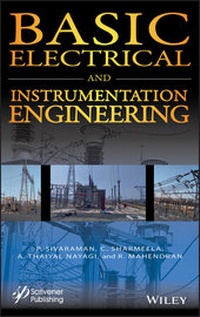
Basic Electrical and Instrumentation Engineering
Description

There are chapters covering the construction and working principle of the DC machine, all varieties of motors, fundamental concepts and operating principles of measuring, and instrumentation, both from a "high end" point of view and the point of view of developing countries, emphasizing low-cost methods.
A valuable reference for engineers, scientists, chemists, and students, this volume is applicable to many different fields, across many different industries, at all levels. It is a must-have for any library.
More details
Other editions
Additional editions

Persons
Sivaraman Palanisamy is an engineer in Chennai, India, with over five years of experience in the power industry. He has trained more than 500 personnel on renewable energy and power quality and carried out power quality assessments for over 200 sites across India. He has published several papers in national and international conferences and three book chapters.
Sharmeela Chenniappan, PhD, is an associate professor at Anna University, Chennai, India. She has 20 years of teaching experience and taught various subjects to undergraduate and post-graduate students. She has published more than 30 research publications in peer reviewed journals, and has presented more than 50 research papers at national and international conferences. Teaching both graduates and undergraduates, she received the best paper award at IEEE POWERCON in 2004.
A. Thaiyal Nayagi teaches at the Rane Polytechnic Technical Campus and has a BE and ME from Anna University, Chennai, India. She has eight years of teaching experience with graduates, undergraduates, and post-graduates and is an expert in automation.
R. Mahendran is an electrical engineer for aviation systems in Millennium Aero Dynamics at Delhi International Airport and has a BE and ME from Anna University, Chennai, India. He has more than five years of experience in the field of power systems and has done more than 25 solar power plant designs and installations.
Content
Foreword xi
Acknowledgements xiii
1 Introduction to Electric Power Systems 1
1.1 Introduction 1
1.1.1 Electrical Parameters 3
1.1.1.1 Voltage 3
1.1.1.2 Current 11
1.1.1.3 Time Period and Frequency 15
1.1.1.4 Phase Angle (¿) 16
1.2 Three-Phase Supply Connections 17
1.2.1 Star Connection 17
1.2.2 Delta Connection 19
1.2.3 Balanced Load 21
1.2.4 Unbalanced Load 23
1.2.5 Star - Delta Conversion 23
1.2.6 Delta to Star Conversion 24
1.3 Power 25
1.3.1 Real Power or Active Power (P) 25
1.3.2 Reactive Power (Q) 28
1.3.3 Apparent Power (S) 31
1.4 Power Factor (PF) 35
1.4.1 Classification Based on Load Characteristics 35
1.4.2 Classification Based on Harmonics Producing Loads 46
1.4.3 The Need for Power Factor Improvement 47
1.4.4 Methods of Power Factor Improvement 48
1.5 Types of Loads 49
1.5.1 Linear Loads 50
1.5.2 Non-Linear Loads 50
1.6 Three-Phase Power Measurement 50
1.7 Overview of Power Systems 56
1.7.1 Components of an Electric Power System 58
1.8 Protection of Power System 63
References 75
2 Transformers 79
2.1 Introduction 79
2.2 Transformer Magnetics 82
2.3 Construction of Transformer 85
2.4 EMF Equation of a Transformer 88
2.5 Ideal Transformer 91
2.6 Transformation Ratio (K) 95
2.7 Circuit Model or Equivalent Circuit of Transformer 96
2.8 Voltage Regulation of Transformer 100
2.9 Name Plate Rating 101
2.10 Efficiency of Transformer 102
2.11 Three-Phase Transformer 104
2.12 Components of the Transformer 113
2.13 Standards for Transformers 116
References 123
3 DC Machines 125
3.1 Introduction 125
3.1.1 DC Generators 125
3.1.2 DC Motors 125
3.1.3 Construction of DC Machines 125
3.2 Operation of DC Machines 132
3.2.1 Principle of DC Generators 132
3.2.2 Operating Principle of Motors 133
3.3 EMF Equation of DC Generator 136
3.4 Torque Equation of a DC Motor 138
3.5 Circuit Model 139
3.5.1 Generator Mode 140
3.5.2 Motor Mode 141
3.5.3 Symbolic Representation of DC Generator 141
3.6 Methods of Excitation 142
3.7 Characteristics of DC Generator 148
3.7.1 Characteristics of Separately Excited DC Generator 150
3.7.2 Load Characteristics of DC Shunt Generator 152
3.7.3 Load Characteristics of DC Series Generator 154
3.7.4 Load Characteristics of DC Compound Generator 155
3.8 Types of DC Motor 156
3.9 DC Motor Characteristics 160
3.10 Necessity for Starters 165
3.11 Speed Control of DC Motors 170
3.12 Universal Motor 179
References 183
4 AC Machines 185
4.1 Introduction 185
4.2 Three-Phase Induction Motor 185
4.2.1 Rotating Magnetic Field 186
4.2.2 Construction 186
4.2.3 Working Principle 189
4.2.4 Slip of an Induction Motor 192
4.2.5 Torque Equation 193
4.2.6 Torque-Slip Characteristics 195
4.2.7 Induction Motor as a Transformer 197
4.2.8 Equivalent Circuit of Induction Motor 198
4.3 Single-Phase Induction Motor 201
4.3.1 Introduction 201
4.3.2 Working Principle 203
4.3.3 Types of Single-Phase Induction Motor 203
4.4 Starting Methods of Induction Motor 209
4.4.1 Need for Starters 209
4.4.2 Types of Starters 209
4.5 Speed Control of Three-Phase Induction Motor 215
4.6 Synchronous Motor 220
4.6.1 Construction 220
4.6.2 Features of a Synchronous Motor 220
4.6.3 Working Principle 221
4.6.4 Starting Methods of Synchronous Motor 221
4.6.5 Torque Equation of Synchronous Motor 222
4.7 Stepper Motor 223
4.8 Brushless DC (BLDC) Motor 225
4.8.1 Construction 225
4.8.2 Working Principle 226
4.9 Alternator 226
4.9.1 Construction 226
4.9.2 Working Principle 229
4.9.3 EMF Equation of an Alternator 232
4.9.4 Voltage Regulation of an Alternator 234
4.10 Standards for Electric Machines 235
References 241
5 Measurement and Instrumentation 243
5.1 Electrical and Electronic Instruments 243
5.1.1 Classification of Instruments 243
5.1.2 Basic Requirements for Measurement 250
5.1.3 Types of Indicating Instruments 259
5.1.4 AC Indicating Instruments 270
5.1.5 Electrical Instruments 275
5.2 Cathode Ray Oscilloscope (CRO) 278
5.3 Digital Storage Oscilloscope 283
5.4 Static and Dynamic Characteristics of Measurements 289
5.4.1 Static Characteristics 289
5.4.2 Dynamic Characteristics 296
5.5 Measurement of Errors 297
5.5.1 Types of Errors 298
5.6 Transducer 300
5.6.1 Classification of Transducers 302
References 338
Index 341
1
Introduction to Electric Power Systems
The main parameters in electrical systems are voltage and current. The product of voltage and current gives a third parameter called power, and power consumed over some time duration is called energy [1]. The electric power system consists of power generation, transmission and distribution system [2]. Power is generated from two main sources, namely conventional energy sources and non-conventional energy sources. The conventional energy sources are non-renewable which gets depleted over a period of time, while non-conventional energy sources are non-depleting sources [3, 10, 30]. Most large-scale power plants are located in areas where the raw materials are available locally and generated power is transmitted over long distances for distribution. An electrical conducting medium is required in order to transfer the power from generating station to load center. This conducting medium is called as transmission system. Transformers and transmission lines are the main components of the transmission system; they are used to transfer the power from generating station to consumers (customers) at various operating voltage levels. Generation voltage of the conventional power plant typically ranges from 6.6 kV to 22 kV, and transmission voltage typically ranges from 110 kV to 765 kV. High voltage is stepped down to various voltage levels for different consumers depending upon the requirements and installed capacity.
1.1 Introduction
In general, electrical power used for commercial and residential purpose is mostly Alternating Current (AC). An AC voltage or current has the magnitude and direction which changes periodically with respect to time, unlike the Direct Current (DC) supply, which has constant magnitude with respect to time. Figure 1.1 shows the waveform of AC (voltage and current) and Figure 1.2 shows the waveform of DC (voltage and current).
Figure 1.1 Waveform of AC.
Figure 1.2 Waveform of DC.
Types of AC supply system:
The AC supply system is classified into two types based on the number of phases:
- Single-phase power supply
- Three-phase power supply
A. The single phase supply
The single-phase power supply is used to power all the single-phase loads in the systems. Generally, single-phase power supply is derived from a three-phase, four-wire circuit. The single-phase voltage level varies from country to country. The general single-phase supply voltage is 220 V, 230 V, 240 V in low voltage systems (in Asian countries). Most of the single-phase supply systems are 2W systems as shown in Figure 1.11.
B. Three-Phase Power Supply
The three-phase power supply is used to power certain loads which need the poly-phase supply for their operation. Here phase means branch circuits or winding and poly means many. Such loads in any applications need a power supply which has a poly-phase supply system. For example, three-phase power supply is also called poly-phase power supply. In order to develop poly-phase supply, the armature winding of an alternator is divided into the number of phases as required. In each winding section, voltage gets induced with 120° displacement. These windings are arranged in such a way that the magnitude and frequency is the same for all the phases with definite phase difference with respect to the other phases. That means, in a three-phase power supply system, there are three voltages with equal magnitude and frequency having a phase difference of 360°/3 = 120° between them.
Advantages of three-phase supply systems are
- Single-phase power supply are obtained from three-phase power supply and in reverse three-phase power supply is not obtained from single-phase power supply
- Three-phase induction motors are self-starting motors where single-phase induction motors are not self-starting motors
- For transmission and distribution, a three-phase system needs smaller size conductor material as compared with single-phase system for same volt amperes
1.1.1 Electrical Parameters
The main parameters in an electrical system are voltage and current. The product of voltage and current gives a third parameter called power, and power consumed over some duration is called energy.
AC systems: Voltage, Current, Frequency and Phase angle
DC systems: Voltage and Current
1.1.1.1 Voltage
Potential difference between any two points in an electrical circuit is called voltage. The SI unit of voltage is Volts (V) [1]. Higher values of voltage are mentioned as kV. The other name of voltage is Electro Motive Force (EMF). The representation of voltage is two types: peak to peak voltage (instantaneous voltage) and RMS voltage.
Alessandro Volta (18th Feb 1745 - 5th March 1827): An Italian scientist who invented the first battery cell. In order to honour him, SI unit of electric potential is named Volt.
Alessandro Volta. Courtesy: Google image.
RMS voltage:
The peak to peak voltage of phase to phase is shown in Figure 1.3. Average voltage of positive half cycle to negative half cycle is zero. As the absolute voltage is not zero, average voltage cannot be used as a measuring scale for AC. In order to perform the analysis and calculation, a new term called RMS is considered for measurement. Theoretically, RMS voltage in AC is equivalent to the amount of heat produced if the DC of some magnitude produces the same heat on the same resistance.
Generally, most of voltage referred in specification is RMS voltage unless specified.
Example 1.1: A 40 W incandescent lamp is connected across 1ø, 230 V, 50 Hz AC supply.
Here the voltage 230 V is RMS voltage.
Note: When using the multi meter for voltage measurements, first check the meter is RMS rated or peak rated in order to avoid confusion. For an example, if RMS rated meter read the voltage as 230 V, the peak rated meter will read the same voltage as 325.2 V.
RMS voltage from peak voltage:
RMS voltage can be calculated if peak voltage is known. The expression for RMS voltage is given in eqn. 1.1.
Figure 1.3 Peak to peak voltage of R phase to Y phase. Note: This figure is captured using Dranetz Power Quality analyser.
(1.1)For sinusoidal wave shape, the value of crest factor is
Example 1.2: A sinusoidal supply voltage is 340 V peak. Calculate equivalent RMS voltage.
Solution:
Example 1.3: A sinusoidal supply voltage is 565 V peak. Calculate equivalent RMS voltage.
Solution:
Peak voltage from RMS voltage:
Peak voltage can be calculated if RMS voltage is known. The expression for peak voltage is given in eqn 1.2.
(1.2)Example 1.4: A sinusoidal supply voltage is 240 V (RMS). Calculate equivalent peak voltage.
Solution:
Example 1.5: A sinusoidal supply voltage is 415 V RMS. Calculate equivalent peak voltage.
Answer:
Peak to peak voltage:
Voltage measured between the maximum value of the positive half cycle and the minimum value of the negative half cycle is known as peak to peak voltage. This voltage is generally measured in individual voltage cycle, unlike the peak voltage which is the product of RMS voltage and crest factor measured in voltage trend. Peak to peak voltage of R to Y phase is shown in Figure 1.3.
The maximum voltage of positive half cycle of above waveform is 556.4 V and minimum voltage of negative half cycle of the waveform is 556.4 V. Voltage between positive half cycle to negative half cycle is +556.4 to -556.4 V is called peak to peak voltage. It is 1112.8 V in the above Figure 1.3. Figure 1.4 shows the peak voltage trend, which is different from peak to peak voltage.
From Figure 1.4, the peak voltage is between 555 V to 560 V for the time duration 70 minutes between 12:40 hours to 13:50 hours.
Voltage in three-phase circuit:
Voltage in a three-phase circuit is determined based on the system configuration. The determination of voltage in a circuit is based on whether the circuit is in star or delta configuration.
Figure 1.4 Peak voltage trend. Note: This figure is captured using Dranetz Power Quality analyser.
- Phase to phase voltage - For delta circuits
- Phase to neutral voltage - For star circuits
The relationship between the above two voltage determinations is expressed in the equation (1.3) and (1.4).
In delta circuit, the phase voltage is determined by
(1.3)In star circuit, the line voltage is determined by
(1.4)Where
VoltageLine is line voltage
VoltagePh is phase voltage
In delta circuit, line current in delta circuit is greater than line current in star circuit. Similarly, the line voltage in star circuit is greater than line voltage in delta circuit.
Example 1.6: A distribution transformer of 2 MVA power rating Dyn11 configuration is having ratio of 11 kV/433 V. How do we understand this voltage?
Answer:
A distribution transformer is generally used to cater single-phase loads connected on three-phase distribution. This is the reason the...
