

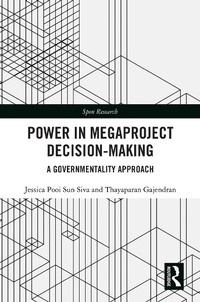
Power in Megaproject Decision-making
A Governmentality Approach
1st Edition
Published on 31. July 2024
210 pages
978-1-040-11370-7 (ISBN)
Description

This research-based book critically examines the complex interplay of power relations in decision-making in megaprojects. This book is tailored for academics, students, practitioners, clients, and policymakers and addresses a significant gap in understanding how formal and informal power influences decision-making.
Through applying governmentality theory and narrative inquiry from thirty-nine interviews, this book presents over sixty-five detailed stories offering a series of real-life narratives that expose the diverse forms of power at play in megaprojects. The stories reveal how deviations from norms can significantly impact project outcomes. This book uncovers the complex web of power relations, institutional norms, and individual actions driving decisions.
This book provides a framework illustrating four behavioural contexts, entrepreneurial, box-ticking, deception, and recklessness, as manifestations of megaproject decision-making, providing readers with a tool to understand and navigate the intricate power dynamics in megaprojects.
Readers will benefit from practical insights and strategies for fostering conducive decision-making environments, tailoring interventions to promote constructive behaviours, and mitigating harmful actions. This book is a resource for anyone seeking to grasp the complexities of megaproject management in the context of power relations, shaping their decision-making leading to success.
Through applying governmentality theory and narrative inquiry from thirty-nine interviews, this book presents over sixty-five detailed stories offering a series of real-life narratives that expose the diverse forms of power at play in megaprojects. The stories reveal how deviations from norms can significantly impact project outcomes. This book uncovers the complex web of power relations, institutional norms, and individual actions driving decisions.
This book provides a framework illustrating four behavioural contexts, entrepreneurial, box-ticking, deception, and recklessness, as manifestations of megaproject decision-making, providing readers with a tool to understand and navigate the intricate power dynamics in megaprojects.
Readers will benefit from practical insights and strategies for fostering conducive decision-making environments, tailoring interventions to promote constructive behaviours, and mitigating harmful actions. This book is a resource for anyone seeking to grasp the complexities of megaproject management in the context of power relations, shaping their decision-making leading to success.
More details
Series
Edition
1. Auflage
Language
English
Place of publication
London
United Kingdom
Publishing group
Taylor & Francis Ltd
Target group
College/higher education
Professional and scholarly
Illustrations
4 Line drawings, black and white; 1 Halftones, black and white; 5 Illustrations, black and white
ISBN-13
978-1-040-11370-7 (9781040113707)
Copyright in bibliographic data and cover images is held by Nielsen Book Services Limited or by the publishers or by their respective licensors: all rights reserved.
Schweitzer Classification
Other editions
Additional editions
Jessica Pooi Sun Siva | Thayaparan Gajendran
Power in Megaproject Decision-making
A Governmentality Approach
Book
approx. 12/2025
1st Edition
Routledge
€231.30
Not yet published

Book
09/2024
Routledge
Unfortunately, price unknown
Article exhausted; check different version
Jessica Pooi Sun Siva | Thayaparan Gajendran
Power in Megaproject Decision-making
A Governmentality Approach
Book
07/2024
1st Edition
Routledge
€241.60
Shipment within 10-20 days
Persons
Dr Jessica Siva is a Lecturer in the School of Architecture and Built Environment. Jessica recently completed her PhD, which examined the governmentality of megaproject decision-making environment. Her work into megaproject decision-making has been awarded various awards and prizes. She has worked on various nationally-funded research projects and has over 50 research publications in the areas of client management and governance, megaproject governance and decision-making, design management, international collaborative practice, government supply chain management, human capital, sustainable urban development decision-making policy, process and practice.
Dr Thayaparan Gajendran is an Associate Professor in the School of Architecture and Built Environment. He is Assistant Dean - Education in the College of Engineering, Science and Environment (Acting). He is a recognised leader in the field of 'sociological analysis of organisations and communities in the context of building resilience'. His research focuses on developing evidence-based practices and policies for building resilience at the complex intersections in the governance of communities and organisations. He has studied the interactions between the different stakeholders in both 'post disaster reconstruction settings' and 'disaster preparedness initiatives' with the view of improving practice and informing policy. He has published numerous research articles and reports.
Dr Thayaparan Gajendran is an Associate Professor in the School of Architecture and Built Environment. He is Assistant Dean - Education in the College of Engineering, Science and Environment (Acting). He is a recognised leader in the field of 'sociological analysis of organisations and communities in the context of building resilience'. His research focuses on developing evidence-based practices and policies for building resilience at the complex intersections in the governance of communities and organisations. He has studied the interactions between the different stakeholders in both 'post disaster reconstruction settings' and 'disaster preparedness initiatives' with the view of improving practice and informing policy. He has published numerous research articles and reports.
Content
List of figures
List of tables
List of boxes
Preface
Synopsis
List of abbreviations
1. Introduction - setting the scene
2. Megaproject decision-making: current challenges
3. Governmentality and deviance: the role of power in decision-making
4. Governmentality framework for decision-making
5. Box ticking: Blind conformance to rules could be counterproductive
6. Deception: Opportunistic use of power can result in beneficial or detrimental outcomes
7. Recklessness: Destructive deviance can be detrimental to project outcomes
8. Entrepreneurial: Authentic use of power can enhance project performance
9. Governmentality as an alternative approach to decision-making: how to support constructive deviance
10. Summary & Concluding Thoughts
List of tables
List of boxes
Preface
Synopsis
List of abbreviations
1. Introduction - setting the scene
2. Megaproject decision-making: current challenges
3. Governmentality and deviance: the role of power in decision-making
4. Governmentality framework for decision-making
5. Box ticking: Blind conformance to rules could be counterproductive
6. Deception: Opportunistic use of power can result in beneficial or detrimental outcomes
7. Recklessness: Destructive deviance can be detrimental to project outcomes
8. Entrepreneurial: Authentic use of power can enhance project performance
9. Governmentality as an alternative approach to decision-making: how to support constructive deviance
10. Summary & Concluding Thoughts
