

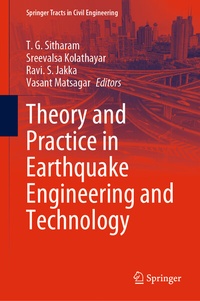
Theory and Practice in Earthquake Engineering and Technology
1st Edition
Published on 7. June 2022
XIV, 368 pages
978-981-19-2324-1 (ISBN)
Description

This book contains diverse topics relevant to earthquake engineering and technology. The chapters are of interest to readers from various disciplines, as the different chapters discuss popular topics on earthquake engineering and allied disciplines. The chapters have adequate illustrations and tables for clarifying underlying concepts. The reader can understand the fundamental concepts easily, and the book is highly useful for practice in the field in addition to classroom learning.
More details
Other editions
Additional editions
T. G. Sitharam | Sreevalsa Kolathayar | Ravi S. Jakka
Theory and Practice in Earthquake Engineering and Technology
Book
06/2022
1st Edition
Springer
€181.89
Shipment within 3-4 weeks
Persons
Prof. Dr. TG Sitharam is the Director of Indian Institute of Technology Guwahati, Assam since July 2019. He is a member of the Science and Engineering Research Board (SERB), Established through an Act of Parliament: SERB Act 2008, Department of Science & Technology, Government of India. He is a Senior Professor in the Department of Civil Engineering, Indian Institute of Science (IISc), Bangalore, and served IISc for more than 27 years. He was Chairman of the Board of Governors at IIT Guwahati during 2019-2020 for more than a year. He was the former Chairman, Research Council, CSIR- CBRI (Central Building Research Institute, Roorkee). He is holding the position of Director (additional charge) of Central Institute of Technology, Kokrajhar, Assam (A Deemed to be University), since May 2021. Over the last 35 years, he has carried out research and development in the area of geotechnical and infrastructure engineering, seismic microzonation and soil dynamics, Geotechnical earthquake engineering and has developed innovative technologies in the area of earth sciences, leading to about 500 technical papers, 20 books with Google scholar H-index of 47 and I-10 index 137 with more than 7175 citations. He has guided 40 Ph.D. students and 35 Master's Students. He was listed in the world's top 2% of scientists for the most-cited research scientists in various disciplines by Stanford University in 2020. His name appeared again in the top 2% of scientists IN Elsevier by Stanford University in 2021. His broad area of research falls into Geotechnical Infrastructure engineering, earth sciences, hydrology, seismology, and natural hazards. He has carried out Seismic microzonation of many urban centers in India and he is an authority on seismic microzonation and site effects. Presently, he is the President of the Indian Society of Earthquake Technology and he was the chairman of the 7th International conference on recent advances in geotechnical earthquake engineering and soil dynamics held in July 2021. He is the chief editor of the International Journal of Geotechnical Earthquake Engineering, (IJGEE), PA, USA since 2010. He is the Editor-in-chief, Springer Transactions in Civil and Environmental Engg series, Book Series, Singapore. He is the Fellow of ASCE, Fellow of ICE (UK), Diplomat of Geotechnical Engineering (D.Ge.) from Academy of Geo-Professionals, ASCE; Fellow of IGS, ISET, ISES, and many other Societies. He is also a certified professional engineer and a chartered engineer from the Institution of Engineers.
Prof. Dr Sreevalsa Kolathayar pursued M.Tech from IIT Kanpur, Ph.D. from Indian Institute of Science (IISc), and served as International Research Staff at UPC BarcelonaTech Spain. He is presently Assistant Professor in the Department of Civil Engineering, National Institute of Technology Karnataka, Surathkal, India. Dr. Sreevalsa has authored five books, edited 16 book volumes, and published 100 research papers. He is Associate Editor of two International Journals and acted as a reviewer for many. His research interests include Seismic Hazard Assessment, Local Site effects, Disaster Risk Reduction, Earth reinforcement, and Water geotechnics. He is currently the Secretary Indian chapter of the International Association for Coastal Reservoir Research (IACRR), and Executive Committee Member of the Indian Society of Earthquake Technology (ISET). In 2017, The New Indian Express honored Dr Sreevalsa with South India's Most Inspiring Young Teachers Award. He is the recipient of the ISET DK Paul Research Award from the Indian Society of Earthquake Technology (ISET) in 2018. He is on the roster of two technical committees of ASCE Geo-Institute. Dr. Sreevalsa received the "IEI Young Engineers Award" by The Institution of Engineers (India), in recognition of his contributions in the field of Civil Engineering. He served as the Organizing Secretary to the 7th International Conference on Recent Advances in GeotechnicalEarthquake Engineering.
Prof. Dr. Ravi Sankar Jakka is working as an Associate Professor in the Department of Earthquake Engineering, Indian Institute of Technology, Roorkee, and serving as Editor to the International Journal of Geotechnical Earthquake Engineering & ISET Journal of Earthquake Technology. He graduated in Civil Engineering from Andhra University Engineering College in the year 2001. He has obtained masters and doctorate degrees from IIT Delhi in the years 2003 and 2007 respectively. His areas of interest are Dynamic Site Characterization, Soil Liquefaction, Seismic Slope Stability of Dams, Landslides, Foundations & Seismic Hazard Assessment. He has published over 100 articles in reputed international journals and conferences. He has supervised over 35 Masters Dissertations and 7 Ph.D. thesis, while he is currently guiding 10 Ph.D. Thesis. He has received prestigious DAAD and National Doctoral fellowships. He has obtained University Gold Medal from Andhra University. He also received the 'Young Geotechnical Engineer Best Paper Award' from the Indian Geotechnical Society. He was instrumental in the development of the Earthquake Early Warning System for northern India, a prestigious national project. He was also the Organizing Secretary to 7th International Conference on Recent Advances in Geotechnical Earthquake Engineering.
Prof. Dr. Vasant Matsagar is currently serving as Dogra Chair Professor in the Department of Civil Engineering at Indian Institute of Technology (IIT) Delhi. He obtained his doctorate degree from Indian Institute of Technology (IIT) Bombay in 2005 in the area of seismic base isolation of structures. He performed post-doctoral research at the Lawrence Technological University (LTU) USA, in the area of carbon fiber reinforced polymers (CFRP) in bridge structures. His current research interests include structural dynamics and vibration control; multi-hazard protection of structures from earthquake, blast, fire, and wind; finite element methods; fiber-reinforced polymers (FRP) in prestressed concrete structures; and bridge engineering. He has published over a hundred international journal papers, hundreds of international conference manuscripts, a book, six edited proceedings, and has filed for two patents. His current Google Scholar citations are 3,794, having an h-index of 29. He has guided students at both undergraduate (UG) and postgraduate (PG) levels in their bachelor's and master's projects and doctoral research. Besides student guidance, he is actively engaged in sponsored research and consultancy projects at national and international levels. He is also involved in teaching courses in structural engineering, e.g., structural analysis, finite element methods, numerical methods, structural stability, structural dynamics, design of steel and concrete structures to name a few.
Prof. Dr Sreevalsa Kolathayar pursued M.Tech from IIT Kanpur, Ph.D. from Indian Institute of Science (IISc), and served as International Research Staff at UPC BarcelonaTech Spain. He is presently Assistant Professor in the Department of Civil Engineering, National Institute of Technology Karnataka, Surathkal, India. Dr. Sreevalsa has authored five books, edited 16 book volumes, and published 100 research papers. He is Associate Editor of two International Journals and acted as a reviewer for many. His research interests include Seismic Hazard Assessment, Local Site effects, Disaster Risk Reduction, Earth reinforcement, and Water geotechnics. He is currently the Secretary Indian chapter of the International Association for Coastal Reservoir Research (IACRR), and Executive Committee Member of the Indian Society of Earthquake Technology (ISET). In 2017, The New Indian Express honored Dr Sreevalsa with South India's Most Inspiring Young Teachers Award. He is the recipient of the ISET DK Paul Research Award from the Indian Society of Earthquake Technology (ISET) in 2018. He is on the roster of two technical committees of ASCE Geo-Institute. Dr. Sreevalsa received the "IEI Young Engineers Award" by The Institution of Engineers (India), in recognition of his contributions in the field of Civil Engineering. He served as the Organizing Secretary to the 7th International Conference on Recent Advances in GeotechnicalEarthquake Engineering.
Prof. Dr. Ravi Sankar Jakka is working as an Associate Professor in the Department of Earthquake Engineering, Indian Institute of Technology, Roorkee, and serving as Editor to the International Journal of Geotechnical Earthquake Engineering & ISET Journal of Earthquake Technology. He graduated in Civil Engineering from Andhra University Engineering College in the year 2001. He has obtained masters and doctorate degrees from IIT Delhi in the years 2003 and 2007 respectively. His areas of interest are Dynamic Site Characterization, Soil Liquefaction, Seismic Slope Stability of Dams, Landslides, Foundations & Seismic Hazard Assessment. He has published over 100 articles in reputed international journals and conferences. He has supervised over 35 Masters Dissertations and 7 Ph.D. thesis, while he is currently guiding 10 Ph.D. Thesis. He has received prestigious DAAD and National Doctoral fellowships. He has obtained University Gold Medal from Andhra University. He also received the 'Young Geotechnical Engineer Best Paper Award' from the Indian Geotechnical Society. He was instrumental in the development of the Earthquake Early Warning System for northern India, a prestigious national project. He was also the Organizing Secretary to 7th International Conference on Recent Advances in Geotechnical Earthquake Engineering.
Prof. Dr. Vasant Matsagar is currently serving as Dogra Chair Professor in the Department of Civil Engineering at Indian Institute of Technology (IIT) Delhi. He obtained his doctorate degree from Indian Institute of Technology (IIT) Bombay in 2005 in the area of seismic base isolation of structures. He performed post-doctoral research at the Lawrence Technological University (LTU) USA, in the area of carbon fiber reinforced polymers (CFRP) in bridge structures. His current research interests include structural dynamics and vibration control; multi-hazard protection of structures from earthquake, blast, fire, and wind; finite element methods; fiber-reinforced polymers (FRP) in prestressed concrete structures; and bridge engineering. He has published over a hundred international journal papers, hundreds of international conference manuscripts, a book, six edited proceedings, and has filed for two patents. His current Google Scholar citations are 3,794, having an h-index of 29. He has guided students at both undergraduate (UG) and postgraduate (PG) levels in their bachelor's and master's projects and doctoral research. Besides student guidance, he is actively engaged in sponsored research and consultancy projects at national and international levels. He is also involved in teaching courses in structural engineering, e.g., structural analysis, finite element methods, numerical methods, structural stability, structural dynamics, design of steel and concrete structures to name a few.
Content
Introduction to Earthquake Engineering and Technology.- Performance Based Seismic Design of Structures.- Seismic Hazard Assessment.- Relevance of Site Effect in Earthquake Resistant Construction.- Seismic microzonation studies in India.- Engineering Preparedness for Earthquake Disaster Mitigation.
