

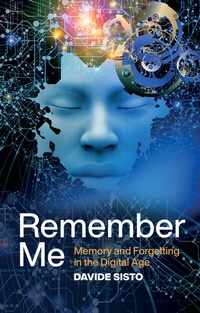
Remember Me
Description

It is this 'looking back', increasingly the focus of social networks, that is the inspiration behind Davide Sisto's brilliant reflection on how our relationship with remembering and forgetting is changing in the digital era. The past does not really exist: it is only a story we tell ourselves. But what happens when we tell this story not only to ourselves but also to our followers, when it is recorded not only on our social media pages but also on the pages of hundreds or thousands of others, making it something that can be viewed and referenced forever? Social media networks are becoming vast digital archives in which the past merges seamlessly with the present, slowly erasing our capacity to forget. And yet at the same time, our memory is being outsourced to systems that we don't control and that could become obsolete at any time, cutting us off from our memories and risking total oblivion.
This timely and thoughtful reflection on memory and forgetting in the digital age will be of interest to students and scholars in media studies and to anyone concerned with the ways our social and personal lives are changing in a world increasingly shaped by social media and the internet.
More details
Other editions
Additional editions
Persons
Content
Introduction. Social Networks and Looking Back
The past is just a story we tell our followers
Facebook and Looking Back: #10YearsChallenge, On This Day, Memories
Chapter One. From Social Networks to Digital Archives
The Twenty Days of Turin: Facebook in 1977
Naked in front of the Computer: Social Networks in the 1990s
The World Doubled: Reincarnation or the Cocaine of the Future?
Blogs, Forums, Mailing Lists: A New Life in 56K
The Era of Shared Passions: An Epidemic of Digital Memories
Digital Memory as Crazed Mayonnaise: The Past is Emancipated, Identities Multiply
Chapter Two. Collective Cultural Autobiographies and Encyclopedias of the Dead 2.0
Experiments in Collective Cultural Autobiography
Copy and Paste: Writing About Oneself is Like Summing Up the History of the Universe
Cancer Bloggers: My Message is My Body
Stories of Cancer Bloggers on YouTube and Facebook
Facebook: Encyclopedia of the Dead 2.0?
Autobiographical Memory: Inventing a Forgotten Past
Disinterred Bodies: Social Networks and Data Flows as Archives
Chapter Three. Total Recall, Digital Immortality, Retromania
Becoming the Database of Ourselves: Lifelogging and Video-camera Memory
The Memobile: From Total Recall to Digital Immortality
The Memory Remains: The Life of Memories Post-Mortem
Mind-Uploading as a Declaration of Independence for Memories
Insomnia Inside a Garbage Heap: Funes, or of a Life that Never Forgets
Creating Space in Memory: Forgetting and Sleep as Forms of Resistance
The Web as a Melancholy Receptacle of Regret: Hollie Gazzard, The Last Message Received, Wartherapy
Retromania and Sad Passions: The End of Nostalgia and the Loss of the Future
San Junipero Exists and Lives in Facebook
Conclusion. Digital Inheritance and a Return to Oblivion
Digital Inheritance: What to Do with our Own Memories?
The Value of Oblivion and the Joy of Being Forgotten
Bibliography
Notes
Index
1
From Social Networks to Digital Archives
The Twenty Days of Turin: Facebook in 1977
Facebook's gradual metamorphosis from social network to colossal digital archive, as evidenced by initiatives like On This Day and Memories, is mostly due to its age: years have passed since Facebook first appeared on 4 February 2004 in Harvard. It is inevitable, then, that its objectives have changed since it was first invented. Having initially created Facebook as an electronic version of the traditional school yearbook, Zuckerberg gave shape to the three conjoined actions that generally define social networks: the construction of a public or semi-public profile within a closed system, the articulation of a list of other users with whom a connection is made, and the possibility of seeing and moving through the list of connections created by other people signed up to the same system. Three conjoined actions that allow us to use a web-based service that is capable of radically repositioning the individual within the public space: from a 'detail' and a 'small, interchangeable cog in the great mechanism of sociality' to the 'centre of one's own network of relationships'.1
This repositioning, often held to be the fundamental cause of the shift from web 1.0 to web 2.0, is closely associated with Facebook. Its invention seems to have irrefutably determined a new beginning in humanity's cultural history, marking the beginning of Silicon Valley's season of psychopathology (a term coined by Éric Sadin with a distinctly apocalyptic emphasis), with Facebook deemed the main culprit for spreading that individualistic sentiment of egocentric omnipotence throughout the world.2 In reality, all Zuckerberg does is bring together, with cunning and foresight, those single dispersive intuitions which, over the course of the last four decades, have accompanied the dominance of gradual technological innovation. Rather than actually beginning the era of the social network, Facebook marks a point of no return, accelerating the process of splitting the unique biological I into many digital I's and favouring the progressive development of our informational souls, fed to the point of indigestion on incalculable quantities of data. To understand my motivation for this statement we must make a leap backwards in time to 1977, the year in which eclectic author Giorgio De Maria published his novel The Twenty Days of Turin (Le venti giornate di Torino) to widespread indifference.
Only six years had passed since electronic engineer Roy Tomlinson sent his 'QWERTYUIOP' message from one computer to another using the Arpanet network, using the @ sign for the first time as a means of separating the user from the domain, which acts as a post box. An aside: a trick of fate means that we will always associate the first sequence of letters on a computer keyboard, from left to right, with the mother of the 270 billion emails that are written and sent each day (according to figures published by Esquire in 2018), multiplying the chaos of overabundance so dear to Goldsmith. At this time, De Maria, employed at Italian state broadcaster RAI and Fiat, as well as being a theatre critic, television screenwriter, accomplished pianist, dramaturg and much more, develops (albeit unwittingly) a description of what would become Facebook forty years later. In his story, set in an obsessively dark Turin, he imagines the existence of a Library, situated in the charitable institute of the St Cottolengo Little House of Divine Providence, in which every citizen can leave their own autobiographical narrative filled with personal anecdotes and subjective reflection on their everyday lives. At the same time, it is possible to read (upon payment) the thoughts left by other users. Created by young men supported (it says) by national and international organizations of considerable importance, the library is frequented by more than five hundred thousand people. De Maria writes, 'It was presented as a good cause, created in the hope of encouraging people to be more open with one another.'3 The Library's creators are not interested in literary fiction but authentic documents capable of reflecting 'the real spirit of the people' that 'could rightly [be called] popular subjects':4 summaries of intimate problems with constipation, admissions of wins on the pools, existential cogitations. For three hundred lire one can access texts by others, for six hundred one has the opportunity to learn the names and surnames of the authors, and for three thousand lire one's own manuscript will be accepted. De Maria observes how entire families, each member unaware of the others, go to this Library to mind other people's business, sifting through each room in search of skeletons in the cupboard. He also proves how the accumulation of personal texts facilitates the reconstruction of many historical events of the time. However, these autobiographical narratives do not necessarily conform to an objective truth:
The pen could scribble freely whatever the spirit dictated. And once it started, it was hard to stop! The prospect of 'being read' quivered in the distance like an enchanting mirage - a mirage as real, nonetheless, as the 'realities' that were written down. I will give myself to you, you will give yourself to me: on these very human foundations, the future exchange would happen.5
A substantial number of citizens are reticent to write, limiting themselves to reading other people's reflections and trying to establish some kind of communication with the unknown authors, once they have obtained their personal data from the Library. The reflections consigned to the Library often degenerate into madness or furious outbursts hidden behind an apparent normality. Each entry reveals personal characteristics that are antithetical to the way the individual appears in society, permeated with passive-aggressive behaviour, between 'cries of fury and pain in relentless successions, fragments of sentences and pleas addressed to God-knows-who'.6 It is no coincidence that the Library's average visitor is 'a shy individual, ready to explore the limits of his own loneliness and to weigh others down with it'.7
In a novel written in 1977, De Maria did in fact imagine and tell a story about what we know today as Facebook, in which visiting this particular Library has disturbing and horrific effects. I will give myself to you, you will give yourself to me, with all of the narcissistic degeneration this entails: from the omnipresent fake news to primordial forms of shitstorms produced by anonymous haters, slaves to their own 'inner troll'. Particularly striking is the description of the manuscripts that, 'conceived in a spirit of pure malice', make fun of the curve in an old woman's spine, a woman without husband or children. A description that anticipates by forty-one years that of the 'inner troll' (a malevolent troublemaker that intervenes in virtual interactions in a provocative, offensive and thoughtless way) given by Jaron Lanier as one of the ten reasons why we should immediately delete all of our social media accounts.8 At the same time, today's reader cannot help but be struck by the nexus between obsessively visiting the Library, the development of a reciprocal spying network, and the outbreak of a collective insomnia, which, as the events recounted in the novel degenerate, highlights aspects that are very familiar to all those using social networks today: 'You couldn't leave the house any more, take a tram, visit a public place, without sensing the leer of somebody who wanted you to believe he'd soaked up all your deepest secrets. If I'd left any of my confessions in that place, I'd probably have lost sleep too.'9
The incredible similarity between the Library and Facebook has led to the posthumous rediscovery of The Twenty Days of Turin. Shortly after De Maria's death in 2009 due to severe mental health problems, Australian writer and critic Ramon Glazov discovered the novel by accident and was bowled over by it, deciding to translate it into English. In 2017 the book was published in the United States by W.W. Norton & Company to great critical and public acclaim. In the pages of the New York Times, Jeff VanderMeer, one of the main exponents of the modern New Weird genre praises De Maria's sensational foresight. This was followed a few months later by a new Italian edition, published by Frassinelli Editore, aimed at promoting a book that had been unfairly ignored in Italy at the time.
Though De Maria's intuition is surprising, The Twenty Days of Turin is a novel written within a social and cultural context in which the first, sporadic forms of telematic communication immediately reveal an irrepressible human desire: the creation of social networking processes that, by making the varyingly authentic biographies of single individuals public, allow for long-distance relationships in which physical presence is latent or intentionally not sought out. Almost simultaneously with The Twenty Days of Turin, the typically social pact ('I will give myself to you' and in exchange, 'you will give yourself to me') finds its digital habitat (albeit a limited one) in the BBS (Bulletin Board System), which dates back to...
