

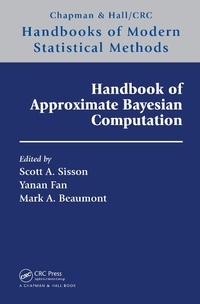
Handbook of Approximate Bayesian Computation
1st Edition
Published on 3. September 2018
678 pages
978-1-4398-8151-4 (ISBN)
Description

As the world becomes increasingly complex, so do the statistical models required to analyse the challenging problems ahead. For the very first time in a single volume, the Handbook of Approximate Bayesian Computation (ABC) presents an extensive overview of the theory, practice and application of ABC methods. These simple, but powerful statistical techniques, take Bayesian statistics beyond the need to specify overly simplified models, to the setting where the model is defined only as a process that generates data. This process can be arbitrarily complex, to the point where standard Bayesian techniques based on working with tractable likelihood functions would not be viable. ABC methods finesse the problem of model complexity within the Bayesian framework by exploiting modern computational power, thereby permitting approximate Bayesian analyses of models that would otherwise be impossible to implement.
The Handbook of ABC provides illuminating insight into the world of Bayesian modelling for intractable models for both experts and newcomers alike. It is an essential reference book for anyone interested in learning about and implementing ABC techniques to analyse complex models in the modern world.
The Handbook of ABC provides illuminating insight into the world of Bayesian modelling for intractable models for both experts and newcomers alike. It is an essential reference book for anyone interested in learning about and implementing ABC techniques to analyse complex models in the modern world.
Reviews / Votes
"The Handbook of Approximate Bayesian Computation presents basic approaches as well as extension and mathematical details about ABC approaches. Advantages (simplicity, wide applicability) as well as challenges (computational burden, various assumptions/choice of tuning parameters) of ABC are discussed in theory and application ... the Handbook of Approximate Bayesian Computation is an excellent book and an indispensable choice for all (beginners and advanced users) who are interested in obtaining a deeper understanding of ABC approaches in application as well as statistical theory."-Heiko Goette, Merck Healthcare KGaA, Darmstadt, Germany
More details
Series
Edition
1. Auflage
Language
English
Place of publication
London
United Kingdom
Publishing group
Taylor & Francis Ltd
Target group
College/higher education
Illustrations
34 Tables, black and white; 114 Illustrations, black and white
File size
12,25 MB
ISBN-13
978-1-4398-8151-4 (9781439881514)
Copyright in bibliographic data and cover images is held by Nielsen Book Services Limited or by the publishers or by their respective licensors: all rights reserved.
Schweitzer Classification
Other editions
Additional editions
Scott A. Sisson | Yanan Fan | Mark Beaumont
Handbook of Approximate Bayesian Computation
Book
12/2020
1st Edition
Chapman & Hall/CRC
€96.70
Shipment within 15-20 days
Scott A. Sisson | Yanan Fan | Mark Beaumont
Handbook of Approximate Bayesian Computation
Likelihood-Free Methods for Complex Models
Book
08/2018
1st Edition
Chapman & Hall/CRC
€255.00
Shipment within 15-20 days
Persons
Scott Sission is Professor, ARC Future Fellow and Head of Statistics in the School of Mathematics and Statistics at UNSW.
Yanan Fan is a Senior Lecturer at the School of Mathematics and Statistics at UNSW.
Mark Beaumont is Professor of Statistics at the University of Bristol.
Yanan Fan is a Senior Lecturer at the School of Mathematics and Statistics at UNSW.
Mark Beaumont is Professor of Statistics at the University of Bristol.
Content
Introduction
Overview of approximate Bayesian computation: S. A. Sisson, Y. Fan and M. A. Beaumont
On the history of ABC: S.Tavar?e
Regression approaches: M. G. B. Blum
Monte Carlo samplers for ABC: Y. Fan and S. A. Sisson
Summary statistics: D. Prangle
Likelihood-free model choose: J.-M. Marin, P. Pudlo, A. Estoup and C. Robert
ABC and indirect inference: C. C. Drovandi
High-dimensional ABC: D. Nott, V. Ong, Y. Fan and S. A. Sisson Theoretical and methodological aspects of MCMC computations with noisy likelihoods: C. Andrieu, A.Lee and M. Viola
Informed Choices: How to calibrate ABC with hypothesis testing: O. Ratmann, A. Camacho, S. Hu and C. Coljin
Approximating the likelihood in approximate Bayesian computation: C. C. Drovandi, C. Grazian, K. Mengersen and C. Robert
Software: D.Wegmann
Divide and conquer in ABC: Expectation-Propagation algorithms for likelihood-free inference: S. Barthelm?e, N. Chopin and V. Cottet
SMC-ABC methods for estimation of stochastic simulation models of the limit order book: G.W. Peters, E. Panayi and F. Septier
Inferences on the acquisition of multidrug resistance in Mycobacterium tuberculosis using molecular epidemiological data: G. S. Rodrigues, S. A. Sisson, M. M. Tanaka
ABC in Systems Biology: J. Liepe and M. P. H. Stumpf
Application of approximate Bayesian computation to make inference about the genetic history of Pygmy hunter-gatherers populations from Western Central Africa: A. Estoup et al
ABC for climate: dealing with expensive simulators: P. B. Holden, N. R. Edwards, J. Hensman and R. D. Wilkinson
ABC in ecological modelling: M. Fasiolo and S. N. Wood
ABC in Nuclear Imaging: Y. Fan, S. R. Meikle, G. Angelis and A. Sitek
Overview of approximate Bayesian computation: S. A. Sisson, Y. Fan and M. A. Beaumont
On the history of ABC: S.Tavar?e
Regression approaches: M. G. B. Blum
Monte Carlo samplers for ABC: Y. Fan and S. A. Sisson
Summary statistics: D. Prangle
Likelihood-free model choose: J.-M. Marin, P. Pudlo, A. Estoup and C. Robert
ABC and indirect inference: C. C. Drovandi
High-dimensional ABC: D. Nott, V. Ong, Y. Fan and S. A. Sisson Theoretical and methodological aspects of MCMC computations with noisy likelihoods: C. Andrieu, A.Lee and M. Viola
Informed Choices: How to calibrate ABC with hypothesis testing: O. Ratmann, A. Camacho, S. Hu and C. Coljin
Approximating the likelihood in approximate Bayesian computation: C. C. Drovandi, C. Grazian, K. Mengersen and C. Robert
Software: D.Wegmann
Divide and conquer in ABC: Expectation-Propagation algorithms for likelihood-free inference: S. Barthelm?e, N. Chopin and V. Cottet
SMC-ABC methods for estimation of stochastic simulation models of the limit order book: G.W. Peters, E. Panayi and F. Septier
Inferences on the acquisition of multidrug resistance in Mycobacterium tuberculosis using molecular epidemiological data: G. S. Rodrigues, S. A. Sisson, M. M. Tanaka
ABC in Systems Biology: J. Liepe and M. P. H. Stumpf
Application of approximate Bayesian computation to make inference about the genetic history of Pygmy hunter-gatherers populations from Western Central Africa: A. Estoup et al
ABC for climate: dealing with expensive simulators: P. B. Holden, N. R. Edwards, J. Hensman and R. D. Wilkinson
ABC in ecological modelling: M. Fasiolo and S. N. Wood
ABC in Nuclear Imaging: Y. Fan, S. R. Meikle, G. Angelis and A. Sitek
