

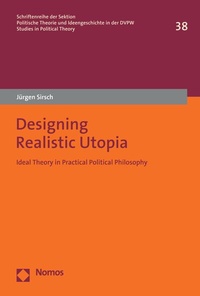
Designing Realistic Utopia
Ideal Theory in Practical Political Philosophy
1st Edition
Published on 11. November 2020
274 pages
978-3-7489-2206-3 (ISBN)
Description

Im Anschluss an John Rawls entwickelt der Autor eine praktisch-politisch relevante und kritische Konzeption idealer Theorie. Dies erfolgt auf der Grundlage einer Auseinandersetzung mit der Kritik an idealer Theorie durch Autoren wie Amartya Sen und Raymond Geuss. Als Antwort auf Sen wird eine Konzeption von Machbarkeitsrestriktionen für ideale Theorie entwickelt, insbesondere für die Konstruktion idealer institutioneller Gesellschaftsentwürfe. Als Antwort auf Geuss werden konstruktivistische Ansätze zur Konstruktion normativer Theorien diskutiert und für eine Konzeption idealtheoretischen Denkens argumentiert, die eine kritische Perspektive auf den Status Quo erlaubt.
More details
Other editions
Additional editions
Book
11/2020
1st Edition
Nomos
€59.00
Shipment within 7-9 days
Content
- Cover
- 1. Introduction
- Outline of the course of the argument
- 2. Ideal theory and idealization
- 2.1 The output of ideal theory: ideal principles and ideal institutions
- 2.2 The input of ideal theory: empirical and moral construction assumptions
- The first type: conceptions of the person
- The second type: idealized assumptions in thought experiments
- The third type: idealization regarding the range of outcomes being considered
- The fourth type: idealization in the sense of assuming moral ideals
- The fifth type: Idealization as assuming away feasibility restrictions
- Part I: Empirical restrictions in political philosophy
- 3. Nonideal theory and the ideal guidance approach
- 3.1 The practical relevance of ideal theory
- 3.1.1 "Clinical theory" as an alternative to the ideal guidance approach
- 3.1.2 The critique of the ideal guidance approach
- The problem of the second-best
- The legitimacy critique
- 3.2 A reasonable compromise?
- 4. Dimensions of feasibility
- 4.1 Institutional design
- 4.2 Dimensions of feasibility
- 4.2.1 Technical feasibility and accessibility
- 4.2.2 Modal dimensions of feasibility restrictions
- 4.2.3 Ontological dimensions of feasibility restrictions
- 4.3 Mapping different approaches to normative theory
- 5. Constructing ideal institutions for the ideal guidance approach
- 5.1 Principles for designing institutions and the status quo bias
- 5.2 The importance of long-term consequences for evaluating incremental reform options
- 5.3 Do we need ideal theory?
- 5.4 Feasibility in the construction of ideal institutions
- Part II: Moral ideals in political philosophy
- 6. Geuss' critique of ideal theory: moral construction assumptions in the focus
- 6.1 Geuss' conception of critical political philosophy
- 6.2 Geuss' critique of ideal theory
- 6.2.1 Recognizing power in ideal theory?
- 6.2.2 Ideology and moral intuitions
- 7. Constructivism as a foundation of morality
- 7.1 Rawls' constructivism
- 7.2 Justifying moral construction assumptions: the universalist interpretation of Rawls' theory
- 7.3 Problems of Rawls' approach: Justifying moral construction assumptions
- 7.4 The contextualist interpretation of Rawls' constructivism
- 7.5 O'Neill's minimalist version of constructivism
- 8. Problems of constructivism and implications for the construction of ideal theory
- 8.1 The need for fundamental moral assumptions in constructivism
- 8.2 Methodological foundations for moral reasoning?
- 8.3 Investigating proceduralism: subjective desires as inputs?
- 8.4 Starting from substantive moral reasons: a defense of an objectivist conception of moral reasoning
- 9. Conclusion
- References
