

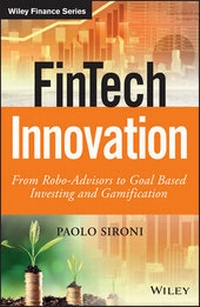
FinTech Innovation
Description

More details
Other editions
Additional editions
Person
Content
Preface xiii
Acknowledgments xix
About the Author xxi
Part One Personalize Personal Finance
Chapter 1 The Theory of Innovation: From Robo-Advisors to Goal Based Investing and Gamification 3
1.1 Introduction 3
1.2 A vibrant FinTech ecosystem 5
1.3 Some definitions, ladies and gentlemen 8
1.4 Personalization is king 9
1.5 The theory of innovation 11
1.6 My Robo-Advisor is an iPod 13
1.7 What incumbents should consider when thinking about FinTech innovation 15
1.8 Conclusions 17
Part Two Automated Long-Term Investing Means Robo-Technology
Chapter 2 Robo-Advisors: Neither Robots Nor Advisors 21
2.1 Introduction 21
2.2 What is a Robo-Advisor? 22
2.3 Automated digital businesses for underserved markets 25
2.4 Passive investment management with ETFs 26
2.5 Algorithms of automated portfolio rebalancing 29
2.6 Personalized decision-making, individual goals, and behaviour 30
2.7 Single minded businesses 31
2.8 Principles of tax-loss harvesting 33
2.9 Conclusions 36
Chapter 3 The Transformation of the Supply-Side 39
3.1 Introduction 39
3.2 The investment management supply-demand chain 40
3.3 How intermediaries make money 42
3.4 Issuers of direct claims (debt owners) 44
3.5 The institutionalization of the private banking relationship 45
3.6 The digital financial advisor 51
3.7 Asset management is being disintermediated 54
3.8 ETF providers and the Pyrrhic victory 57
3.9 Vertically integrated solutions challenge traditional platforms 59
3.10 Conclusions 60
Chapter 4 Social and Technology Mega Trends Shape a New Family of Taxable Investors 61
4.1 Introduction 61
4.2 Generational shift (X, Y, Z, and HENRYs) 62
4.3 About transparency, simplicity, and trust 65
4.4 The cognitive era 67
4.5 Conclusions 70
Chapter 5 The Industry's Dilemma and the Future of Digital Advice 71
5.1 Introduction 71
5.2 Wealth management firms: Go digital or die 72
5.3 Asset management firms: Less passive, more active 75
5.4 Robo-Platforms: Less transactions, more portfolios 76
5.5 Digital-Advisors: Empowered customization 77
5.6 Robo-Advisors: Be human, be virtual, take care of retirement 79
5.7 Conclusions: Clients take centre stage, at last 81
Part Three Goal Based Investing is the Spirit of the Industry
Chapter 6 The Principles of Goal Based Investing: Personalize the Investment Experience 85
6.1 Introduction 85
6.2 Foundations of Goal Based Investing 89
6.3 About personal needs, goals, and risks 91
6.4 Goal Based Investing process 96
6.5 What changes in portfolio modelling 97
6.6 Personal values 100
6.7 Goal elicitation 100
6.8 Goal priority 102
6.9 Time horizons 102
6.10 Risk tolerance 103
6.11 Reporting goal-centric performance 105
6.12 Conclusions 108
Chapter 7 The Investment Journey: From Model Asset Allocations to Goal Based Operational Portfolios 109
7.1 Introduction 109
7.2 Main traits of Modern Portfolio Theory 113
7.2.1 Asset diversification and efficient frontier 114
7.2.2 The Mean-Variance model portfolio 117
7.2.3 Final remarks about Mean-Variance 118
7.3 Main traits of Black-Litterman 118
7.3.1 The equilibrium market portfolio 119
7.3.2 Embedding professional views 121
7.3.3 The Black-Litterman optimal portfolio 122
7.3.4 Final remarks on Black-Litterman 122
7.4 Mean-Variance and mental accounts 123
7.4.1 Final remarks on Mean-variance and Mental Account 123
7.5 Main traits of Probabilistic Scenario Optimization 124
7.5.1 The PSO process 124
7.5.2 The investor's risk and return profile 126
7.5.3 Generation of scenarios and scenario paths 128
7.5.4 Stochastic simulation of products and portfolios over time 128
7.5.5 Potential and admissible portfolios: Allocation constraints 129
7.5.6 Adequate portfolios: Risk adequacy 130
7.5.7 Objective function: Probability maximization 131
7.5.8 Final remarks on PSO 135
7.5.9 Conclusions 135
Chapter 8 Goal Based Investing and Gamification 137
8.1 Introduction 137
8.2 Principles of Gamification 138
8.3 Gamification of wealth management 140
8.4 The mechanics of games 141
8.5 Conclusions 143
Concluding Remarks 145
Bibliography 147
Index 151
Preface
So far, most of my professional life has been spent at the intersection between FINance and TECHnology, whose line of separation has recently been blurred by financial technology companies (FinTechs). The forces that are fostering their innovative mindset are unveiled in this book, which closely scrutinizes the revolution occurring in the wealth management industry, and particularly digital advice, personalized investing, and cognitive analytics being used to give insight into the behaviour of customers. The findings are based partially on market research and academic material, but mostly on what I owe to the hundreds of business conversations with industry leaders, innovators, entrepreneurs and colleagues. They have enriched this book, transformed any business travel that I have undertaken into a scholarly opportunity, and ultimately made my humble career, which started in risk management, an invaluable journey. Back in the 1990s, I learned to implement advanced quantitative methods to manage trading risks and I engaged periodically with top managers and regulators in search of graphical yet robust simulation methods to turn complex mathematical equations into intuitive reporting. When the wind of innovation blew at my door in the early days of the FinTech revolution, I was easily led on an entrepreneurial journey, it was my goal to change the investment experience as it existed between financial advisors and their respective clients, to allow them to speak more comfortably the intuitive language of Goal Based Investing (whose quantitative foundations are demonstrated in my previous book Modern Portfolio Theory: from Markowitz to Probabilistic Scenario Optimisation). I then had the privilege and deep learning opportunity to engage with the extensive network and client base of IBM on a global scale. This contributed to refining the strategic thinking at the heart of this book about the many challenges that small and large wealth management firms face in a disrupted landscape made of technology developments, generational shifts, changes in investors' behaviour, tighter regulation, and declining revenues in the traditional models of financial advice. Wealth managers do stand at the digital epicentre of a tectonic fault, which is disrupting their landscape that has, in many ways, been unchanged for centuries.
On the institutional side of this fault, FinTechs have been building new business models, such as automated investment services, that compete fiercely with established banking operations. There is an ongoing debate about the future of the industry and the chances of FinTechs to disintermediate incumbent organizations fully. Whether they will settle in as the new leaders, or will die like a bee after expending its sting, cannot really be divined and is not the primary scope of this book. We are not siding either with David or with Goliath. What we are instead concerned with is any innovation that can transform the investing experience to benefit each and every one of us, the community of taxable investors and their human or digital financial advisors. As a matter of fact, FinTechs have already won the first round of the innovation battle, as incumbents have started to update their business models and compete in a challenging race to zero prices. Robo-Advisors, for example, were born as "garage companies" using digital tools to on-board customers and enhance their experience to disintermediate retail and private banking relationships. They also developed advanced technology to operate automated portfolio rebalancing, to squeeze trading costs to a minimum, and disintermediate the role of asset managers.
On the other side of the fault, the community of end investors is also shifting in response to technology trends which are transforming social behaviour globally. Not only Millennials but older generational cohorts are embracing with unforeseen facility all aspects of the digitalization of everyday life. From a wealth management perspective, their willingness to become more digital in handling their investments has further lowered the barriers to entry.
The transforming forces at play inside this fault are unprecedented. The offer-side has always dominated the wealth management relationship because financial institutions had unrivalled placing power with private clients. They could team up with product factories, such as asset managers and desks of capital markets, to embed hefty fees into financial products, collect them from final investors, and redistribute them among institutional players. The loss of reputation suffered by these players during the Global Financial Crisis (GFC) has seeded the regulatory terrain with new legislation, which is breaking the financial services' cartel in favour of final consumers, by raising fiduciary standards and enforcing greater transparency. While the offer-side is becoming progressively a "constrained offer-side", the community of investors is granted the flexibility to disintermediate centuries-old banking frameworks with relatively easier to understand investment experiences, any time, anywhere, at a much lower costs. This process of digitalization of the banking relationship is encouraging the demand-side (private clients) to take a more conscious and proactive role, empowering individuals and with them their personal financial advisors or digital intermediaries, and threatens to relegate wealth management institutions to lower margin business models.
The epicentre of this figurative earthquake is indeed located in the process of remodelling the asymmetry of information, which has always characterized the relationship between institutions and final clients, and kept the tectonic fault between them stable. This is now being pulled apart! The community of investors, intermediated by smart and tech-savvy financial advisors, can now become the new price-makers and force banks to be price-takers as part of a global process of banking democratization.
The book takes us on a journey below the disrupted surface of the wealth management industry, providing insights into what happens in its underlying layers. Deep within the crust, digitalization and demographic changes coupled with social media and Big Data analytics are colliding against established economic interests. Yet, this seismic activity is not just unsettling the technological and business landscape around but is also creating new minerals, a process known by scientists as flash evaporation. Goal Based Investing (GBI) is the resulting gold mine enriching the fault zone and is permitting early adopters of robo-technology to transform disruption into sustaining innovation. The theory of innovation provides a framework that helps to explain where the forces of change originate from, what is happening in the marketplace, and how the industry can evolve once robo-technology becomes mainstream.
Pre-eminently, Goal Based Investing seems to be the new normal in investment management as it provides a solution to fee-only businesses attempting to showcase their added value. Although such an investment philosophy is not new in economic studies, the industry has never truly felt compelled to realign to its best practice imperatives: traditional sales models have long proven that product-driven organizations were profitable. Moreover, technology constraints did not previously allow the building of the right customer experiences and make GBI principles effectively engaging. But this has now been solved by the usage of application programming interfaces (APIs), new digital tools, and faster than ever computing power. Furthermore, Gamification is emerging as a new digital force in the wealth management ecosystem. Goal Based Investing can provide the consistent mindset to gamify investments by simulating personal goals, market scenarios, and life events to enforce more adequate investment behaviour.
Discussing new methods (Goal Based Investing) and developing new solutions (automated rebalancing, API analytics, Gamification) might not be sufficient to enforce industry change if the economic incentives don't remodel as well within the firms themselves. In the present day widespread market regulation about fiduciary standards is facilitating a realignment to sounder client/portfolio-centric approaches. This enhancement is not cost free, and it requires a change of perspective from a traditional asset management point of view (optimization of the market variables) to a more personalized investment modality (elicitation of investors' ambitions and fears over time). In such a transforming environment, in which investors' fears and their long-term aspirations take centre stage, GBI principles will gear financial advice and financial planning to converge, and thus allow customization of the investment offering around clients' ultimate goals, generating premium services to tier and drive profitability (hence sustaining innovation). GBI robo-winners will be best placed to outpace laggards, whether FinTechs or digital incumbents.
Organization of the Book
Individual investors, financial advisors, portfolio managers, technology and digital managers, banking executives, and FinTech entrepreneurs can gain strategic insights about the transformation of the wealth management industry by reading this book and understanding the links between new technology and quantitative finance, as well as adapting to a tighter market regulation and higher fiduciary standards. Technology experts will learn about the rationales behind the many requests and challenges addressed to them by business owners. Financial professionals will learn how new technology can transform their...
