

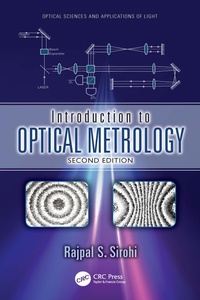
Introduction to Optical Metrology
2nd Edition
Published on 26. September 2025
476 pages
978-1-040-39321-5 (ISBN)
Description

This book describes both the theory and practice of optical techniques to measure various parameters encountered routinely in science and engineering.
Introduction to Optical Metrology, Second Edition, examines the theory and practice of various measurement methodologies utilizing both the corpuscular and the wave nature of light. The book begins by introducing the subject of optics and then addresses the propagation of laser beams through free space and optical systems. It discusses interferometry, holography, speckle metrology, the moire phenomenon, photoelasticity, and microscopy. The remaining chapters describe techniques and methods of measurements of refractive index, thickness, radii of curvature, angle, velocity, pressure, length, optical testing, and fiber-optic-based methods. Apart from these, this edition includes a chapter on temperature measurement, sections on fringe unwrapping methods, testing of free-form optics, shearography, etc. Featuring new and updated exercise problems at the end of each chapter, this edition provides an applied understanding of essential optical measurement concepts, techniques, and procedures.
The primary audience for this book is undergraduate and graduate students who specialize in optics. It will also be useful to researchers and professionals working on optical testing and fiber-optic-based and MEMS-based measurements. A solutions manual and figure slides are available for adopting professors.
Introduction to Optical Metrology, Second Edition, examines the theory and practice of various measurement methodologies utilizing both the corpuscular and the wave nature of light. The book begins by introducing the subject of optics and then addresses the propagation of laser beams through free space and optical systems. It discusses interferometry, holography, speckle metrology, the moire phenomenon, photoelasticity, and microscopy. The remaining chapters describe techniques and methods of measurements of refractive index, thickness, radii of curvature, angle, velocity, pressure, length, optical testing, and fiber-optic-based methods. Apart from these, this edition includes a chapter on temperature measurement, sections on fringe unwrapping methods, testing of free-form optics, shearography, etc. Featuring new and updated exercise problems at the end of each chapter, this edition provides an applied understanding of essential optical measurement concepts, techniques, and procedures.
The primary audience for this book is undergraduate and graduate students who specialize in optics. It will also be useful to researchers and professionals working on optical testing and fiber-optic-based and MEMS-based measurements. A solutions manual and figure slides are available for adopting professors.
More details
Series
Edition
2nd edition
Language
English
Place of publication
London
United Kingdom
Publishing group
Taylor & Francis Ltd
Target group
College/higher education
Professional and scholarly
Illustrations
8 Tables, black and white; 303 Line drawings, black and white; 303 Illustrations, black and white
File size
35,40 MB
ISBN-13
978-1-040-39321-5 (9781040393215)
Copyright in bibliographic data and cover images is held by Nielsen Book Services Limited or by the publishers or by their respective licensors: all rights reserved.
Schweitzer Classification
Other editions
Additional editions
Rajpal S. Sirohi
Introduction to Optical Metrology
Book
09/2025
2nd Edition
CRC Press
€188.90
Shipment within 10-20 days
Person
Rajpal S. Sirohi served as Professor of Physics at IIT Madras for more than two decades and as Director of IIT Delhi and Vice Chancellor to several Universities in India. He was a Distinguished Scholar at the Rose-Hulman Institute of Technology, Terre Haute, Indiana; Chair Professor at Tezpur University, Assam, India; and Faculty at Alabama A&M University, Huntsville, Alabama. Professor Rajpal S. Sirohi is now retired and spends his time reading books on the history of science and spends mornings and evenings with his grandchildren. His research areas are optical metrology, optical instrumentation, laser instrumentation, holography, and speckle phenomenon.
Content
Chapter 1 Introduction to Optics Chapter 2 Laser Beams Chapter 3 Sources, Detectors, and Recording Media Chapter 4 Interferometry Chapter 5 Holography and Digital Holography Chapter 6 Speckle Phenomenon, Speckle Photography, and Speckle Interferometry Chapter 7 The Moire Phenomenon Chapter 8 Photoelasticity Chapter 9 Microscopy Chapter 10 Measurement of Refractive Index Chapter 11 Measurement of Radius of Curvature and Focal Length Chapter 12 Optical Testing Chapter 13 Angle Measurement Chapter 14 Thickness Measurement Chapter 15 Measurement of Velocity Chapter 16 Pressure Measurement Chapter 17 Temperature Measurement Chapter 18 Fiber-Optic and MEMs-Based Measurements Chapter 19 Length Measurement
