

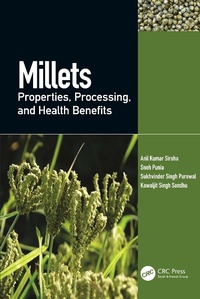
Millets
Properties, Processing, and Health Benefits
1st Edition
Published on 29. July 2021
272 pages
978-1-000-40286-5 (ISBN)
Description

Millets are low cost cereal grains and widely used in the food industry and animal husbandry as an important source of food and feed. As a rich source of starch, protein, minerals, vitamins, and specific bioactive compounds that contain beneficial antioxidant properties, they have gained considerable attention as a botanical dietary supplement and various functional foods.
Millets: Properties, Processing, and Health Benefits explores millet production, chemistry and nutritional aspects, processing technologies, product formulations, and more. Understanding the properties of millets provides a basis for better utilizing millet crops, in addition to further development of millets as an important industrial crop.
Key Features:
Provides millet taxonomy, history, nutritional aspects, and health benefits
Discusses the physical and functional properties of millets
Explores various millet-based products
Deals with starch composition, structure, properties, and applications
Touches on postharvest management of millets
This book combines information on the composition, functional properties and processing along with information on the health properties of millets. With its unique presentation on millets flour and starch, it will be suitable for those wanting to use millets in various food products, including food technologists, nutritionists, research scientists, and agriculture professionals.
Millets: Properties, Processing, and Health Benefits explores millet production, chemistry and nutritional aspects, processing technologies, product formulations, and more. Understanding the properties of millets provides a basis for better utilizing millet crops, in addition to further development of millets as an important industrial crop.
Key Features:
Provides millet taxonomy, history, nutritional aspects, and health benefits
Discusses the physical and functional properties of millets
Explores various millet-based products
Deals with starch composition, structure, properties, and applications
Touches on postharvest management of millets
This book combines information on the composition, functional properties and processing along with information on the health properties of millets. With its unique presentation on millets flour and starch, it will be suitable for those wanting to use millets in various food products, including food technologists, nutritionists, research scientists, and agriculture professionals.
More details
Edition
1. Auflage
Language
English
Place of publication
London
United Kingdom
Publishing group
Taylor & Francis Ltd
Target group
Professional and scholarly
Illustrations
27 Tables, black and white; 23 Line drawings, black and white; 6 Halftones, color; 3 Halftones, black and white; 6 Illustrations, color; 26 Illustrations, black and white
ISBN-13
978-1-000-40286-5 (9781000402865)
Copyright in bibliographic data and cover images is held by Nielsen Book Services Limited or by the publishers or by their respective licensors: all rights reserved.
Schweitzer Classification
Other editions
Additional editions
Anil Kumar Siroha | Sneh Punia | Sukhvinder Singh Purewal
Millets
Properties, Processing, and Health Benefits
Book
10/2024
1st Edition
CRC Press
€118.20
Shipment within 10-20 days
Anil Kumar Siroha | Sneh Punia | Sukhvinder Singh Purewal
Millets
Properties, Processing, and Health Benefits
Book
07/2021
1st Edition
CRC Press
€282.60
Shipment within 15-20 days
Anil Kumar Siroha | Sneh Punia | Sukhvinder Singh Purewal
Millets
Properties, Processing, and Health Benefits
Book
07/2021
CRC Press
Unfortunately, price unknown
Available (delivery time upon request)
Persons
Anil Kumar Siroha, Ph.D. is presently working as Assistant Professor (C) in the Department of Food Science and Technology, Chaudhary Devi Lal University, Sirsa. He has both master's and doctorate degrees in Food Science and Technology. His area of interests includes starch, starch modification and development of new products. He has published more than 20 research papers in national and international journals and several book chapters.
Dr. Siroha edited a book entitled "Pearl millet: properties, functionality and applications". He also serves as a reviewer for various national and international journals. He is active member of Association of Food Scientists and Technologists (AFSTI), Mysore, India.
Sneh Punia, Ph.D. is presently working as Assistant Professor (C) in the Department of Food Science and Technology, Chaudhary Devi Lal University, Sirsa. Dr. Punia is involved in the mandated research activities of institution and has expertise on extraction and functional characterization of antioxidants, starch, their modifications and functional products.
She has presented her research in various national and international conferences and publishes more than 50 research papers/book chapters in national and international journals/books. Dr. Punia has published two edited and one authored book with CRC Taylor and Francis Group. She also serves as the reviewer for various international journals. Dr. Punia received her M.Sc. and doctorate degree in Food Science and Technology, Chaudhary Devi Lal University, Sirsa, Haryana (India).
Sukhvinder Singh Purewal, Ph.D. is presently working as Young Scientist, Department of Science and Technology (SYST Scheme) in Department of Food Science & Technology, Maharaja Ranjit Singh Punjab Technical University, Bathinda. His area of interests includes solid state fermentation, bioactive compounds from natural resources, antioxidants and food biotechnology. He has published more than 15 research papers in Journals of International repute.
He has also worked on a UGC, Delhi sponsored Major Research Project during 2012-2015. He was awarded for best paper presentation in National as well as International Conferences. He is an active life member of Association of Microbiologists of India (AMI), The Biotech Research Society, India (BRSI), Mycological Society of India (MSI), Association of Food Scientists and Technologists (AFSTI), Mysore, India and Indian Science Congress Association (ISCA).
Dr. Kawaljit Singh Sandhu is presently working as Associate Professor and Head in the Department of Food Science &Technology, Maharaja Ranjit Singh Punjab Technical University (MRSPTU), Bathinda, Punjab. He has more than 18 years of experience in teaching and research. He joined MRSPTU in 2017 as a founder Head of the Department.
In 2006, he was awarded Post-Doctoral research fellowship by Korean Ministry of Education, South Korea to carry out research on starch structural and digestibility properties. He was awarded with Young Scientist Award from Association of Food Scientists and Technologists (AFSTI), Mysore, India. Dr. Sandhu has successfully completed one research project funded by UGC, New Delhi. Dr. Sandhu area of research interest includes characterization, modification, and utilization of starches from different botanical sources, drug delivery, bioactive compounds, and food product development. He has published more than 75 international/national scientific papers and several book chapters.
Dr. Siroha edited a book entitled "Pearl millet: properties, functionality and applications". He also serves as a reviewer for various national and international journals. He is active member of Association of Food Scientists and Technologists (AFSTI), Mysore, India.
Sneh Punia, Ph.D. is presently working as Assistant Professor (C) in the Department of Food Science and Technology, Chaudhary Devi Lal University, Sirsa. Dr. Punia is involved in the mandated research activities of institution and has expertise on extraction and functional characterization of antioxidants, starch, their modifications and functional products.
She has presented her research in various national and international conferences and publishes more than 50 research papers/book chapters in national and international journals/books. Dr. Punia has published two edited and one authored book with CRC Taylor and Francis Group. She also serves as the reviewer for various international journals. Dr. Punia received her M.Sc. and doctorate degree in Food Science and Technology, Chaudhary Devi Lal University, Sirsa, Haryana (India).
Sukhvinder Singh Purewal, Ph.D. is presently working as Young Scientist, Department of Science and Technology (SYST Scheme) in Department of Food Science & Technology, Maharaja Ranjit Singh Punjab Technical University, Bathinda. His area of interests includes solid state fermentation, bioactive compounds from natural resources, antioxidants and food biotechnology. He has published more than 15 research papers in Journals of International repute.
He has also worked on a UGC, Delhi sponsored Major Research Project during 2012-2015. He was awarded for best paper presentation in National as well as International Conferences. He is an active life member of Association of Microbiologists of India (AMI), The Biotech Research Society, India (BRSI), Mycological Society of India (MSI), Association of Food Scientists and Technologists (AFSTI), Mysore, India and Indian Science Congress Association (ISCA).
Dr. Kawaljit Singh Sandhu is presently working as Associate Professor and Head in the Department of Food Science &Technology, Maharaja Ranjit Singh Punjab Technical University (MRSPTU), Bathinda, Punjab. He has more than 18 years of experience in teaching and research. He joined MRSPTU in 2017 as a founder Head of the Department.
In 2006, he was awarded Post-Doctoral research fellowship by Korean Ministry of Education, South Korea to carry out research on starch structural and digestibility properties. He was awarded with Young Scientist Award from Association of Food Scientists and Technologists (AFSTI), Mysore, India. Dr. Sandhu has successfully completed one research project funded by UGC, New Delhi. Dr. Sandhu area of research interest includes characterization, modification, and utilization of starches from different botanical sources, drug delivery, bioactive compounds, and food product development. He has published more than 75 international/national scientific papers and several book chapters.
Content
1. Millet Grains: Taxonomy, History, and Nutritional Approach 2. Effect of Processing on Millet Properties 3. Physical and Functional Properties of Millets 4. Nutritional Composition and Health Benefits 5. Millet Starch: Pasting, Rheological, and Morphological Properties 6. Impact of Modification on Starch Properties 7. Bioactive Compounds of Millets 8. Millets-Based Food Products 9. Millets Diseases and Their Control.
