

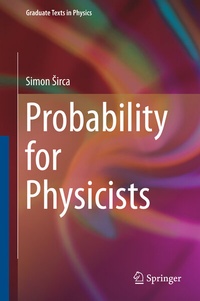
Probability for Physicists
Description

Reviews / Votes
"Sirca . provides a thorough background; sections cover fundamentals of probability analysis, statistical distributions, and applications of the theories using computer-based algorithms. . The work includes useful graphs, four appendixes covering random number generation, and tables of normal distributions. There are extensive references and a valuable index. Summing Up: Recommended. Graduate students; researchers/faculty; professionals." (N. Sadanand, Choice, Vol. 54 (4), December, 2016)More details
Other editions
Additional editions
Person
Simon Sirca studied physics at the Faculty of Mathematics and Physics, University of Ljubljana, and acquired his first research experience as a young researcher at the Jozef Stefan Institute in Ljubljana and the Institute for Nuclear Physics at the University of Mainz, Germany, concluding his PhD work with the thesis Axial form-factor of the nucleon from coincidence pion electroproduction at low Q 2 . He was a postdoctoral research associate at the Massachusetts Institute of Technology and the Thomas Jefferson National Accelerator Facility (Jefferson Lab) in the USA. His main research is in the field of hadronic structure and dynamics as explored by scattering of electrons on light nuclei, exploiting state-of-the-art polarized beams, polarized targets, and techniques of recoil polarimetry. He is also involved in theoretical work on quark models of hadrons, with the focus on electroweak processes like pion electroproduction in the nucleon resonance region. He is the head ofthe research group Structure of Hadronic Systems that has been active in the OOPS and BLAST Collaborations at MIT, a collaboration of Jefferson Lab, and the A1 Collaboration and University of Mainz. He is an Associate Professor at the Faculty of Mathematics and Physics, University of Ljubljana, where he has been teaching numerous courses in Mathematical Physics, Modern Physics and Mathematical Physics (Computational Physics).
