

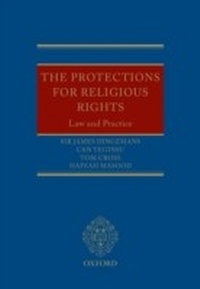
Protections for Religious Rights: Law and Practice
Law and Practice
1st Edition
Published on 31. October 2013
619 pages
978-0-19-163676-9 (ISBN)
Description

The Protections for Religious Rights is the first practitioner work to offer a full and systematic treatment of the law as it pertains to religious rights in the UK and abroad. A practical working aid to a sensitive and important area of increasing litigation and public debate, this text examines the applicable legal instruments, considers the current state of the law, and reviews domestic, comparative, and international case law to provide a comprehensive reference resource thatinforms on all matters of significance in this area. The protections for religious rights in the UK are rooted in international law and the English common law. Religious conflicts have arisen when communities have perceived that their religious rights have been targeted for suppression, or ignored. Despite international human rights instruments which are intended to protect such rights, many courts have adopted a narrow and restrictive approach towards these aspects. With practical evaluations of the relevant international instruments which inform domestic law in the UK, the important substantive areas of employment, education, family, and goods and services, are addressed specifically in dedicated chapters. Comparative perspectives are also considered in an extensive chapter offering global treatment of legislation and authorities, drawing on expertise from the United States, Canada, South Africa, Australia, India, Ireland, New Zealand, and Turkey. Otherareas where protections for religious rights are engaged are addressed in a final chapter - including coverage of places of worship, criminal law, planning, charitable status, prisons, immigration, and animal rights - making this text a complete resource for all concerned or interested in this area oflaw. The text includes an appendix of selected materials for easy reference to relevant extracts from international treaties, constitutions and domestic statutes.
More details
Other editions
Additional editions
Book
10/2013
Oxford University Press
€365.60
Shipment within 15-20 days
Content
- Cover
- THE PROTECTIONS FOR RELIGIOUS RIGHTS
- Copyright
- FOREWORD
- PREFACE
- CONTENTS
- Table of Cases
- Table of Legislation
- List of Abbreviations
- 1. Introduction
- A. Preamble
- B. A Short History of English Law and Religious Rights
- (1) Medieval England
- (2) The English Reformation and establishment of the Church of England
- (3) The dismantling of restrictions on religious freedom
- (4) Religious freedom in the twentieth and twenty-first centuries
- (5) The position of the Church of England in the twenty-first century
- I INTERNATIONAL STANDARDS AND PROTECTIONS
- 2. The United Nations Standards and Protections
- A. Introduction
- (1) The importance of international law in the protection of religious rights
- (2) The role of international law in domestic courts
- (3) The UN framework of protection for religious rights
- B. Universal Declaration of Human Rights 1948
- (1) An important reference point for the protection of religious rights
- (2) Article 18
- (3) Indirect protections
- C. International Covenant on Civil and Political Rights 1966
- (1) The framework of protection
- (2) Substantive protections: Article 18 and General Comment 22
- (3) Substantive protections: Article 27 and indirect protections
- (4) Practice and procedure
- D. UN Declaration on the Elimination of All Forms of Intolerance and of Discrimination Based on Religion or Belief 1981
- E. UN Special Rapporteur on Freedom of Religion or Belief
- (1) The mandate
- (2) Working methods
- F. UN Convention on the Rights of the Child 1989
- (1) Article 14(1)
- (2) Article 14(2)
- (3) Article 14(3)
- (4) Related provisions
- 3. The European Standards and Protections
- A. The European Convention on Human Rights
- (1) Introduction
- (2) Article 9 ECHR: an overview
- (3) When is Article 9 engaged?
- (4) Has there been an interference with Article 9 rights?
- (5) Is the interference justified under Article 9(2)?
- (6) Article 14 ECHR
- (7) Bringing an ECHR claim: procedure and remedies
- B. Religious Rights in the Context of the European Union
- (1) Introduction
- (2) Overview: fundamental rights within the EU framework
- (3) Religion in European law: provisions and substantive principles
- (4) Religion in European law: practical principles
- 4. Comparative Perspectives
- A. Australia (Paul Babie)
- (1) Introduction
- (2) Protecting religious freedom
- (3) The principal Australian contexts in which religious rights arise
- (4) Conclusion
- B. Canada (Howard Kislowicz)
- (1) Main provisions and brief historical perspective
- (2) Key constitutional and statutory materials
- (3) Leading cases
- C. India (Mara Malagodi)
- (1) Introduction
- (2) Background
- (3) The constitutional framework
- (4) Key constitutional provisions, statutes, and case law
- (5) Conclusions
- D. New Zealand (Saeeda Verrall)
- (1) Introduction
- (2) New Zealand's religious landscape at a glance
- (3) Legislation relating to religious rights and freedoms
- (4) Jurisprudence considering religious rights
- (5) Conclusions
- E. Northern Ireland (Claire Archbold)
- (1) Constitutional law
- (2) Human rights
- (3) Discrimination law
- (4) Education
- (5) Family Law
- (6) Wills, trusts, and property law
- (7) Charities
- (8) Planning
- (9) Criminal law
- F. Republic of Ireland (James Anderson and Claire Archbold)
- (1) Constitutional law
- (2) Human Rights
- (3) Criminal law
- (4) Family law
- (5) Education law
- (6) Employment and discrimination law
- (7) Charity law
- G. South Africa (Waheeda Amien)
- (1) Introduction
- (2) Constitutional provisions
- (3) Jurisprudence
- (4) Main principles emerging from the case law
- (5) Conclusion
- H. Turkey (Mine Yildirim)
- (1) General framework
- (2) The constitutional protection of freedom of religion or belief: article 24
- (3) The approach of the higher courts to religious rights
- I. United States (Nicholas Hatzis)
- (1) The First Amendment
- (2) Direct interference with freedom of religion
- (3) Indirect interference with freedom of religion
- II DOMESTIC PROTECTIONS
- 5. The Human Rights Act 1998
- A. Introduction
- B. Article 9
- (1) Religion or belief
- (2) Manifestation of belief
- (3) Interference
- (4) Justifi cation
- (5) Article 9 in combination with Article 14
- (6) Section 13 HRA 1998
- C. Remedies
- (1) Available remedies and jurisdiction
- (2) Sections 3 and 4 HRA 1998
- (3) Damages
- (4) Prerogative orders
- (5) Declarations and injunctions
- (6) Remedies in criminal proceedings
- D. Procedure
- (1) Introduction
- (2) HRA-based judicial review
- (3) Free-standing claims
- (4) Other legal proceedings
- 6. The Equality Act 2010
- A. Introduction
- B. Background
- C. Protected Characteristics
- (1) Religion or belief
- (2) Race
- D. Prohibited Conduct
- (1) Direct discrimination
- (2) Indirect discrimination
- (3) Harassment
- (4) Victimization
- E. Exceptions
- (1) Employment
- (2) Services and public functions, premises and associations
- (3) Services and public functions-specifi c exemptions from section 29
- F. Advancement of Equality
- (1) Public sector equality duty
- (2) Positive action
- G. Procedure and Remedies
- (1) Proceedings in the county court
- (2) Proceedings in the employment tribunal
- (3) Transitional provisions
- 7. Services and Public Functions, Premises, Associations
- A. Introduction
- B. Legislative History
- C. Who and What is Protected?
- (1) Provision of services and public functions
- (2) Premises
- (3) Associations
- (4) The 'religious organisations' exception
- D. Procedure and Remedies
- 8. Religion and Employment
- A. Introduction
- B. Discrimination Law
- (1) Introduction
- (2) Legislative history
- (3) Who and what is protected?
- C. Unfair Dismissal and Other Protections
- (1) Unfair dismissal
- (2) Human rights law
- (3) Protections under the School Standards and Framework Act 1998
- D. Time Off for Religious Observance
- (1) Sunday working for shop workers
- (2) Other requests for time off work
- E. Religious Symbols and Dress
- (1) The ECHR
- (2) Discrimination law
- F. Refusal of Work Tasks
- (1) Conscientious objection clauses
- (2) Work tasks and beliefs concerning same-sex couples
- G. Expression of Religious Views in the Workplace
- H. Religious Rights of Employers
- (1) Exceptions under the Equality Act 2010
- (2) The School Standards and Framework Act 1998
- (3) Protections under the ECHR
- I. Procedure and Remedies
- (1) Discrimination claims
- (2) Claims for unfair dismissal
- 9. Religion and Education
- A. Introduction
- (1) Overview of this chapter
- (2) Key legal sources
- B. Educational Provision in the United Kingdom
- (1) The basic types of school
- (2) Faith schools
- (3) Academies
- C. Teaching and Content
- (1) Religious education and collective worship
- (2) Sex education
- (3) Corporal punishment
- (4) Absence from school for religious holidays, festivals, and pilgrimages
- D. Discrimination in Education
- (1) Discrimination by schools
- (2) Discrimination in the exercise of public functions
- (3) School transport
- E. Admissions
- (1) Overview of admissions law
- (2) Faith-based admissions criteria
- (3) Preferences for schools based on religion or belief
- F. Dress and Symbols in Schools
- (1) School uniform and religious dress
- (2) Religious symbols in schools
- 10. Religious Expression and Toleration
- A. Introduction
- B. Blasphemy
- (1) Origins
- (2) Application and development in the twentieth and twenty-first centuries
- (3) Abolition
- C. Religious Hatred and Other Public Order Off ences
- (1) Religious hatred off ences
- (2) Hatred against persons on grounds of sexual orientation
- (3) Other public order off ences and the ECHR
- (4) Jurisprudence of the ECtHR
- D. Toleration and Conscientious Objection
- (1) Toleration in statute
- (2) Conscientious objection
- 11. Religion and the Family
- A. Marriage
- (1) Introduction
- (2) The Marriage Act and religious marriages
- (3) Marriage is not a manifestation of religious belief
- B. Civil Partnership
- (1) Introduction
- (2) Religious premises: the changes brought in by the Equality Act 2010
- C. Divorce
- (1) Introduction
- (2) The relationship between civil and religious termination of marriages
- (3) Section 10A of the Matrimonial Causes Act 1973
- (4) Alternative dispute resolution with religious bodies
- D. Upbringing of Children
- (1) Introduction
- (2) Private law cases
- (3) Public law cases
- 12. Protections for Religious Rights in Other Areas
- A. Places of Worship
- (1) Introduction
- (2) Ratings exemption
- (3) Solemnization of marriages
- (4) Ecclesiastical Courts Jurisdiction Act 1860
- B. Church Courts
- C. Rituals, Burials, and Ceremonies
- (1) Introduction
- (2) Common law rights of burial
- (3) Funerary rites of other religions
- D. Criminal Law
- E. Planning and the Environment
- (1) Introduction
- (2) Planning decisions/material considerations
- (3) Planning and Article 9 ECHR
- (4) Planning and the public sector equality duty
- F. Charitable Status
- G. Prisons
- H. Animal Slaughter
- Appendix I: United Nations Standards and Protections
- Appendix II: European Standards and Protections
- Appendix III: Domestic Standards and Protections
- Appendix IV: Constitutional Protections Around the World
- Index
