

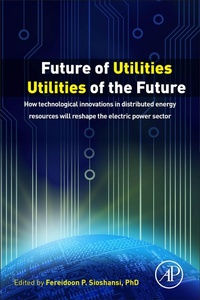
Future of Utilities - Utilities of the Future
How Technological Innovations in Distributed Energy Resources Will Reshape the Electric Power Sector
Published on 15. March 2016
492 pages
978-0-12-804320-2 (ISBN)
Description

Future of Utilities - Utilities of the Future: How technological innovations in distributed generation will reshape the electric power sector relates the latest information on the electric power sector its rapid transformation, particularly on the distribution network and customer side. Trends like the rapid rise of self-generation and distributed generation, microgrids, demand response, the dissemination of electric vehicles and zero-net energy buildings that promise to turn many consumers into prosumers are discussed.
The book brings together authors from industry and academic backgrounds to present their original, cutting-edge and thought-provoking ideas on the challenges currently faced by electric utilities around the globe, the opportunities they present, and what the future might hold for both traditional players and new entrants to the sector.
The book's first part lays out the present scenario, with concepts such as an integrated grid, microgrids, self-generation, customer-centric service, and pricing, while the second part focuses on how innovation, policy, regulation, and pricing models may come together to form a new electrical sector, exploring the reconfiguring of the current institutions, new rates design in light of changes to retail electricity markets and energy efficiency, and the cost and benefits of integration of distributed or intermittent generation, including coupling local renewable energy generation with electric vehicle fleets.
The final section projects the future function and role of existing electrical utilities and newcomers to this sector, looking at new pathways for business and pricing models, consumer relations, technology, and innovation.
- Contains discussions that help readers understand the underlying causes and drivers of change in the electrical sector, and what these changes mean in financial, operational, and regulatory terms
- Provides thought-provoking ideas on the challenges currently faced by electric utilities around the globe, the opportunities they present, and what the future might hold for both traditional players and new entrants to the sector
- Helps readers anticipate what developments are likely to define the function and role of the utility of the future
More details
Other editions
Additional editions
Fereidoon Sioshansi
Future of Utilities - Utilities of the Future
How Technological Innovations in Distributed Energy Resources Will Reshape the Electric Power Sector
Book
03/2016
Academic Press
€97.79
Shipment within 15-20 days
Content
Part I. What is changing and what are the implications1. What future for electric power sector2. The value of an integrated grid3. Microgrids: Finally finding their place4. The new power on the consumer side of the meter5. A customer-centric view of electricity service6. The role of the utility and pricing in the transition
Part II. Innovation, policy, regulations, pricing7. Regulation for a sustainable energy system - reconfiguring the institutions8. Rate design of the future9. Rates and revenues: Differential impacts of customer-sited distributed generation in vertically-integrated and competitive retail markets10. Rehabilitating Retail Electricity Markets: Pitfalls and Opportunities11. Assessing the Cost and Benefits of DER Integration12. Efficiency and equity considerations in designing rates in the context of the death spiral for electric utilities13. Modeling the impacts of disruptive technologies and pricing on peak demand14. Intermittency - it's the short-term that matters15. Opportunities and challenges in coupling local renewable energy generation with EV fleets
Part III. Function and role of the utility of the future - or the future of utilities16. Identifying value pools, building new business models, and defining strategies rooted in inherent capabilities in utilities17. Utilities don't simply connect, they integrate18. Smart, renewable or decentralized: Strategic choices of European energy incumbents19. Imagine a future where entrepreneurial, profitable utilities thrive despite disruptive technologies: German case study20. The future of utility customers and utility customers of the future21. Flexibility business models: new actors, new roles, new rules22. Decentralized reliability options - market based capacity arrangements23. Network pricing for the prosumer future: Demand-based tariffs or nodal pricing?24. The evolution of smart grids begs disaggregated nodal pricing25. The distributed utility: Conflicts and opportunities between the incumbent utilities, suppliers and the emerging new entrants26. Innovation platform enables the Internet of things
