

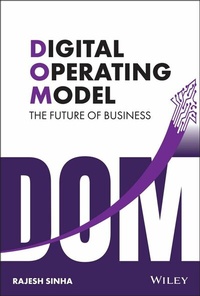
Digital Operating Model
Description

In Digital Operating Model: The Future of Business, digital strategist and execution expert Rajesh Sinha delivers a robust and practical operating blueprint for digital transformation. Applicable to any industry, any size company, this playbook helps executives, professionals, managers, founders, owners, and other business leaders understand the importance and realize the benefits of a digital future for their companies--all without having to spend massive amounts of money in the process.
The author explores effective methods to create multiple digital accelerators, develop cultural alignment that fosters innovation and delivers rapid solutions, and shares insights into the new mantras of our goods-and-services on-demand economy. Readers will also find:
* Step-by-step guidance to implementing a digital platform strategy that leads to exponential business growth
* Methods for designing and applying new businesses processes that create better experiences internally for your teams and externally for your customers and customers' customers, which also leads to exponential business growth
* Real-life examples and case studies of businesses that have achieved successful digital acceleration and grown dramatically in the process
Digital Operating Model shows readers how to meet their professional objectives while realizing profound transformation that offers innovative and durable differentiation both in terms of purpose and profits.
More details
Other editions
Additional editions
Person
Everyone deserves digital tech to better their lives. All proceeds from this book will be donated to the Fulcrum Foundation, a nonprofit dedicated to "no one should be left behind on this planet."
For more on the author, visit RajeshSinha.com
Content
Acknowledgments xv
Part I The Impossible Is Possible 1
Chapter 1 Your Mantra for Success 3
Chapter 2 DOM in Motion 17
Chapter 3 The New Normal 33
Chapter 4 DOM in Motion/Small-to-Midsize Company Food Service Management: Whitsons Culinary Group61
Part II Become the Disruptor 73
Chapter 5 Building Your Digital Road Map 75
Chapter 6 Unleashing the Power of Your Business Platform 95
Chapter 7 DOM in Motion/Mid- to Large-Size Company Insurance: Crum & Forster 115
Part III Don't Get Disrupted 121
Chapter 8 Crisis Creates Opportunity 123
Chapter 9 Outsmarting the Competition 139
Chapter 10 DOM in Motion: Business Platform Success 151
Part IV The Future Is Here 161
Chapter 11 Maintain Your Forward Momentum 163
Chapter 12 The Decades Ahead 181
Epilogue 195
Endnotes 199
Appendix/ Rajesh Sinha: A Digital Entrepreneur's Journey 205
About the Website 211
Index 213
CHAPTER 2
DOM in Motion
Do not judge me by my successes, judge me by how many times I fell down and got back up again.1
-Nelson Mandela
All businesses are not giants of their industry or even aspire to be. But every business has more possibilities than it realizes and looks for ways to differentiate itself from its competitors.
Disruption on the business side as well as with technology through business platforms can capitalize on that untapped potential, provide more and better services, and at a cost savings with incredible growth potential. DOM is the enabling pathway, that when embraced fully by a company, creates the velocity-DOM in motion-to create a win, win, win situation.
WHY TAKE THE JOURNEY?
For many companies, the onset of the COVID-19 pandemic meant a digital scramble to patch together systems to keep functioning and maintain continuity for customers. Some systems worked better than others.
Many companies faced initial slowdowns; others couldn't meet the challenges and had to shut down. But some saw the potential and disrupted their industries.
DOM Acceleration
Quest Food Management Services is one of those that opted to disrupt. The Lombard, Illinois-based food services group provides services to business, industry, higher education, conference centers, and the K-12 segment in the Midwest, with more than $65 million in annual revenue.
Though the company implemented a food services management software platform prior to the pandemic, adoption was slow and growth only incremental, according to company President Nicholas Saccaro. Then COVID hit and upended everything.
"As we started to reopen from COVID, our operating model completely changed. Instead of opening a cafeteria and serving five hundred kids a lunch period and so on, where we could rely on all this tribal knowledge of existing personnel, now we are doing seven- and fourteen-day meal kits and drive-through distribution where there is absolutely no data, no tribal knowledge to go off of whatsoever," says Saccaro. "So, the adoption of the food management platform in our organization skyrocketed because people found that this was an opportunity to get better data to be able to leverage the learnings and the experiences we were seeing literally every single day."
As Quest accelerated its digital journey-DOM in motion-the company transformed itself. "We were kind of reinventing our model," Saccaro says. "The pandemic really kind of accelerated our adoption and use of these digital tools because it was so important for us to be able to plan the business accordingly. If we weren't able to utilize systems like that where we could forecast production needs or track production trends, we wouldn't know how much to order or how many staffers we had to bring in. It was like starting a new business or a new division of our organization."
The pandemic further shaped people's experiences with food and dining, says Saccaro. Now they utilize technology to be able eat food where they want, when they want, and how they want, and to have access to all kinds of broad options. "This is absolutely going to transform the way we think about customer experience," he adds.
Pre-pandemic Quest was at DOM Level 2/early experimenters-still mired in siloed systems, some operations manual and others automated, many disconnected, and technology hesitant. Then, out of necessity, the company embraced the DOM. Today the company is innovating, has a high-performing culture, and has defined metrics to measure its operations. In other words, it is a Level 3/digitally credible company on the way to Level 4/digitally mature.
Rethinking Your Space
Now is the time for businesses of all sizes to look toward the future, assess their systems and processes, and rethink the possibilities in their industries. It's time to look to innovative ideas and processes, and rebuild bigger and better.
The traditional linear mindset-one step and one customer at a time-is being replaced with the digital mindset that enables small companies to compete on the same playing field as behemoths.
The business model and business objective remain unchanged; it's the execution phase empowered by an innovative thought process that ultimately enables a shift to a digital culture and DOM in motion. Already, experts predict that companies worldwide will spend close to $7 trillion on digital transformation between 2020 and 2023.2
Breakwater Treatment & Wellness is a great example of a company that embraced the digital operating model as a pathway to focus on what makes it unique-its processes. The Cranbury, New Jersey-based cannabis products and services company provides a high-end educational shopping experience to customers, according to Andrew Zaleski, Breakwater's President. All the cannabis buds are hand-trimmed to ensure the highest quality. Plus, the company recruits top-notch cultivation and harvesting experts and is involved in research to continually improve its products.
The power of DOM helps Breakwater measure and maintain its quality products as well as provides a platform to deliver a better experience to customers. "Breakwater is fully committed to this process, which has allowed us to sustain a reputation for high quality over low cost and high-volume alternatives," says Zaleski.
CHANGING DEMOGRAPHICS
For those people and companies not yet convinced that disruption and digital acceleration are essential to survival, consider some of the changes in demographics and consumer behaviors happening today and the expected possibilities for tomorrow. Companies with aspirations to survive and thrive into the next decade will need to respond to the needs and demands of these changing forces.
World population will surpass 8 billion by 2025, according to United Nations projections.3 Leading markets will shift more to Asia. Millennials and Gen Z have been joined by Generation Alpha and soon a new generation. These generations have brains wired differently than earlier generations and bring new expectations and new skill sets as they join the workforce in ever greater numbers. Asian markets and consumers differ from their Western counterparts, too.
All of this will further affect consumer and customer purchasing behaviors that already have been changed by the pandemic. Better, faster, smoother, more efficient, and integrated operations and transactions on demand are the expected norm. Slowdowns, glitches, and breakdowns simply are no longer acceptable. This new workforce and consumer will reject products and services as well as delivery and payment systems that don't live up to the latest technology and expectations.
To meet these demands, new businesses will emerge. Existing businesses also have the affordable opportunity to compete if they embrace digital acceleration and maximize their potential through the availability of platform approaches.
Purposeful Companies Poised for the Future
Today's workforce-as well as tomorrow's-want a company's strategies to be driven by purpose that in turn creates a thriving culture. Successes are about a purposeful culture and environment pinned on the premise of how to make lives easier. It's no longer only about profits. Digital is about simpler, faster, and better. When companies and people pay attention to that, the profits and the successes follow.
Values Front and Center
If that sounds like a stretch, again look at Quest. When the pandemic hit, Saccaro says, the company decided early on that no matter what happened, the company would remain true to its longtime core values of integrity, responsiveness, accountability, respect, and excellence among its teams, communities, and customers.
"We said we are going to lean on those values," says Saccaro, "even if it means we have to endure some more pain right now to do what we think is right. If we are making decisions that are in alignment with our values, we will find a way to navigate through this."
A few of the ways Quest did that during the pandemic included:
- Taking on a $5 million-plus Paycheck Protection Program (a Small Business Administration-backed loan program) loan to keep employees whole for eight weeks when there was literally nothing for them to do because the schools were shut down.
- Making sure that clients who helped keep their employees financially secure weren't billed while the company received the PPP money so they wouldn't feel like Quest was taking advantage of them.
- Mike McTaggart, Quest's owner, going without a salary so the money could go to food pantries and creating the Quest Cares Fund for employees.
"At every single turn our intentions were to keep our mission, vision, and values front and center and not change who we are," says Saccaro. "It's easy to have solid relationships when things are going well but you really strengthen them and build them over the long haul when things aren't going well."
The company did all that and it "absolutely" paid off, adds Saccaro, in "the commitment we have seen from our clients in terms of the contract extensions, their willingness to be flexible with us, and the new business we've signed. We have had two incredible growth...
