

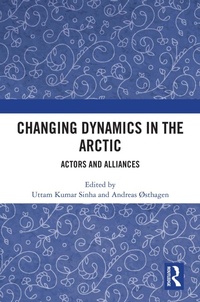
Changing Dynamics in the Arctic
Actors and Alliances
Will be published approx. on 29. June 2026
198 pages
978-1-040-96142-1 (ISBN)
Description

This book addresses four key questions about contemporary Arctic geopolitics: How do Arctic states view security from a geopolitical perspective? What conditions could re-stabilize Arctic cooperation? What forces have shaped current Arctic dynamics? And what choices could foster future collaboration, innovation, and sustainability in the region? Geopolitical contestation resulting from Russia's invasion of Ukraine has significantly impacted cooperation between Arctic states. The suspension of the Arctic Council under Russia's chairmanship, Finland and Sweden's NATO accession, limited progress under Norway's chairship, increasing militarization in Russian and Nordic Arctic territories, expanding military exercises, and governance challenges under Denmark's new chairship represent the new realities of Arctic geopolitics. Environmental and climate threats emanating from the Arctic, once the primary concern for regional and global states, have been overshadowed by traditional hard security considerations. Consequently, the Arctic's strategic importance has grown exponentially while trust between East and West has deteriorated. Military threat perceptions between the Arctic Seven NATO members and Russia now stand at unprecedented levels. This edited volume presents diverse perspectives on how Arctic states are reassessing existing and future governance and security mechanisms in the region.
This book will appeal to scholars and students of international relations, security studies, Arctic studies, and geopolitics, as well as policymakers, diplomats, and anyone interested in contemporary Arctic governance, climate security, and great power competition in polar regions.
The chapters in this book were originally published as a special issue of Strategic Analysis.
This book will appeal to scholars and students of international relations, security studies, Arctic studies, and geopolitics, as well as policymakers, diplomats, and anyone interested in contemporary Arctic governance, climate security, and great power competition in polar regions.
The chapters in this book were originally published as a special issue of Strategic Analysis.
More details
Language
English
Place of publication
London
United Kingdom
Publishing group
Taylor & Francis Ltd
Target group
College/higher education
Product notice
Reflowable
File size
2,81 MB
ISBN-13
978-1-040-96142-1 (9781040961421)
Copyright in bibliographic data and cover images is held by Nielsen Book Services Limited or by the publishers or by their respective licensors: all rights reserved.
Schweitzer Classification
Other editions
Additional editions
Book
approx. 06/2026
1st Edition
Routledge
€191.50
Not yet published
Persons
Uttam Kumar Sinha is Senior Fellow at the Manohar Parrikar Institute for Defence Studies and Analyses, New Delhi. He specializes in water security, environmental geopolitics, and strategic studies with particular focus on South Asian regional dynamics. Dr. Sinha has authored several books and research papers on transboundary water issues, climate security, and India's strategic environment, contributing significantly to policy discourse on water diplomacy.
Andreas Osthagen is Research Director Arctic & Ocean Politics at the Fridtjof Nansen Institute (FNI), Norway, specializing in Arctic geopolitics, maritime security, and international law. His research focuses on territorial disputes, resource management, and security dynamics in polar regions. Dr. Osthagen has published extensively on Arctic governance, Svalbard politics, and maritime boundary issues, contributing to academic and policy discussions on High North security and international cooperation in the Arctic.
Andreas Osthagen is Research Director Arctic & Ocean Politics at the Fridtjof Nansen Institute (FNI), Norway, specializing in Arctic geopolitics, maritime security, and international law. His research focuses on territorial disputes, resource management, and security dynamics in polar regions. Dr. Osthagen has published extensively on Arctic governance, Svalbard politics, and maritime boundary issues, contributing to academic and policy discussions on High North security and international cooperation in the Arctic.
Content
Introduction 1. Divided Arctic in a Divided World Order 2. Hot Stakes in the Arctic: Global Rivalries and New Geopolitical Forces 3. Russia's Geopolitical Position in the Arctic: What's New? 4. Great Power Competition in the Arctic and the Role of India 5. Understanding Russia's Arctic Security Strategies 6. US-Russia Arctic Cooperation: Strategic Ebbs and Flows 7. The European Union and Arctic Security: First Steps Towards a New Paradigm? 8. Dynamics of Nordic-Asia Relations Post Finland and Sweden's Accession to NATO 9. Situating the Local Level in Arctic Politics: How Can It Engage in Arctic Governance, and How Is It Affected by Arctic Geopolitics? 10. Using the ATCM Model for Regulation of Scientific Research in Svalbard 11. Environmental Security is 'Must' vis-a-vis Military Security, Not a 'Substitution' 12. The Environmental Agenda for the Arctic: A Russian Perspective 13. Critical Raw Materials: Interests of China and the European Union in the Arctic
