

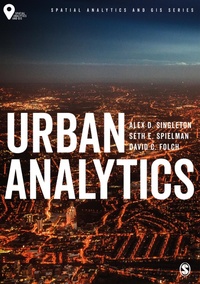
Urban Analytics
1st Edition
Published on 27. November 2017
200 pages
978-1-5264-1859-3 (ISBN)
Description

The economic and political situation of cities has shifted in recent years in light of rapid growth amidst infrastructure decline, the suburbanization of poverty and inner city revitalization. At the same time, the way that data are used to understand urban systems has changed dramatically.
Urban Analytics offers a field-defining look at the challenges and opportunities of using new and emerging data to study contemporary and future cities through methods including GIS, Remote Sensing, Big Data and Geodemographics.
Written in an accessible style and packed with illustrations and interviews from key urban analysts, this is a groundbreaking new textbook for students of urban planning, urban design, geography, and the information sciences.
Urban Analytics offers a field-defining look at the challenges and opportunities of using new and emerging data to study contemporary and future cities through methods including GIS, Remote Sensing, Big Data and Geodemographics.
Written in an accessible style and packed with illustrations and interviews from key urban analysts, this is a groundbreaking new textbook for students of urban planning, urban design, geography, and the information sciences.
Reviews / Votes
This is a comprehensive and timely consolidation of current thinking about urban analytics. The book is fizzing with new ideas, and brimming with practical examples of the science of doing. Compulsive student reading. -- Paul Longley Urban analytics is fast emerging as the core set of tools employed to deal with problems of big data, urban simulation, and demographics. This book is essential reading to all those involved in this newly emergent field, providing a new arsenal of analytic tools to make sense of how cities are being restructured. -- Michael Batty Urban Analytics neatly interweaves an introduction to this emerging field, with an accessible discussion of enduring themes and new approaches in quantitative geography. An engaging text that will appeal to students in a range of disciplines. -- David O'Sullivan This excellent starter text captures the excitement and enthusiasm of a new kind of urban research: one that exploits the vast new data resources that are becoming available, from social media, crowdsourcing, and sensor networks; and makes use of the unprecedented power of today's computer technology. It fills an important gap, and will be an essential text for students in a wide range of disciplines, from civil, infrastructure, and transportation engineering to geography, planning, and urban studies. -- Michael Goodchild Urban analytics has come of age! This textbook by three leading scholars in data-driven and computational urban science is needed and welcome. It is a fantastic resource for educating the next generation of urban scholars. -- Harvey J. Miller Urban Analytics is a great introductory text for getting familiar with logics and perspectives characterising the analysis, interpretation and representation of urban data. It is a highly valuable work for urban scholars who are familiar with qualitative approaches, but would like to gain a deeper understanding of the ways data and computational techniques allow us to understand and gain meaningful knowledge of cities and urban phenomena. -- Alberto Vanolo Urban analytics is integral to city infrastructure, and it is hugely important that people understand the implication and uses of City data. This book accessibly explains the underlying concepts of urban analytics for students and interested professionals. I believe this book will be very helpful, and will recommend it for my students and (business) partners in city data projects. -- Nanda PiersmaMore details
Series
Edition
First Edition
Language
English
Place of publication
London
United Kingdom
Target group
College/higher education
Product notice
Reflowable
File size
10,53 MB
ISBN-13
978-1-5264-1859-3 (9781526418593)
Copyright in bibliographic data and cover images is held by Nielsen Book Services Limited or by the publishers or by their respective licensors: all rights reserved.
Schweitzer Classification
Other editions
Additional editions
Alex David Singleton | Seth Spielman | David Folch
Urban Analytics
Book
12/2017
1st Edition
SAGE Publications Ltd
€205.36
Shipment within 15-20 days
Alex David Singleton | Seth Spielman | David Folch
Urban Analytics
Book
12/2017
1st Edition
SAGE Publications Ltd
€101.50
Shipment within 15-20 days
Persons
Alex Singleton is Professor of Geographic Information Science at the University of Liverpool, where he entered as a lecturer in 2010. He holds a BSc (Hons) Geography from the University of Manchester and a PhD from University College London. To date, his research income totals around GBP15m, with two career highlights including the ESRC funded Consumer Data Research Centre; and the recently awarded ESRC Centre for Doctoral Training in New Forms of Data. Alex's research is embedded within the Geographic Data Science Lab (geographicdatascience.com) and concerns various aspects of urban analytics. In particular, his work has extended a tradition of area classification within Geography where he has developed an empirically informed critique of the ways in which geodemographic methods can be refined for effective yet ethical use in public resource allocation applications.
Seth Spielman is an Associate Professor of Geography at the University of Colorado. His expertise is in the intersection of maps, statistics, and machine learning. He has received the Breheny Prize for work in Urban Analytics, a distinguished scholar award in Planning from the American Association of Geographers, and was profiled in the journal Science as an archetype of a new generation of data-centric geographers. His publications have appeared in a diverse set of journals including PNAS, PlosOne, Demography, Annals of the Association of American Geographers, and the International Journal of GIS. Outside of academia his professional experience has ranged from the hyper digital world of Data Science and Software Engineering in Silicon Valley to the insanely analog practice of being the sole proprietor of an antiquarian bookshop in Manhattan.
David Folch is an Assistant Professor in the Department of Geography at Florida State University. His research focuses on spatial analytical methods, with a contextual interest in US cities and neighborhoods. His approach to research sits at the intersection of geography, economics and computer science, which in practice means merging geographic and economic theories with high-performance computing and large datasets to address research questions with distinctly spatial manifestations. His work has involved developing improved measures for residential segregation and the creation of spatial approaches for reducing uncertainty in American Community Survey estimates. He holds degrees in geography and economics.
Seth Spielman is an Associate Professor of Geography at the University of Colorado. His expertise is in the intersection of maps, statistics, and machine learning. He has received the Breheny Prize for work in Urban Analytics, a distinguished scholar award in Planning from the American Association of Geographers, and was profiled in the journal Science as an archetype of a new generation of data-centric geographers. His publications have appeared in a diverse set of journals including PNAS, PlosOne, Demography, Annals of the Association of American Geographers, and the International Journal of GIS. Outside of academia his professional experience has ranged from the hyper digital world of Data Science and Software Engineering in Silicon Valley to the insanely analog practice of being the sole proprietor of an antiquarian bookshop in Manhattan.
David Folch is an Assistant Professor in the Department of Geography at Florida State University. His research focuses on spatial analytical methods, with a contextual interest in US cities and neighborhoods. His approach to research sits at the intersection of geography, economics and computer science, which in practice means merging geographic and economic theories with high-performance computing and large datasets to address research questions with distinctly spatial manifestations. His work has involved developing improved measures for residential segregation and the creation of spatial approaches for reducing uncertainty in American Community Survey estimates. He holds degrees in geography and economics.
Content
Questioning the City through Urban Analytics
Sensing the City
Urban Data Infrastructure
Visualizing the City
Differences within Cities
Explaining the City
Generative Urban Systems
Cities as Networks and Flows
The Future of Urban Analytics
Sensing the City
Urban Data Infrastructure
Visualizing the City
Differences within Cities
Explaining the City
Generative Urban Systems
Cities as Networks and Flows
The Future of Urban Analytics
