

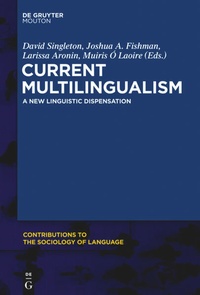
Current Multilingualism
Description

This volume approaches contemporary multilingualism as a new linguistic dispensation, in urgent need of research-led, reflective scrutiny. The book addresses the emergent global and local patterns of multingual use and acquisition across the world and explores the major trends that characterize today's multilingualism. It is divided into three parts on the basis of the broad themes: education (including multilingual learning in its general, theoretical aspects), sociolinguistic dimensions and language policy. The book's fifteen chapters, written by renowned international experts, discuss a range of issues relating to the quintessential and unique properties of multilingual situations - issues relevant to the challenges faced in different ways by researcher and practitioners alike. All the contributions share a focus on currently operative patterns of interaction between contexts, events and processes.
More details
Other editions
Additional editions
Complete work / Part of the work
Persons
Content
2 - Current multilingualism: A new linguistic dispensation [Seite 9]
3 - I Language teaching and language learning [Seite 31]
3.1 - 1 Global English: Central or Atypical Form of SLA? [Seite 33]
3.2 - 2 Faraway, so close: Trilingualism in the Basque Autonomous Community and Malta from a socio-educational perspective [Seite 51]
3.3 - 3 Issues in all-Irish education: Strengthening the case for comparative immersion [Seite 75]
3.4 - 4 Informal bilingual acquisition: Dynamic spaces for language education [Seite 105]
4 - II Social aspects of current multilingualism [Seite 125]
4.1 - 5 Minority language use in Ireland: The time dimension [Seite 127]
4.2 - 6 Mapping increasing linguistic diversity in multicultural Europe and abroad [Seite 145]
4.3 - 7 Multilingual attitudes and attitudes to multilingualism in Croatia [Seite 169]
4.4 - 8 Emerging and conflicting forces of polyphony in the Berlin speech community after the fall of the wall: On the social identity of adolescents [Seite 193]
4.5 - 9 Multilingualism in Morocco and the linguistic features of the Casablanca variety [Seite 237]
4.6 - 10 Multilingualism in Sweden [Seite 253]
5 - III Language Policy [Seite 277]
5.1 - 11 Language planning for a decimated and often forgotten non-territorial tongue [Seite 279]
5.2 - 12 Endangered languages and endangered archives in the Russian Federation [Seite 285]
5.3 - 13 Linguistic quandary in multilingual Malaysia: Socio-political issues, language policy, educational changes [Seite 303]
5.4 - 14 Managing language diversity in the Irish health services [Seite 323]
5.5 - 15 Slipping between policy and management: (De)centralized responses to linguistic diversity in Ethiopia and South Africa [Seite 345]
6 - Index [Seite 379]
