

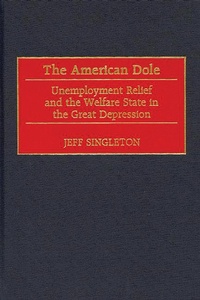
The American Dole
Unemployment Relief and the Welfare State in the Great Depression
1st Edition
Published on 30. September 2000
256 pages
978-0-313-00053-9 (ISBN)
Description

As Jeff Singleton shows, the rapid expansion of unemployment relief in the early 1930s generated pressures which led to the first federal welfare programs. However the process has received relatively little attention from historians, and unemployment relief does not play a major role in discussions of the current state of welfare.
Singleton seeks not only to fill this gap, but to challenge popular interpretations of relief policy in the early 1930s. He shows that relief was expanding prior to the depression and that the modern aspects of social policy implemented in the 1920s profoundly influenced the response of the welfare system to the early stages of the economic crisis. Relief under President Herbert Hoover was neither primarily voluntarist nor traditional. The first full-fledged federal welfare program was implemented under the Hoover administration by the Reconstruction Finance Corporation. The initial goals of the New Deal's Federal Emergency Relief Administration were to reduce the national relief caseload and the federal welfare role, while improving standards for those on the dole. The institutionalization of state-level welfare was a consequence of the failure of the 1935 reform program (the WPA and the Social Security Act) to eliminate the dole, not a product of conscious liberal policy. Singleton concludes by evaluating the 1996 Personal Responsibility Act in the context of these conclusions. If the dole was not a product of liberal reform, but, instead, arose to fill a policy vacuum, then it will be difficult to eliminate by legislative fiat unless states and the federal government are willing to finance relatively costly alternatives. A provocative analysis of interest to historians and social scientists concerned with American social and labor policy.
Singleton seeks not only to fill this gap, but to challenge popular interpretations of relief policy in the early 1930s. He shows that relief was expanding prior to the depression and that the modern aspects of social policy implemented in the 1920s profoundly influenced the response of the welfare system to the early stages of the economic crisis. Relief under President Herbert Hoover was neither primarily voluntarist nor traditional. The first full-fledged federal welfare program was implemented under the Hoover administration by the Reconstruction Finance Corporation. The initial goals of the New Deal's Federal Emergency Relief Administration were to reduce the national relief caseload and the federal welfare role, while improving standards for those on the dole. The institutionalization of state-level welfare was a consequence of the failure of the 1935 reform program (the WPA and the Social Security Act) to eliminate the dole, not a product of conscious liberal policy. Singleton concludes by evaluating the 1996 Personal Responsibility Act in the context of these conclusions. If the dole was not a product of liberal reform, but, instead, arose to fill a policy vacuum, then it will be difficult to eliminate by legislative fiat unless states and the federal government are willing to finance relatively costly alternatives. A provocative analysis of interest to historians and social scientists concerned with American social and labor policy.
More details
Series
Edition
1. Auflage
Language
English
Place of publication
New York
United States
Publishing group
Bloomsbury Publishing Plc
ISBN-13
978-0-313-00053-9 (9780313000539)
Copyright in bibliographic data and cover images is held by Nielsen Book Services Limited or by the publishers or by their respective licensors: all rights reserved.
Schweitzer Classification
Other editions
Additional editions
Book
09/2000
Praeger Publishers Inc
€98.50
Shipment within 15-20 days
Person
JEFF SINGLETON has taught American history at a number of universities and community colleges. He also has done research for and been active in community organizations, advocacy groups, and human services organizations. He presently is teaching at Boston College.
Content
Preface
Unemployment Relief and the Welfare State
The "Rising Tide of Relief"
The Myth of Voluntarism
The National Dole
Work Relief
Ending the Dole as We Knew It
Conclusion
Appendix
Bibliography
Unemployment Relief and the Welfare State
The "Rising Tide of Relief"
The Myth of Voluntarism
The National Dole
Work Relief
Ending the Dole as We Knew It
Conclusion
Appendix
Bibliography
