

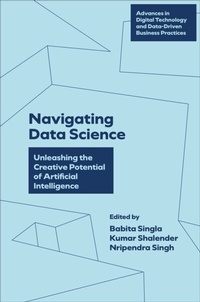
Navigating Data Science
Unleashing the Creative Potential of Artificial Intelligence
1st Edition
Published on 14. April 2025
168 pages
978-1-83608-300-9 (ISBN)
Description

The rapid rise of generative intelligence is apparent from its adoption prospects across industrial sectors. Business leaders are prioritizing applications of Generative Intelligence although the challenges related to this technology adoption also need to be addressed in detail. Navigating Data Science: Unleashing the Creative Potential of Artificial Intelligence can offer significant contributions in the field of generative intelligence in the context of data science and help stakeholders formulate strategies to tackle its adoption, implementation, and control challenges.
The research presented here delves into the combined capability of DS and AI with specific reference to real-world business scenarios. From analysing the use of New Age innovations in marketing to science and Technology and the Healthcare sector, the authors contributed to enhance the body of knowledge in the field of DS and AI. The ethical considerations of using AI tools in education, academic research, and Gig workers have also been dealt with in detail in the book. The impact of technology in moulding the overall well-being of employees within the specific framework of their work-life has been discussed by the authors as a key issue to be considered by organizations today.
Advances in Digital Technology and Data-Driven Business Practices examines the possibilities, challenges and ethics of a range of technologies applied in business, including: Metaverse, Marketing Automation, Search Engine Optimization (SEO), Search Engine Marketing (SEM), Social Media Marketing, Content Marketing, Analytics and Data Analysis, Augmented Reality (AR) and Virtual Reality (VR), Chatbots and Artificial Intelligence (AI). Adopting and adapting to these technologies is essential for staying competitive and effectively reaching target audiences.
The research presented here delves into the combined capability of DS and AI with specific reference to real-world business scenarios. From analysing the use of New Age innovations in marketing to science and Technology and the Healthcare sector, the authors contributed to enhance the body of knowledge in the field of DS and AI. The ethical considerations of using AI tools in education, academic research, and Gig workers have also been dealt with in detail in the book. The impact of technology in moulding the overall well-being of employees within the specific framework of their work-life has been discussed by the authors as a key issue to be considered by organizations today.
Advances in Digital Technology and Data-Driven Business Practices examines the possibilities, challenges and ethics of a range of technologies applied in business, including: Metaverse, Marketing Automation, Search Engine Optimization (SEO), Search Engine Marketing (SEM), Social Media Marketing, Content Marketing, Analytics and Data Analysis, Augmented Reality (AR) and Virtual Reality (VR), Chatbots and Artificial Intelligence (AI). Adopting and adapting to these technologies is essential for staying competitive and effectively reaching target audiences.
More details
Series
Language
English
Place of publication
Bingley
United Kingdom
Target group
Professional and scholarly
ISBN-13
978-1-83608-300-9 (9781836083009)
Copyright in bibliographic data and cover images is held by Nielsen Book Services Limited or by the publishers or by their respective licensors: all rights reserved.
Schweitzer Classification
Other editions
Additional editions
Babita Singla | Kumar Shalender | Nripendra Singh
Navigating Data Science
Unleashing the Creative Potential of Artificial Intelligence
Book
04/2025
Emerald Publishing Limited
€106.50
Shipment within 3-4 weeks
Persons
Babita Singla is a professor at Chitkara Business School, Chitkara University, Punjab, India.
Kumar Shalender is a post-doctorate in the field of Strategic and Technology Management and has 14 years of experience in Business Model Development.
Nripendra Singh is a tenured Full Professor of Marketing in the Department of Business, Economics & Communication, College of Science, Technology, and Business at the Pennsylvania Western University.
Kumar Shalender is a post-doctorate in the field of Strategic and Technology Management and has 14 years of experience in Business Model Development.
Nripendra Singh is a tenured Full Professor of Marketing in the Department of Business, Economics & Communication, College of Science, Technology, and Business at the Pennsylvania Western University.
Content
Chapter 1. Data Science and Artificial Intelligence: Exploring Collaborative Potential for Healthcare Sector; Kumar Shalender, Babita Singla, and Nripendra Singh
Chapter 2. The Next Wave in Marketing: Data Science in the Age of Generative AI; M. Kalaivani, Suganya V, N.V. Suresh, and S. Catherine
Chapter 3. Analysing Indian Science and Technology Indicators Using Data Science: A Global Perspective; Anant Bhatt, Rubani Singla, Shilpa Gite, Shruti Patil, and Ketan Kotecha
Chapter 4. Unveiling the Enigma of Shadow: Ethical Difficulties in the Field of AI; S. Catherine, N.V. Suresh, T. Mangaiyarkarasi, and Leena Jenefa
Chapter 5. Influence of Ethical AI Practices on Gig Workers' Trust and Psychological Well-being; K. Shanthi and Suganya V
Chapter 6 Decoding the ethical concerns in AI based decisions using Big Data; Anvesha Jain, Shrishti Singh, and Ruchi Jain
Chapter 7. From Ideation to Publication: Ethical Practices for Using Generative AI in Academic Research; Jaswinder Pal Singh, Neha Mishra, and Babita Singla
Chapter 8. Future Trends and Emerging Possibilities in AI; Simarjit Kaur, Shveta Bansal, and Aashima Sharma
Chapter 2. The Next Wave in Marketing: Data Science in the Age of Generative AI; M. Kalaivani, Suganya V, N.V. Suresh, and S. Catherine
Chapter 3. Analysing Indian Science and Technology Indicators Using Data Science: A Global Perspective; Anant Bhatt, Rubani Singla, Shilpa Gite, Shruti Patil, and Ketan Kotecha
Chapter 4. Unveiling the Enigma of Shadow: Ethical Difficulties in the Field of AI; S. Catherine, N.V. Suresh, T. Mangaiyarkarasi, and Leena Jenefa
Chapter 5. Influence of Ethical AI Practices on Gig Workers' Trust and Psychological Well-being; K. Shanthi and Suganya V
Chapter 6 Decoding the ethical concerns in AI based decisions using Big Data; Anvesha Jain, Shrishti Singh, and Ruchi Jain
Chapter 7. From Ideation to Publication: Ethical Practices for Using Generative AI in Academic Research; Jaswinder Pal Singh, Neha Mishra, and Babita Singla
Chapter 8. Future Trends and Emerging Possibilities in AI; Simarjit Kaur, Shveta Bansal, and Aashima Sharma
