

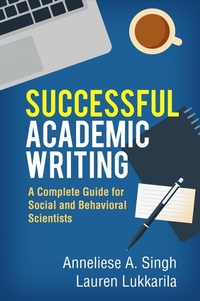
Successful Academic Writing
A Complete Guide for Social and Behavioral Scientists
Published on 9. May 2017
260 pages
978-1-4625-2942-1 (ISBN)
Description

Graduate students, instructors, and newly minted PhDs in psychology, education, counseling, sociology, social work, management, marketing, nursing, public health, communication, and other social and behavioral science disciplines. Serves as a text in courses on research methods/design, graduate writing, or the thesis/dissertation.
More details
Other editions
Additional editions
Anneliese A. Singh | Lauren Lukkarila
Successful Academic Writing
A Complete Guide for Social and Behavioral Scientists
Book
06/2017
1st Edition
Guilford Press
€45.00
Shipment within 15-20 days
Persons
Anneliese A. Singh, PhD, LPC, is an award-winning social justice scholar, author, speaker, and community organizer who speaks on a wide variety of racial healing; racial justice; diversity, equity and inclusion; and LGBTQ+ topics. She is the inaugural Chief Diversity Officer at Tulane University, where she is Professor in the School of Social Work and has a joint appointment in the Department of Psychology. Dr. Singh has taught widely on qualitative research methods and academic writing in the behavioral and social sciences. Her research, practice, advocacy, and more than 100 publications explore the resilience and liberation experiences of trans people, people of color, survivors of trauma, and South Asian immigrants, as well as social justice and empowerment training. Dr. Singh founded the Georgia Safe Schools Coalition and the Trans Resilience Project to translate her LGBTQ+ research findings into school and community-based change efforts. She has given TEDx talks on gender liberation and is a frequent workshop presenter. Dr. Singh's pronouns are she/her/hers and they/them/theirs.
Lauren Lukkarila, PhD, is Assistant Director of the Georgia Tech Language Institute, where she is also a lecturer and coordinates the curriculum of the Intensive English program, as well as many of the other academic-, professional-, and general-skills short programs. Dr. Lukkarila's research foci include feminist approaches to English as a second language (ESL) pedagogy, critical pedagogy in ESL, academic reading-writing connections, identity and academic writing, critical thinking pedagogy, and academic writing pedagogy. She has been teaching pre- and postmatriculated ESL writers how to succeed at U.S. university academic writing for over a decade. She is a frequent guest lecturer on graduate academic writing and has been honored for her curriculum innovation with international students.
Content
I. Becoming an Academic Writer
1. What Is Academic Writing?
2. Preparing for Writing Success in Your Discipline
3. Developing Your Own Writing Identity
II. Developing Academic Writing Skills
4. Understanding Academic Writer-Reader Roles and Writing Structures
5. The Use of Tone and Style in Your Academic Writing
6. Coaching Yourself to Completion
III. Specific Types of Academic Writing
7. Grounding Your Voice in the Literature
8. The Writing Formula for Empirical Academic Writing
9. Publish, Don't Perish
Appendix. Answer Key
References
Index
About the Authors
