

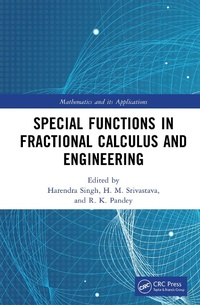
Special Functions in Fractional Calculus and Engineering
1st Edition
Published on 29. June 2023
314 pages
978-1-000-89975-7 (ISBN)
Description

Special functions play a very important role in solving various families of ordinary and partial differential equations as well as their fractional-order analogs, which model real-life situations. Owing to the non-local nature and memory effect, fractional calculus is capable of modeling many situations which arise in engineering. This book includes a collection of related topics associated with such equations and their relevance and significance in engineering.
Special Functions in Fractional Calculus and Engineering highlights the significance and applicability of special functions in solving fractional-order differential equations with engineering applications. This book focuses on the non-local nature and memory effect of fractional calculus in modeling relevant to engineering science and covers a variety of important and useful methods using special functions for solving various types of fractional-order models relevant to engineering science. This book goes on to illustrate the applicability and usefulness of special functions by justifying their numerous and widespread occurrences in the solution of fractional-order differential, integral, and integrodifferential equations.
This book holds a wide variety of interconnected fundamental and advanced topics with interdisciplinary applications that combine applied mathematics and engineering sciences, which are useful to graduate students, Ph.D. scholars, researchers, and educators interested in special functions, fractional calculus, mathematical modeling, and engineering.
Special Functions in Fractional Calculus and Engineering highlights the significance and applicability of special functions in solving fractional-order differential equations with engineering applications. This book focuses on the non-local nature and memory effect of fractional calculus in modeling relevant to engineering science and covers a variety of important and useful methods using special functions for solving various types of fractional-order models relevant to engineering science. This book goes on to illustrate the applicability and usefulness of special functions by justifying their numerous and widespread occurrences in the solution of fractional-order differential, integral, and integrodifferential equations.
This book holds a wide variety of interconnected fundamental and advanced topics with interdisciplinary applications that combine applied mathematics and engineering sciences, which are useful to graduate students, Ph.D. scholars, researchers, and educators interested in special functions, fractional calculus, mathematical modeling, and engineering.
More details
Series
Edition
1. Auflage
Language
English
Place of publication
London
United Kingdom
Publishing group
Taylor & Francis Ltd
Target group
College/higher education
Professional and scholarly
Illustrations
14 Tables, black and white; 66 Line drawings, black and white; 14 Halftones, black and white; 80 Illustrations, black and white
ISBN-13
978-1-000-89975-7 (9781000899757)
Copyright in bibliographic data and cover images is held by Nielsen Book Services Limited or by the publishers or by their respective licensors: all rights reserved.
Schweitzer Classification
Other editions
Additional editions
Harendra Singh | H. M. Srivastava | R. K. Pandey
Special Functions in Fractional Calculus and Engineering
Book
11/2024
1st Edition
CRC Press
€71.90
Shipment within 10-20 days
Harendra Singh | H. M. Srivastava | R. K. Pandey
Special Functions in Fractional Calculus and Engineering
Book
06/2023
1st Edition
CRC Press
€208.20
Shipment within 10-20 days
Persons
Dr. Harendra Singh is an Assistant Professor at the Department of Mathematics, Post-Graduate College, Ghazipur-233001, Uttar Pradesh, India, and has been listed in the top 2% scientists list published by Stanford University. He primarily teaches subjects such as real and complex analysis, functional analysis, abstract algebra, and measure theory in post-graduate level courses in mathematics. Dr. Singh has published 50 research papers in various journals of repute and has published three books from Taylor and Francis, one with Springer and one with Elsevier. He has attained a number of national and international conferences and presented several research papers. He is a reviewer of various journals, and his areas of interest are mathematical modeling, Fractional differential equations, integral equations, calculus of variations, and analytical and numerical methods.
Dr. H. M. Srivastava is a Professor Emeritus, Department of Mathematics and Statistics, University of Victoria, British Columbia V8W 3R4, Canada. He earned his Ph.D. degree in 1965 while he was a full-time member of the teaching faculty at the Jai Narain Vyas University of Jodhpur in India (since 1963). Professor Srivastava has held (and continues to hold) numerous Visiting, Honorary and Chair Professorships at many universities and research institutes in different parts of the world. Having received several D.Sc. degrees as well as honorary memberships and fellowships of many scientific academies and scientific societies around the world, he is also actively associated editorially with numerous international scientific research journals as an Honorary or Advisory Editor or as an Editorial Board Member. He has also edited many special issues of scientific research journals as the Lead or Joint Guest Editor. He has published 36 books, monographs, and edited volumes, 36 books (and encyclopedia) chapters, 48 papers in international conference proceedings, and more than 1350 peer-reviewed international scientific research journal articles, as well as Forewords and Prefaces to many books and journals. Dr. Srivastava's research interests include several areas of pure and applied mathematical sciences, such as real and complex analysis, fractional calculus and its applications, integral equations and transforms, higher transcendental functions and their applications, q-series and q-polynomials, analytic number theory, analytic and geometric inequalities, probability and statistics, and inventory modeling and optimization.
Dr. Rajesh Pandey is an Associate Professor in the Department of Mathematical Sciences, at the Indian Institute of Technology (BHU), Varanasi, India. He is the recipient of the Indo-US fellowship and INSA Visiting Fellowship for the year 2012. He had been a visiting faculty member at the Southern Illinois University, Carbondale Illinois, IL, during 2012-13, The University of Tokyo, Japan from Nov-Dec, 2010, Central South University China, and Shanghai University Shanghai, China in Dec. 2020. He has also worked as an Assistant Professor in Mathematics at BITS Pilani and the Indian Institute of Information Technology Design and Manufacturing Jabalpur from July 2009-May 2014. Dr. Pandey received his Ph.D. degree from the Department of Applied Mathematics, Institute of Technology (BHU), Varanasi, India in 2009 and has published 60 research papers in refereed journals and guided 8 Ph.D. students. He has been a member of management committees for academic institutions and also a member of the advisory committees in various national and international conferences. His current areas of research include fractional derivatives, image processing, and numerical methods for integral and integrodifferential equations.
Dr. H. M. Srivastava is a Professor Emeritus, Department of Mathematics and Statistics, University of Victoria, British Columbia V8W 3R4, Canada. He earned his Ph.D. degree in 1965 while he was a full-time member of the teaching faculty at the Jai Narain Vyas University of Jodhpur in India (since 1963). Professor Srivastava has held (and continues to hold) numerous Visiting, Honorary and Chair Professorships at many universities and research institutes in different parts of the world. Having received several D.Sc. degrees as well as honorary memberships and fellowships of many scientific academies and scientific societies around the world, he is also actively associated editorially with numerous international scientific research journals as an Honorary or Advisory Editor or as an Editorial Board Member. He has also edited many special issues of scientific research journals as the Lead or Joint Guest Editor. He has published 36 books, monographs, and edited volumes, 36 books (and encyclopedia) chapters, 48 papers in international conference proceedings, and more than 1350 peer-reviewed international scientific research journal articles, as well as Forewords and Prefaces to many books and journals. Dr. Srivastava's research interests include several areas of pure and applied mathematical sciences, such as real and complex analysis, fractional calculus and its applications, integral equations and transforms, higher transcendental functions and their applications, q-series and q-polynomials, analytic number theory, analytic and geometric inequalities, probability and statistics, and inventory modeling and optimization.
Dr. Rajesh Pandey is an Associate Professor in the Department of Mathematical Sciences, at the Indian Institute of Technology (BHU), Varanasi, India. He is the recipient of the Indo-US fellowship and INSA Visiting Fellowship for the year 2012. He had been a visiting faculty member at the Southern Illinois University, Carbondale Illinois, IL, during 2012-13, The University of Tokyo, Japan from Nov-Dec, 2010, Central South University China, and Shanghai University Shanghai, China in Dec. 2020. He has also worked as an Assistant Professor in Mathematics at BITS Pilani and the Indian Institute of Information Technology Design and Manufacturing Jabalpur from July 2009-May 2014. Dr. Pandey received his Ph.D. degree from the Department of Applied Mathematics, Institute of Technology (BHU), Varanasi, India in 2009 and has published 60 research papers in refereed journals and guided 8 Ph.D. students. He has been a member of management committees for academic institutions and also a member of the advisory committees in various national and international conferences. His current areas of research include fractional derivatives, image processing, and numerical methods for integral and integrodifferential equations.
Content
Chapter 1. An Introductory Overview of Special Functions and Their Associated Operators of Fractional Calculus
H. M. Srivastava
Chapter 2. Analytical Solutions for Fluid Model Described by Fractional Derivative Operators Using Special Functions in Fractional Calculus
Ndolane Sene
Chapter 3. Special Functions and Exact Solutions for Fractional Diffusion Equations with Reaction Terms
E. K. Lenzi and M. K. Lenzi
Chapter 4. Computable Solution of Fractional Kinetic Equations Associated with Incomplete ?-Functions and M-Series
Nidhi Jolly and Manish Kumar Bansal
Chapter 5. Legendre Collocation Method for Generalized Fractional Advection Diffusion Equation.
Sandeep Kumar, R. K. Pandey, Shiva Sharma, Harendra Singh
Chapter 6. The Incomplete Generalized Mittag-Le?er Function and Fractional Calculus Operators
Rakesh K. Parmar and Purnima Chopra
Chapter 7. Numerical Solution of Fractional Order Diffusion Equation Using Fibonacci Neural Network
Kushal Dhar Dwivedi
Chapter 8. Analysis of a Class of Reaction-Diffusion Equation Using Spectral Scheme
Prashant Pandey and Priya Kumari
Chapter 9. New Fractional Calculus Results for the Families of Extended Hurwitz-Lerch Zeta Function
Rakesh K. Parmar, Arjun K. Rathie and S. D. Purohit
Chapter 10. Compact Di?erence Schemes for Solving the Equation of Oscillator Motion with Viscoelastic Damping
A. M. Elsayed and T. S. Aleroev
Chapter 11. Dynamics of the Dadras-Momeni System in the Frame of the Caputo-Fabrizio Fractional Derivative
Chandrali Baishya and P. Veeresha
Chapter 12. A Fractional Order Model with Non-Singular Mittag-Leffler Kernel
Ali Akguel
H. M. Srivastava
Chapter 2. Analytical Solutions for Fluid Model Described by Fractional Derivative Operators Using Special Functions in Fractional Calculus
Ndolane Sene
Chapter 3. Special Functions and Exact Solutions for Fractional Diffusion Equations with Reaction Terms
E. K. Lenzi and M. K. Lenzi
Chapter 4. Computable Solution of Fractional Kinetic Equations Associated with Incomplete ?-Functions and M-Series
Nidhi Jolly and Manish Kumar Bansal
Chapter 5. Legendre Collocation Method for Generalized Fractional Advection Diffusion Equation.
Sandeep Kumar, R. K. Pandey, Shiva Sharma, Harendra Singh
Chapter 6. The Incomplete Generalized Mittag-Le?er Function and Fractional Calculus Operators
Rakesh K. Parmar and Purnima Chopra
Chapter 7. Numerical Solution of Fractional Order Diffusion Equation Using Fibonacci Neural Network
Kushal Dhar Dwivedi
Chapter 8. Analysis of a Class of Reaction-Diffusion Equation Using Spectral Scheme
Prashant Pandey and Priya Kumari
Chapter 9. New Fractional Calculus Results for the Families of Extended Hurwitz-Lerch Zeta Function
Rakesh K. Parmar, Arjun K. Rathie and S. D. Purohit
Chapter 10. Compact Di?erence Schemes for Solving the Equation of Oscillator Motion with Viscoelastic Damping
A. M. Elsayed and T. S. Aleroev
Chapter 11. Dynamics of the Dadras-Momeni System in the Frame of the Caputo-Fabrizio Fractional Derivative
Chandrali Baishya and P. Veeresha
Chapter 12. A Fractional Order Model with Non-Singular Mittag-Leffler Kernel
Ali Akguel
