

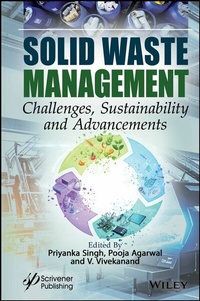
Solid Waste Management
Description

Tackle the global challenge of environmental sustainability with this essential book, which provides a critical review of innovative and sustainable solid waste management strategies by leveraging advanced technologies like AI and geographic information system-based predictive models.
Solid waste products are continuously generated due to rapid industrialization activities and population growth. These solid waste products severely affect the environment and societal health. An efficient management system for solid waste products requires appropriate transportation, infrastructure, and disposal facilities. Recently, conventional disposal techniques have encountered many challenges, including inadequate landfill disposal, management of hazardous solid waste, and operational inefficiencies. Advanced technologies based on predictive models of artificial intelligence and geographic information systems (GIS) are being used to address these concerns. Remote sensing GIS systems efficiently predict the nature and trends of waste generation areas using data captured by aerial photography, videography, and integrated sensors. Artificial intelligence-based methodologies are computationally designed to mimic the human mind and are successfully employed for the development of strategies for the generation, segregation, storage, and treatment of solid waste. This book explores recent trends, innovations, and recycling methods for a sustainable approach to managing solid waste products and provides a critical review of various approaches, process engineering economics, and sustainable valorization techniques for biological waste products, making it an invaluable resource for beginners and seasoned practitioners.
More details
Other editions
Additional editions
Persons
Priyanka Singh, PhD is an Associate Professor at the Institute of Allied Medical Science and Technology at the National Institute of Medical Sciences University. She has published 31 research articles in peer-reviewed journals and ten book chapters in international book publications, and filed patent with the Government of India. She is actively engaged in research related to nanotechnology, bioprocess technology, and enzyme engineering.
Pooja Agarwal, PhD is a Professor in the Department of Chemistry in the School of Basic and Applied Sciences at Galgotias University with more than 13 years of teaching experience. She has more than 18 research publications in reputed journals and book chapters and one edited book to her credit. Her research focuses on material science, biomaterials, nanomaterials, and composite materials.
V. Vivekanand, PhD is an Assistant Professor and the Head of the Centre for Energy and Environment at the Malaviya National Institute of Technology. He has published more than 90 international research articles in journals of high repute and more than 30 articles in international conferences, and authored more than seven book chapters. He has a keen research interest in biomass pretreatment, bioprocessing, and its conversion for bioenergy applications.
Content
1
Towards a Circular Future: Sustainable Management of Solid Waste Products
Deep Gupta1* and Sudhir Kumar Gaur2
1School of Smart Agriculture Science, COER University Roorkee, Vardhaman Puram, Roorkee, Uttarakhand, India
2School of Business Studies, COER University Roorkee, Vardhaman Puram, Roorkee, Uttarakhand, India
Abstract
Solid waste management has an impact on the environment, society, and the economy, making it a critical global concern. The notion of sustainable solid waste management is introduced in this chapter, emphasizing the necessity for allencompassing plans to deal with the rising amounts of trash produced globally. It lays the groundwork for realizing how crucial it is to implement sustainable practices in order to reduce solid waste's negative environmental effects. Effective systems for the collection and transportation of waste take front stage, highlighting environmentally friendly practices including source segregation and community involvement. This content also touches on resource recovery and waste minimization, including case studies of effective waste reduction and recycling initiatives. Examined are cutting-edge resource recovery technologies that support the ideas of a circular economy, such as composting and waste-to-energy procedures.
The importance of public awareness campaigns, community involvement, and legislative initiatives in promoting sustainable waste management practices is acknowledged in the chapter's conclusion. For legislators, companies, and communities attempting to align waste management procedures with more general sustainability goals, it offers a succinct yet thorough reference. The urgent need for practical solutions to the growing problems associated with trash generation is examined in this chapter on the sustainable management of solid waste products. It navigates the present trash production trends, highlighting the variety of items thrown worldwide and the need for customized treatment strategies. The chapter explores several forms of solid waste, emphasizing the special difficulties that come with trash from cities, businesses, electronics, and construction projects.
Keywords: Solid waste, biological waste, medical waste, sustainable management
1.1 Introduction
The management of solid waste products is a major concern in the modern world, intertwined with public health, environmental sustainability, and socioeconomic well-being. Solid waste generation has reached previously unheard-of levels due to changing consumption habits and growing global populations, making immediate action to lessen its negative effects necessary. An overview of sustainable solid waste management is given in this chapter, along with a discussion of key concepts, challenges, and workable solutions for this pressing issue. Solid waste is a diverse range of items that are dumped from homes, businesses, industries, and organizations. It presents a multitude of challenges to societies across the globe [1]. The traditional "take, make, dispose" linear approach has resulted in the accumulation of enormous amounts of garbage, placing a burden on natural resources, contaminating ecosystems, and posing a health risk to humans. Furthermore, these issues are made worse by inadequate waste management infrastructure, especially in developing nations where informal disposal methods are common.
The circular economy, which promotes closed-loop systems where resources are reused, recycled, or repurposed, resource efficiency, and minimizing waste output, is central to the conversation on sustainable solid waste management. A comprehensive strategy including stakeholders from many sectors-from communities and consumers to government organizations and business sectors-is needed to fully embrace this paradigm shift.
The enormous volume and variety of trash produced makes managing solid waste one of the biggest difficulties. Only municipal solid trash has a diverse range of items, such as organic garbage, paper, plastics, metals, and hazardous compounds, all of which require specific treatment and disposal techniques. Thus, efficient waste categorization and segregation become essential processes for maximizing resource recovery and reducing contamination to the environment. The need of establishing sustainable waste management procedures is further highlighted by the negative environmental effects of inappropriate garbage disposal, including soil and water contamination, air pollution, and habitat damage. Landfills, which were once the most popular method of getting rid of waste, are dangerous for the environment because of things like leachate contamination and greenhouse gas emissions [2]. Because they provide advantages for the environment and the economy, alternative waste treatment methods like composting, anaerobic digestion, and waste-to-energy conversion are becoming more and more important to investigate. Furthermore, the social dimensions of solid waste management cannot be overlooked, as marginalized communities often bear the brunt of inadequate waste infrastructure and environmental degradation. Fair access to waste management services and substantial local community participation in decision-making processes are required by environmental justice principles. Fostering equitable and sustainable waste management systems also requires empowering informal trash workers, who are vital to recycling and rubbish collection in many situations.
The shift to sustainable waste management needs strong legislative frameworks, effective enforcement strategies, and financial incentives to encourage ethical trash management. For example, extended producer responsibility (EPR) programmes encourage producers to manage the end-of-life of their products, which in turn promotes eco-design and waste reduction initiatives. Likewise, market-driven tools like pay-as-you-throw plans and landfill levies can internalize the costs associated with disposing of rubbish while encouraging recycling and waste avoidance. The goal of environmental sustainability and human well-being necessitates the sustainable management of solid waste products. A coordinated effort involving technology innovation, policy reform, community participation, and behavioral change is needed to address this complicated situation. Societies may reduce the environmental effects of waste generation, preserve finite resources, and create resilient, inclusive communities for future generations by embracing the circular economy's tenets and using integrated waste management techniques.
1.1.1 Importance of Sustainable Managing Solid Waste Products
In order to address the urgent environmental, social, and economic issues that contemporary societies face, sustainable management of solid waste products is essential. For the reasons listed below, this project is extremely important.
- Environmental Conservation: Natural resources and ecosystems are seriously threatened by improper solid waste management. Landfills release pollutants and greenhouse gases into the environment, which leads to contamination of the soil and water. Recycling and composting are examples of sustainable waste management techniques that lessen pollution, ease the load on landfills, and support biodiversity preservation.
- Resource Conservation: Valuable items that can be recovered and repurposed are frequently found in solid trash. Resource efficiency is increased by using sustainable waste management techniques to collect and recycle resources like plastics, paper, and metals. By doing this, the extraction of virgin resources is decreased, energy is preserved, and the negative effects of resource extraction and processing on the environment are lessened.
- Mitigation of Climate Change: Methane, a powerful greenhouse gas that contributes to climate change, is primarily obtained from landfills. Methane emissions can be greatly decreased by removing organic waste from landfills and utilizing anaerobic digestion or composting. Furthermore, waste-to-energy technologies have the ability to utilize waste's energy potential, replacing energy sources based on fossil fuels and reducing greenhouse gas emissions.
- Public Health and Safety: Inadequate waste management techniques put communities' health at danger; especially in underdeveloped nations where burning and open dumping of waste are commonplace. Garbage disposed of inappropriately can expose people to viruses and dangerous substances that can cause respiratory disorders, waterborne infections, and other health risks. Sustainable waste management contributes to the protection of public health and guarantees a secure living environment for all through appropriate collection, treatment, and disposal of waste.
- Economic Benefits: By reducing costs, fostering innovation, and creating jobs, the transition to sustainable waste management offers economic benefits. The recycling and resource recovery sectors boost the economy and create job opportunities. Adopting circular economy concepts, such as product stewardship and extended producer responsibility, also encourages eco-design and builds a stronger, more resilient economy.
- Social Equity: By guaranteeing fair access to garbage collection and disposal services, especially in underserved communities, sustainable waste management promotes social equity. By addressing inequities in waste management infrastructure and services, community engagement in waste management programmes empowers local stakeholders, develops social cohesion, and advances environmental...
