

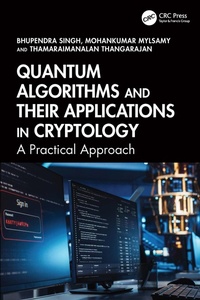
Quantum Algorithms and their Applications in Cryptology
A Practical Approach
1st Edition
Published on 16. December 2025
294 pages
978-1-040-53500-4 (ISBN)
Description

Cryptography has long been an essential tool in safeguarding digital communication and securing sensitive information. As technology has progressed, so has the complexity of the methods used to protect our data. In the wake of quantum computing's rise, traditional cryptographic systems face serious challenges, demanding a new understanding of how quantum algorithms could both undermine and enhance security.
Chapter 1 deals with the Basics of Cryptography lays the groundwork by introducing classical cryptography, tracing its evolution from ancient ciphers to modern cryptosystems.
In Chapter 2, readers are introduced to Quantum Algorithms, the principles of quantum mechanics relevant to computing, including qubits, superposition, and entanglement.
Chapter 3 focuses on Shor's algorithm, a landmark quantum algorithm that threatens the security of widely used public-key cryptosystems like RSA and ECC.
In Chapter 4, Grover's Algorithm is examined in the context of brute-force attacks on symmetric key cryptography.
Chapter 5 focuses on Simon's Algorithm and its role in breaking cryptographic primitives through structure exploitation.
In Chapter 6, a broader discussion about Cryptographic Implications of Quantum Computing is given on how quantum computing affects modern cryptographic systems.
Finally, in Chapter 7, the future of cryptography in the quantum era is discussed.
Chapter 1 deals with the Basics of Cryptography lays the groundwork by introducing classical cryptography, tracing its evolution from ancient ciphers to modern cryptosystems.
In Chapter 2, readers are introduced to Quantum Algorithms, the principles of quantum mechanics relevant to computing, including qubits, superposition, and entanglement.
Chapter 3 focuses on Shor's algorithm, a landmark quantum algorithm that threatens the security of widely used public-key cryptosystems like RSA and ECC.
In Chapter 4, Grover's Algorithm is examined in the context of brute-force attacks on symmetric key cryptography.
Chapter 5 focuses on Simon's Algorithm and its role in breaking cryptographic primitives through structure exploitation.
In Chapter 6, a broader discussion about Cryptographic Implications of Quantum Computing is given on how quantum computing affects modern cryptographic systems.
Finally, in Chapter 7, the future of cryptography in the quantum era is discussed.
More details
Edition
1. Auflage
Language
English
Place of publication
London
United Kingdom
Publishing group
Taylor & Francis Ltd
Target group
Professional and scholarly
Illustrations
20 Tables, black and white; 21 Line drawings, black and white; 21 Illustrations, black and white
File size
14,01 MB
ISBN-13
978-1-040-53500-4 (9781040535004)
Copyright in bibliographic data and cover images is held by Nielsen Book Services Limited or by the publishers or by their respective licensors: all rights reserved.
Schweitzer Classification
Other editions
Additional editions
Bhupendra Singh | Mohankumar Mylsamy | Thamaraimanalan Thangarajan
Quantum Algorithms and their Applications in Cryptology
A Practical Approach
Book
approx. 12/2025
1st Edition
CRC Press
€167.20
Not yet published
Bhupendra Singh | Mohankumar Mylsamy | Thamaraimanalan Thangarajan
Quantum Algorithms and their Applications in Cryptology
A Practical Approach
Book
approx. 12/2025
1st Edition
CRC Press
€75.20
Not yet published
Persons
Bhupendra Singh is an alumnus of Allahabad University, IIT Madras, and Masaryk University, Brno, Czech Republic. He joined DRDO as a Scientist-B in 2005 and is currently working as a Scientist-F at the same organization. He is the project director of a project of national importance. His areas of research include the design and analysis of symmetric key cryptographic algorithms, the design and anal- ysis of quantum-safe symmetric and asymmetric key cryptographic algorithms, the analysis of quantum random number generators, and construction of cryptographi- cally significant Boolean functions and S-Boxes. He was a panelist at VAIBHAV- 2020 in the Quantum Technology Vertical, organized by the PMO. His team won the second prize of Rs. 2.5 lakhs at the International Quantum Science and Tech- nology Hackathon 2022, organized by the Office of the Principal Scientific Advisor, Government of India. Dr.Singh has been an elected executive committee member of the Cryptology Research Society of India since 2015. He has filed three patents and holds one copyright in the area of cybersecurity and quantum algorithms.
Mohankumar Mylsamy obtained his Ph.D. degree in Information and Com- munication Engineering from Anna University, Chennai, Tamil Nadu, India in 2020, received the M.E. degree in Information and Communication Engineering from Anna University of Technology, Coimbatore, India, in 2010; currently he is working as an Associate Professor in the Department of Electronics and Communication Engineer- ing, Sri Eshwar College of Engineering, Coimbatore, Tamilnadu, India. He served as principal investigator for a funded project from DRDO, focusing on Quantum Simu- lator and Cryptography algorithms. He is a life member of professional societies in- cluding ISTE and IAENG. His research interests include Wireless Sensor Networks, VLSI design, Image processing and Quantum Computing.
Thamaraimanalan Thangarajan holds a Ph.D. in Information and Com- munication Engineering, awarded by Anna University, Chennai, India. With a re- markable 15 years of teaching and 13 years of research experience, his expertise spans various domains, notably Quantum Computing and Cryptography. He cur- rently serves as an Associate Professor at Sri Eshwar College of Engineering, Coim- batore, Tamil Nadu, India. He served as Co-Principal Investigator of a DRDO funded project, focusing on Quantum Simulator and quantum cryptanalysis of asymmetric and symmetric key cryptographic algorithms. He has published several research pa- pers in renowned international journals and presented his work at prestigious con- ferences, contributing significantly to advancements in his field of expertise. He is a member of professional societies including IEEE (Senior Member), ISTE, IETE, and IAENG. His research interests encompass quantum computing, artificial intelli- gence, machine learning, the Internet of Things (IoT), Low power VLSI design and Wireless Sensor Networks.
Mohankumar Mylsamy obtained his Ph.D. degree in Information and Com- munication Engineering from Anna University, Chennai, Tamil Nadu, India in 2020, received the M.E. degree in Information and Communication Engineering from Anna University of Technology, Coimbatore, India, in 2010; currently he is working as an Associate Professor in the Department of Electronics and Communication Engineer- ing, Sri Eshwar College of Engineering, Coimbatore, Tamilnadu, India. He served as principal investigator for a funded project from DRDO, focusing on Quantum Simu- lator and Cryptography algorithms. He is a life member of professional societies in- cluding ISTE and IAENG. His research interests include Wireless Sensor Networks, VLSI design, Image processing and Quantum Computing.
Thamaraimanalan Thangarajan holds a Ph.D. in Information and Com- munication Engineering, awarded by Anna University, Chennai, India. With a re- markable 15 years of teaching and 13 years of research experience, his expertise spans various domains, notably Quantum Computing and Cryptography. He cur- rently serves as an Associate Professor at Sri Eshwar College of Engineering, Coim- batore, Tamil Nadu, India. He served as Co-Principal Investigator of a DRDO funded project, focusing on Quantum Simulator and quantum cryptanalysis of asymmetric and symmetric key cryptographic algorithms. He has published several research pa- pers in renowned international journals and presented his work at prestigious con- ferences, contributing significantly to advancements in his field of expertise. He is a member of professional societies including IEEE (Senior Member), ISTE, IETE, and IAENG. His research interests encompass quantum computing, artificial intelli- gence, machine learning, the Internet of Things (IoT), Low power VLSI design and Wireless Sensor Networks.
Content
Chapter 1. Basics of Cryptography. Chapter 2. An Introduction to Quantum Algorithms. Chapter 3. Shor's Algorithm: Factoring and Cryptanalysis. Chapter 4. Grover's Algorithm: Quantum Search. Chapter 5. Simon's Algorithm: Collision Finding. Chapter 6. Cryptographic Implications of Quantum Computing. Chapter 7. Future Trends and Applications
