

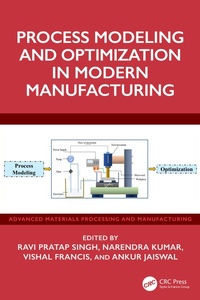
Process Modeling and Optimization in Modern Manufacturing
Published on 23. October 2025
210 pages
978-1-040-43838-1 (ISBN)
Description

This book covers modeling and optimization of various modern manufacturing processes such as advanced machining, hybrid manufacturing, and additive manufacturing including related case studies in these domains. Various areas like smart manufacturing, hybrid manufacturing, 3D printing, process modeling and characterization, optimization, and so forth are covered in detail. The focus of this book is on artificial neural network, finite element analysis, firefly/genetic algorithm, particle swarm, and fuzzy-based techniques, which are the main optimization and modeling techniques.
Features of the book:
Provides in-depth investigations on prospects of modeling and optimization of modern manufacturing processes.
Detailed overview on different evolutionary and bio-inspired optimization techniques and their implementation.
Provides step-by-step guidance on how to use machine learning for the enhancement of productivity and quality in modern manufacturing processes.
Discusses sustainability and Industry 4.0-based content.
Includes case studies and practical examples.
This book is aimed at researchers and graduate students in mechanical, manufacturing, production, and industrial engineering.
Features of the book:
Provides in-depth investigations on prospects of modeling and optimization of modern manufacturing processes.
Detailed overview on different evolutionary and bio-inspired optimization techniques and their implementation.
Provides step-by-step guidance on how to use machine learning for the enhancement of productivity and quality in modern manufacturing processes.
Discusses sustainability and Industry 4.0-based content.
Includes case studies and practical examples.
This book is aimed at researchers and graduate students in mechanical, manufacturing, production, and industrial engineering.
More details
Series
Language
English
Place of publication
London
United Kingdom
Publishing group
Taylor & Francis Ltd
Target group
College/higher education
Professional and scholarly
Illustrations
28 Tables, black and white; 42 Line drawings, black and white; 16 Halftones, black and white; 58 Illustrations, black and white
File size
7,34 MB
ISBN-13
978-1-040-43838-1 (9781040438381)
Copyright in bibliographic data and cover images is held by Nielsen Book Services Limited or by the publishers or by their respective licensors: all rights reserved.
Schweitzer Classification
Other editions
Additional editions
Ravi Pratap Singh | Narendra Kumar | Vishal Francis
Process Modeling and Optimization in Modern Manufacturing
Book
10/2025
1st Edition
CRC Press
€175.80
Shipment within 10-20 days
Persons
Ravi Pratap Singh works as Assistant Professor (Grade-I) in the Department of Mechanical Engineering at the National Institute of Technology, Kurukshetra, Haryana, India. Prior to this, he served the Department of Industrial & Production Engineering, NIT Jalandhar, Punjab as an Assistant Professor for about five years and the Department of Technical Education, Uttar Pradesh, India for about two years. He has received the MTech in Industrial and Production Engineering, and PhD degree in the area of Hybrid Manufacturing Processes, from the Department of Mechanical Engineering, NIT Kurukshetra. He is a Life Member of the IIIE, Mumbai; The Institution of Engineers (India), Kolkata; Ultrasonic Society of India (USI), New Delhi; ISTE, New Delhi; Additive Manufacturing Society of India (AMSI), Bangalore; and SCIence and Engineering Institute (SCIEI), Log Angeles, USA. He has published more than 180 research articles throughout the several SCI / Scopus indexed journal, including International / National level conferences. His research articles have received more than 14000 citations around the globe with the h-index of 52. He is also academically engaged with the editorship and reviewership with the several SCI/ Scopus indexed Journals from last 9-10 years.
Narendra Kumar is Assistant Professor (Grade-I) in the Industrial and Production Engineering Department at Dr. B R Ambedkar National Institute of Technology, Jalandhar, Punjab. He obtained his Ph.D in Mechanical Engineering from Indian Institute of Information Technology, Design and Manufacturing Jabalpur. His research work was based on Development and Performance Evaluation of Pellet based Additive Manufacturing Process for Flexible Parts. His thesis project was the part of DST sponsored project "Hybrid Additive-Subtractive Manufacturing System using CNC Machining Center". Prior to joining, NIT Jalandhar, he has worked for Bajaj Institute of Technology, Wardha. He also worked on DST/AMT sponsored project titled "development of metal-based deposition system using induction heating method" as Research Associate. His research interests are broadly related to Additive Manufacturing, Machining Methods and Material Development. He has published more than 55 research papers in international journals and conferences proceedings of high repute.
Vishal Francis is currently working as an Assistant Professor in the School of Mechanical Engineering, Lovely Professional University, Punjab. He has obtained his Ph.D. from the Indian Institute of Information Technology, Design and Manufacturing, Jabalpur, India. He has worked in the area of 3D printing of nanocomposite materials during his doctoral work. His area of interest is 3D printing, high-performance material development for 3D printing, printed electronics and 3D printed prostheses.
Ankur Jaiswal received the Bachelor of Mechanical Engineering from Chhattisgarh Swami Vivekanand Technical University, Bhilai, India, the M.Tech. Degree in Machine Design from Guru Ghasidas Vishwavidyalaya (A Central University) Chhattisgarh India. He received Ph.D. degree in Mechanisms and Robotics from the Visvesvaraya National Institute of Technology (VNIT), Nagpur, India in the year 2019. Currently, he serves as Assistant Professor in the Department of Mechatronics, Manipal Institute of Technology, Manipal Academy of Higher Education, Manipal, Karnataka, India. He has 3.6 years of work experience in reputed institutes such as GMRIT Rajam (A.P) and MIT, Manipal Karnataka. He has published 21 papers in reputed journals and international/national conferences and 3 book chapters. His research interests include Robotics and Mechanical Design, Optimization, Modelling and Simulation, Kinematics and Dynamics of serial and parallel manipulators. Industrial Automation, and Smart Manufacturing.
Narendra Kumar is Assistant Professor (Grade-I) in the Industrial and Production Engineering Department at Dr. B R Ambedkar National Institute of Technology, Jalandhar, Punjab. He obtained his Ph.D in Mechanical Engineering from Indian Institute of Information Technology, Design and Manufacturing Jabalpur. His research work was based on Development and Performance Evaluation of Pellet based Additive Manufacturing Process for Flexible Parts. His thesis project was the part of DST sponsored project "Hybrid Additive-Subtractive Manufacturing System using CNC Machining Center". Prior to joining, NIT Jalandhar, he has worked for Bajaj Institute of Technology, Wardha. He also worked on DST/AMT sponsored project titled "development of metal-based deposition system using induction heating method" as Research Associate. His research interests are broadly related to Additive Manufacturing, Machining Methods and Material Development. He has published more than 55 research papers in international journals and conferences proceedings of high repute.
Vishal Francis is currently working as an Assistant Professor in the School of Mechanical Engineering, Lovely Professional University, Punjab. He has obtained his Ph.D. from the Indian Institute of Information Technology, Design and Manufacturing, Jabalpur, India. He has worked in the area of 3D printing of nanocomposite materials during his doctoral work. His area of interest is 3D printing, high-performance material development for 3D printing, printed electronics and 3D printed prostheses.
Ankur Jaiswal received the Bachelor of Mechanical Engineering from Chhattisgarh Swami Vivekanand Technical University, Bhilai, India, the M.Tech. Degree in Machine Design from Guru Ghasidas Vishwavidyalaya (A Central University) Chhattisgarh India. He received Ph.D. degree in Mechanisms and Robotics from the Visvesvaraya National Institute of Technology (VNIT), Nagpur, India in the year 2019. Currently, he serves as Assistant Professor in the Department of Mechatronics, Manipal Institute of Technology, Manipal Academy of Higher Education, Manipal, Karnataka, India. He has 3.6 years of work experience in reputed institutes such as GMRIT Rajam (A.P) and MIT, Manipal Karnataka. He has published 21 papers in reputed journals and international/national conferences and 3 book chapters. His research interests include Robotics and Mechanical Design, Optimization, Modelling and Simulation, Kinematics and Dynamics of serial and parallel manipulators. Industrial Automation, and Smart Manufacturing.
Content
Chapter 1. Introduction to Process Modeling and Optimization in Modern Manufacturing: An Overview
Chapter 2. Recent Advances in the Applications of Machine Learning Optimization Techniques in Modern and Hybrid Manufacturing for Quality, Sustainability, and Productivity: Some Case Studies.
Chapter 3. Modelling and Optimization of Abrasive Water Jet Machining Process on Surface Quality of green composite using Nature-Inspired Techniques methods: Comparative Study of TLBO, ABC and PSO
Chapter 4. Machine Learning-Enabled Gesture Recognition in 3D Printed Robotic Prostheses: Advances in Electromyography Control
Chapter 5. Investigation of the AISI 1040 Steel Machining Characteristics with the Application of Cutting Fluid (Corn oil+ Al2O3) using the Taguchi-TOPSIS (T-T) Approach
Chapter 6. Optimization of Electro Discharge Machining Parameters for Additively Manufactured Composite (AlSi10Mg + Niobium Carbide (NbC)) Using Random Forest Algorithm
Chapter 7. Investigation, Modeling and Advanced Optimization of Additive Manufacturing Characteristics: A Study on Evolutionary Methods
Chapter 8. Analysis for development of High-performance polymer nanocomposites for FDM based Additive Manufacturing
Chapter 9. Machine Learning based Optimization for FDM Printed Poly Lactic Acid parts
Chapter 10. Experimental Investigation on Cutting Rate in ?ECDM of Si-based Pyrax Glass: Evolutionary Parametric Optimization and Surface Morphology
Chapter 11. Micro Drilling in Cu-based Shape Memory Alloy via ?-ECM: Influence of Input Variables and GWO, PSO based Advanced Optimization
Chapter 2. Recent Advances in the Applications of Machine Learning Optimization Techniques in Modern and Hybrid Manufacturing for Quality, Sustainability, and Productivity: Some Case Studies.
Chapter 3. Modelling and Optimization of Abrasive Water Jet Machining Process on Surface Quality of green composite using Nature-Inspired Techniques methods: Comparative Study of TLBO, ABC and PSO
Chapter 4. Machine Learning-Enabled Gesture Recognition in 3D Printed Robotic Prostheses: Advances in Electromyography Control
Chapter 5. Investigation of the AISI 1040 Steel Machining Characteristics with the Application of Cutting Fluid (Corn oil+ Al2O3) using the Taguchi-TOPSIS (T-T) Approach
Chapter 6. Optimization of Electro Discharge Machining Parameters for Additively Manufactured Composite (AlSi10Mg + Niobium Carbide (NbC)) Using Random Forest Algorithm
Chapter 7. Investigation, Modeling and Advanced Optimization of Additive Manufacturing Characteristics: A Study on Evolutionary Methods
Chapter 8. Analysis for development of High-performance polymer nanocomposites for FDM based Additive Manufacturing
Chapter 9. Machine Learning based Optimization for FDM Printed Poly Lactic Acid parts
Chapter 10. Experimental Investigation on Cutting Rate in ?ECDM of Si-based Pyrax Glass: Evolutionary Parametric Optimization and Surface Morphology
Chapter 11. Micro Drilling in Cu-based Shape Memory Alloy via ?-ECM: Influence of Input Variables and GWO, PSO based Advanced Optimization
