

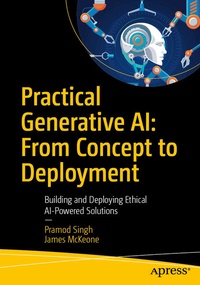
Practical Generative AI: From Concept to Deployment
Description

This book is a comprehensive guide that immerses you into the world of building and deploying AI-powered solutions. You are introduced to the core architecture of LLMs and equipped with essential Best Data Practices (BDPs) for utilizing Generative AI responsibly, ensuring ethical and efficient AI deployment.
The book starts with the foundational aspects of Generative AI application development. You will learn the nuances of data handling in Generative AI apps, from working with embeddings to managing unstructured and structured data, and handling Personally Identifiable Information (PII) data. The exploration extends to understanding the differences between deterministic and LLM-based data synthesis and integrating Generative AI apps with enterprise data, providing you with practical insights into leveraging data effectively for intelligent applications. A chapter on prompt engineering explains the importance of prompts in AI interactions, covering a spectrum of techniques and pitfalls while offering exercises to enhance prompt engineering skills. As you progress through the book, you take a journey from conceptualization to production and deployment of Generative AI applications. You discover the essentials of Generative AI application development, gain insights into the pathway from ideation to production, and explore the intricacies of LLM selection and fine-tuning.
The book equips you with the knowledge and tools necessary to navigate the complex terrain of AI development and deployment, making it an indispensable resource for AI enthusiasts, developers, and business leaders alike.
What You Will Learn
- Know the core architecture of LLMs and how these models have revolutionized AI applications
- Handle various data types, including unstructured, structured, and personally identifiable information (PII) data in Generative AI applications
- Understand prompt engineering and its importance in AI interactions and applications
- Understand modular design of Generative AI apps, essential backend and frontend components, and the unique principles guiding Generative AI app design
Who This Book Is For
From AI enthusiasts exploring the field to software developers seeking practical insights, and business leaders looking to harness the power of AI for organizational growth and innovation
More details
Other editions
Additional editions
Persons
Pramod Singh is an expert Associate Partner at Bain & Company, where he leads the Data Science & Machine Learning guild in the Asia Pacific region as part of Bain's Advanced Analytics Group. With over 15 years of experience in Data Science, Pramod specializes in building large-scale machine learning systems and leading advanced analytics teams. He also heads Bain's Generative AI ringfence group in APAC and is a published author of five books in machine learning and distributed computing.
In his role, Pramod engages with Bain's clients across various industries and geographic locations, including India, Australia, Singapore, Thailand, South Korea, and the wider Asia Pacific region. Over his four year tenure at Bain & Co., he has advised clients on Generative AI solutions, large-scale ML deployments, analytics adoption, tech stack overhauls, data strategy, and responsible AI. His deep industry expertise extends to the retail, telecom, and financial services sectors.
James McKeone is a dedicated data scientist with a passion for solving real-world problems. He excels in crafting innovative solutions and defining architectures for end-to-end data science products. Specializing in Generative AI development, James thrives on leading cutting-edge projects and building effective teams. With extensive experience in writing data science solutions and managing teams, he has successfully delivered projects to stakeholders at all levels. James brings cross-disciplinary expertise from various industries and is committed to achieving measurable results through innovation and collaboration. He has a proven track record of delivering successful data science solutions to stakeholders across various levels of seniority, from technical teams to boards of some of Australia's largest companies. As a leader, he has managed teams of up to five data scientists and data engineers, fostering a culture of safety and active feedback within his teams.
Content
Chapter 1: Introduction.- Chapter 2: Data Handling in GenAI Applications.- Chapter 3: Prompt Engineering Techniques.- Chapter 4: Evaluating GenAI Applications.- Chapter 5; Open Source Language Models and Fine-tuning.- Chapter 6; Building GenAI Apps on the Cloud.- Chapter 7: Business Use Cases and Strategic Implications.
