

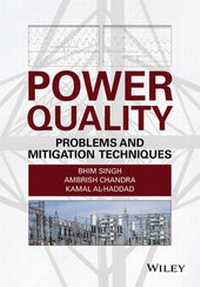
Power Quality
Description

More details
Other editions
Additional editions
Persons
Content
Preface
Due to the increased use of power electronic converters in domestic, commercial, and industrial sectors, the quality of power in distribution networks is deteriorating at an alarming rate. This is causing a number of problems such as increased losses, poor utilization of distribution systems, mal-operation of sensitive equipment, and disturbance to nearby consumers, protective devices, and communication systems. These problems are also aggravated by the direct injection of non-steady power from renewable energy sources in the distribution system. It is expected that in the next few years, more than 80% of AC power is to be processed through power converters owing to their benefits of energy conservation, flexibility, network interconnection, and weight and volume reduction in a number of equipment such as lighting, HVAC, computers, fans, and so on. In view of these facts, it is considered timely to write this book to identify, classify, analyze, simulate, and quantify the associated power quality problems and thereby provide mitigation techniques to these power quality problems that will help practicing engineers and scientist to design better energy supply systems and mitigate existing ones.
Motivation
This book is aimed at both undergraduate and postgraduate students in the field of energy conversion and power quality in more than 10,000 institutions around the word. The book aims to achieve the following:
- Easy explanation of the subject matter through illustrations, waveforms, and phasor diagrams using minimum texts, which is one of the most efficient methods of understanding complex phenomenon.
- Simple learning of the subject through numerical examples and problems, which is one of the most favorite techniques of learning by engineering graduates.
- To gain an in-depth knowledge of the subject through computer simulation-based problems, which is the most favored skill of today's young engineers.
- To get the confidence to find the solutions of latest practical problems, which are encountered in the field of power quality.
- To develop enthusiasm for logical thinking in students and instructors.
- To gain an in-depth understanding of latest topics on power quality in minimum time and with less efforts.
Focus and Target
This book is planned in a unique and different manner compared with existing books on the subject. It consists of rare material for easy learning of the subject matter and a large number of simple derivations are included in a simplified mathematical form for solving most of the power quality problems in analytical form and designing their mitigation devices. Aside from this, the book provides essential theory supported by a reasonable number of solved numerical examples with illustrations, waveforms and phasor diagrams, small review questions, unsolved numerical problems, computer simulation-based problems, and references.
In addition to undergraduate and postgraduate students in the field of power quality, this book will also prove useful for researchers, instructors, and practicing engineers in the field.
This book facilitates simplified mathematical formulations in closed form solution through calculation, computation, and modeling of power quality problems and designing their mitigation devices.
Structure
This book consists of 11 chapters. Chapter 1 gives an introduction on power quality (PQ), causes and effects of PQ problems, requirement of PQ improvements, and mitigation aspects of PQ problems. Chapter 2 deals with PQ definitions, terminologies, standards, benchmarks, monitoring requirements, financial loss, and analytical quantification through numerical problems.
In Chapters 3-6, passive shunt and series compensation using lossless passive LC components, active shunt compensation using DSTATCOM (distribution static compensators), active series compensation using DVR (dynamic voltage restorer), and combined compensation using UPQC (unified power quality compensator) are covered for mitigation of current-based PQ problems such as reactive power compensation to achieve power factor correction (PFC) or voltage regulation (VR), load balancing, and neutral current reduction and mitigation of voltage-based PQ problems such as compensation of voltage drop, sag, swell, unbalance, and so on in the single-phase and three-phase three-wire and four-wire loads and supply systems.
In Chapter 7, various types of nonlinear loads, which cause these power quality problems, are illustrated, classified, modeled, quantified, and analyzed for associated power quality problems.
Chapters 8-11 deal with different kinds of power filters such as passive filters, active shunt filters, active series filters, and hybrid filters to meet the requirements of various kinds of power quality problems such as current and voltage harmonic elimination, reactive power compensation, and so on caused by harmonics-producing single-phase and three-phase nonlinear loads. Moreover, these power filters are also used for elimination of voltage harmonics present in the supply systems.
The major strength of this book is its 175 numerical examples, 250 review questions, 175 numerical problems, 250 computer simulation-based problems, and 600 references in different chapters.
Acknowledgments
The authors would like to thank faculty colleagues for their support and encouragement in writing this book. Professor Singh gratefully acknowledges the support from the Indian Institute of Technology Delhi, and École de technologie supérieure, Montréal, Canada (ÉTS).
Professor Singh would like to thank his research students for their contributions to some of the chapters in terms of making diagrams, figures, simulations, numerical verifications, proofreading, and constructive suggestions. Many of them deserve mention, namely, Chinmay Jain, Sabharj Arya, Ikhlaq Hussain, Rajan Kumar, Raj Kumar Garg, N. Krishna Swami Naidu, M. Sandeep, Vashist Bist, Shailendra Sharma, P. Jayaprakash, V. Rajagopal, Yash Pal, Raja Sekhara Reddy Chilipi, Stuti Shukla, M. Rajesh, Miloud Rezkallah, Sanjeev Singh, Vishal Verma, Ram Niwas, Vinod Khadkikar, Jitendra Solanki, Parag Knajiya, Sunil Kumar, Sai Pranith, Sunil Kumar Dubey, Sagar Goel, Subrat Kumar, Arun Kumar Verma, Krishan Kant Bhalla, Geeta Pathak, Nidhi Mishra, Chandu Valluri, Mohit Joshi, and Mishal Chauhan. Some of the work presented in this book primarily comes from the research conducted by them under the supervision of Professor Singh at IIT Delhi. Professor Singh expresses his gratitude to IIT Delhi for sponsoring this research. Professor Singh also expresses his gratitude to his wife Sushila Singh, children Mohit Singh, Ankita, Tripti Singh, Mohit Gupta, Gyanit Singh, and Pallavi Singh, grand children Advika and Ishan, parents, other family members, relatives, and friends for providing support during writing of this book. Professor Singh also expresses his gratitude to Professor Anjali Agarwal, Niharika, Radhika, and their relative and friends who provided excellent hospitality and family environment during his stay in Canada for writing this book.
Professor Chandra gratefully acknowledges the support from Natural Sciences and Engineering Research Council of Canada, Ecole de Technologie Supérieure (ÉTS), and Groupe de Recherche en Électronique de Puissance et Commande Industrielle GRÉPCI. Professor Chandra will like to thank Professor Bhim Singh with whom he has personal and professional relationship for the past more than 40 years. Professor Chandra would like to thank all his past and present students, especially Brij N. Singh, Vinod Khadkikar, Mukhtiar Singh, Slaven Kincic, Etienne Tremblay, Jorge Lara Cardoso, and Miloud Rezkallah. There is no doubt that a professor learns a lot from his students. Some of the work presented in this book comes from their research work done under the supervision of Professor Chandra at ÉTS. Professor Chandra has learnt a lot from his students doing graduation on power quality, the topic that he has been teaching for the past 15 years. He is thankful to all of them. Professor Chandra is also grateful to his wife Anjali and children Niharika, Radhika, and Avneesh to provide the support and the pleasant family environment at home.
Professor Al-Haddad would like to express his gratitude and high appreciation to his colleague and friend Professor Bhim Singh who is collaborating with him since 1995 on a continuous basis. This long time collaboration with Canada Research Chair in Electric Energy Conversion and Power Electronics (CRC-EECPE) led by professor Al-Haddad started with Dr Bhim Singh first visit to Montreal in 1995 as a visiting researcher, followed by invited professor position, adjunct professor member of the CRC, and since then it is a continuous work between the team from IIT Delhi and the CRC-EECPE researchers. Professor Al-Haddad also would like to express his gratitude to the following agencies who strongly supported this work: Canada Research Chairs (CRC), Natural Sciences and Engineering Research Council of Canada (NSERC), Fond de Recherche Nature et Technologies du gouvernement du Québec (FRQNT), ÉTS, and Groupe de Recherche en Électronique de Puissance et Commande Industrielle GRÉPCI. He also expresses his gratitude to his numerous hard working researchers, his brilliant dedicated graduate and undergraduate students, a long list of more than 150 names, his colleagues in the electrical engineering department as well as those from IEEE Industrial Electronics Society and equally important to his wife Fadia, and daughters Isabel and...
