

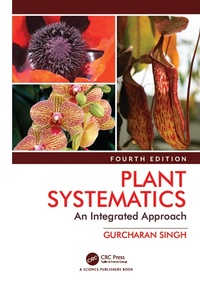
Plant Systematics
An Integrated Approach, Fourth Edition
4th Edition
Published on 7. June 2019
568 pages
978-1-000-57677-1 (ISBN)
Description

This fourth edition of Plant Systematics is completely revised and updated. It incorporates the updated International Code of Nomenclature for Algae, Fungi and Plants (Shenzhen Code, 2018), the new version of PhyloCode (Beta version of Phylocode 5, 2014), APweb version 14 (September, 2018), revised Angiosperm Phylogeny Group classification (APG IV, 2016), new Pteridophyte Phylogeny Group Classification (PPG I, 2016), besides the updates since the publication of third edition.
The book is a blend of classical fundamental aspects and recent developments, especially in the field of molecular systematics, cladistics and computer identification. Special attention has been given to information on botanical nomenclature, identification, molecular systematics and phylogeny of angiosperms. The complicated concepts of phylogeny, taxometrics and cladistics have been explained with a view to providing a comparison between these diverse but interactive fields of study. An attempt has been made to build upon a common example when exploring different methods, especially in procedures of identification, taxometrics and cladistics. The major systems of classification are evaluated critically. Discussion on major families of Pteridophytes, Gymnosperms and Angiosperms, especially those of major phylogenetic interest, form a major portion of this edition. The ebook includes nearly 500 color photographs set out in 36 pages covering plants from different parts of the world. In addition, 305 black & white illustrations have been included to provide a better understanding of the plants covered in the book.
The book is a blend of classical fundamental aspects and recent developments, especially in the field of molecular systematics, cladistics and computer identification. Special attention has been given to information on botanical nomenclature, identification, molecular systematics and phylogeny of angiosperms. The complicated concepts of phylogeny, taxometrics and cladistics have been explained with a view to providing a comparison between these diverse but interactive fields of study. An attempt has been made to build upon a common example when exploring different methods, especially in procedures of identification, taxometrics and cladistics. The major systems of classification are evaluated critically. Discussion on major families of Pteridophytes, Gymnosperms and Angiosperms, especially those of major phylogenetic interest, form a major portion of this edition. The ebook includes nearly 500 color photographs set out in 36 pages covering plants from different parts of the world. In addition, 305 black & white illustrations have been included to provide a better understanding of the plants covered in the book.
More details
Edition
4th edition
Language
English
Place of publication
London
United Kingdom
Publishing group
Taylor & Francis Ltd
Target group
College/higher education
Illustrations
30 Tables, black and white; 270 Line drawings, black and white; 73 Halftones, black and white; 343 Illustrations, black and white
ISBN-13
978-1-000-57677-1 (9781000576771)
Copyright in bibliographic data and cover images is held by Nielsen Book Services Limited or by the publishers or by their respective licensors: all rights reserved.
Schweitzer Classification
Other editions
Additional editions
Book
03/2021
4th Edition
CRC Press
€71.90
Shipment within 15-20 days
Book
06/2019
4th Edition
CRC Press
€311.70
Shipment within 15-20 days
Previous edition
Arun K. Pandey | Shruti Kasana
Plant Systematics
E-Book
05/2021
1st Edition
CRC Press
€73.99
Available for download
Person
Gurcharan Singh is a practicing taxonomist with experience in the floristics and phytosociology of NW Himalayas and the general nomenclatural subject. He also has knowledge on the Floristics of SW United States, mainly California plants. Now retired, after nearly 40 years of experience in teaching taxonomy, ecology and environment at University of Delhi, India. He has published 42 research papers, including those on new species and nomenclatural changes. He has also authored 14 books. He is presently engaged in developing an online database that will help in online identification and providing guidance in various online forums.
Content
Plants, Taxonomy and Systematics: Plants and Kingdoms of Life, Two Kingdom System, Two Empires Thee Kingdoms, Five Kingdom System, Six or Seven Kingdoms?, The Plant Kingdom, Taxonomy and Systematics, Basic Components (Principles) of Systematics, Aims of Systematics, Advancement levels in Systematics.
Descriptive Terminology: Habit and life span, Habitat, Roots, Stems, Leaves, Leaf arrangement, Leaf duration, Leaf incision, Stipules, Leaf shape, Leaf margin, Leaf base, Leaf apex, Leaf surface, Venation, Inflorescence, Racemose types, Cymose types, Specialized types, Flower, Calyx, Corolla, Perianth, Androecium, Gynoecium, Fruit, Simple fruits, Aggregate fruits, Multiple fruits, Floral diagram, Floral formula.
Process of Identification: Specimen preparation, Field work, Equipment, Pressing, handling special groups, Drying, Herbarium methods, Botanical gardens, Herbaria, Pest control, Virtual herbarium, Identification methods, Taxonomic literature, Taxonomic keys, Computers in identification, DNA Barcoding.
Systematic evidence, Interdisciplinary Approach: Morphology, Habit, Underground parts, Leaves, Flowers, Fruits, Anatomy, Wood Anatomy, Trichomes, Epidermal features, Leaf anatomy, Floral Anatomy. Floral Anatomy, Embryology, Families marked out by distinct embryological features, Specific examples of role of embryological data, Palynology, Pollen aggregation, Pollen wall, Pollen aperture, Micromorphology and Ultrastructure, Micromorphology, Ultrastructure, Chromosomes, Chromosomal number, Chromosomal structure, Chromosomal behavior, Chemotaxonomy, Primary metabolites, Secondary metabolites, Non-semantide Macromolecules, Proteins, Molecular systematics, Molecular evolution, Location of molecular data, Molecular techniques, DNA polymorphism, Examples of molecular studies, Species vs Gene trees.
Hierarchical Classification: Taxonomic groups categories and ranks, Utilization of categories, Species concept, Infraspecific ranks, Genus, Family.
Nomenclature of Plants: Need for Scientific names, Why Latin? Development of Botanical Code, Botanical Code, Preamble, Principles of ICN, Names of Taxa, The Type Method, Author Citation, Publication of Names, Rejection of Names, Principle of Priority, Names of Hybrids, Names of Cultivated Plants, Unified Biological Nomenclature, Draft BioCode, PhyloCode.
Descriptive Terminology: Habit and life span, Habitat, Roots, Stems, Leaves, Leaf arrangement, Leaf duration, Leaf incision, Stipules, Leaf shape, Leaf margin, Leaf base, Leaf apex, Leaf surface, Venation, Inflorescence, Racemose types, Cymose types, Specialized types, Flower, Calyx, Corolla, Perianth, Androecium, Gynoecium, Fruit, Simple fruits, Aggregate fruits, Multiple fruits, Floral diagram, Floral formula.
Process of Identification: Specimen preparation, Field work, Equipment, Pressing, handling special groups, Drying, Herbarium methods, Botanical gardens, Herbaria, Pest control, Virtual herbarium, Identification methods, Taxonomic literature, Taxonomic keys, Computers in identification, DNA Barcoding.
Systematic evidence, Interdisciplinary Approach: Morphology, Habit, Underground parts, Leaves, Flowers, Fruits, Anatomy, Wood Anatomy, Trichomes, Epidermal features, Leaf anatomy, Floral Anatomy. Floral Anatomy, Embryology, Families marked out by distinct embryological features, Specific examples of role of embryological data, Palynology, Pollen aggregation, Pollen wall, Pollen aperture, Micromorphology and Ultrastructure, Micromorphology, Ultrastructure, Chromosomes, Chromosomal number, Chromosomal structure, Chromosomal behavior, Chemotaxonomy, Primary metabolites, Secondary metabolites, Non-semantide Macromolecules, Proteins, Molecular systematics, Molecular evolution, Location of molecular data, Molecular techniques, DNA polymorphism, Examples of molecular studies, Species vs Gene trees.
Hierarchical Classification: Taxonomic groups categories and ranks, Utilization of categories, Species concept, Infraspecific ranks, Genus, Family.
Nomenclature of Plants: Need for Scientific names, Why Latin? Development of Botanical Code, Botanical Code, Preamble, Principles of ICN, Names of Taxa, The Type Method, Author Citation, Publication of Names, Rejection of Names, Principle of Priority, Names of Hybrids, Names of Cultivated Plants, Unified Biological Nomenclature, Draft BioCode, PhyloCode.
