

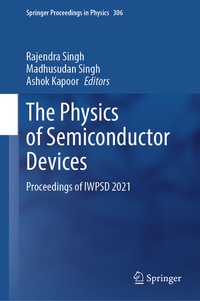
The Physics of Semiconductor Devices
Description

More details
Other editions
Additional editions
Persons
Rajendra Singh is Professor at the Department of Physics, IIT Delhi, New Delhi since 2006. He received a Ph.D. degree from the Inter-University Accelerator Centre (affiliated to J.N.U., New Delhi) in 2001. He worked as Post-doctoral Fellow first at the Walter Schottky Institute, Technical University of Munich, Germany, and then at the Max Planck Institute of Microstructure Physics, Halle, Germany (2001-2006). His areas of interest are GaN-based materials and devices, wafer bonding, layer transfer of crystalline semiconductors and 2D materials, 2D materials and devices, 2D/3D heterojunctions. He has about 150 publications in International Journals and a similar number of publications in conference proceedings.
Madhusudan Singh received his Ph.D. degree in Electrical Engineering from the University of Michigan, Ann Arbor, in 2005. After the post-doctoral experience at MIT, and research scientist experience at Arizona State, and serving as an Associate Editor for John Wiley,he joined the faculty of Department of Electrical Engineering, IIT Delhi in 2013 as Associate Professor. His research interests include solution-processed devices, flexible and printed electronics, materials chemistry, sensors and detectors, and general device physics.
Ashok Kumar Kapoor received his Ph. D degree from the Department of Physics, Delhi University. He Joined Solid State Physics Laboratory, Delhi, in 1985 and superannuated as scientist 'G' and Group Head of Material Characterization group. His areas of research interest are the growth and characterization of semiconductor materials and conduction mechanisms in conducting polymers for solar cells and display applications for MBE growth of 2D metal chalcogenides. He has co-authored 35 publications in International and National journals and about 30 papers presented in various conferences and seminars. He has given several invited talks in various seminars and educational institutions.
