

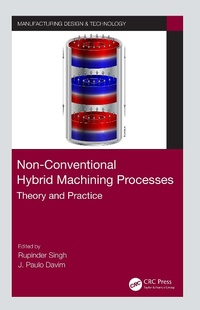
Non-Conventional Hybrid Machining Processes
Theory and Practice
1st Edition
Published on 29. October 2020
158 pages
978-0-429-64274-6 (ISBN)
Description

This new book covers process optimization and process capability for hybrid NCMP (nonconventional machining process), and combines NCMP and conventional machining removal processes for various hybridized processes.
This book is focused on understanding the basic mechanism of some of the NCMPs for their possible hybridization. This book can be used for the development of a basic framework on hybridization for the selected NCMP. The framework is further strengthened by case studies included in this book. The concept of macro-modeling for NCMP and the framework for the development of industrial standards have been outlined.
This book is of interest to researchers and graduate students working in the field of hybrid NCMP, especially for the development of novel processes. Field engineers of NCMP may also use it for further process development.
Features:
Provides a detailed description of mechanism for different NCMPs for possible hybridization.
Includes a case study on mechanism of processes.
Offers a systematic approach for understanding NCMP.
Covers the issues of process optimization and process capability for hybrid NCMP.
This book is focused on understanding the basic mechanism of some of the NCMPs for their possible hybridization. This book can be used for the development of a basic framework on hybridization for the selected NCMP. The framework is further strengthened by case studies included in this book. The concept of macro-modeling for NCMP and the framework for the development of industrial standards have been outlined.
This book is of interest to researchers and graduate students working in the field of hybrid NCMP, especially for the development of novel processes. Field engineers of NCMP may also use it for further process development.
Features:
Provides a detailed description of mechanism for different NCMPs for possible hybridization.
Includes a case study on mechanism of processes.
Offers a systematic approach for understanding NCMP.
Covers the issues of process optimization and process capability for hybrid NCMP.
More details
Series
Edition
1. Auflage
Language
English
Place of publication
London
United Kingdom
Publishing group
Taylor & Francis Ltd
Target group
Professional and scholarly
Illustrations
26 Tables, black and white; 73 Line drawings, black and white; 67 Halftones, black and white; 140 Illustrations, black and white
ISBN-13
978-0-429-64274-6 (9780429642746)
Copyright in bibliographic data and cover images is held by Nielsen Book Services Limited or by the publishers or by their respective licensors: all rights reserved.
Schweitzer Classification
Other editions
Additional editions
Book
10/2024
1st Edition
CRC Press
€69.80
Shipment within 15-20 days
Book
10/2020
1st Edition
CRC Press
€241.30
Shipment within 15-20 days
Persons
Rupinder Singh received his Ph.D degree in Mechanical Engineering in 2006 from T.I.E.T Patiala, Masters of Technology (Production Engineering) in 2001 and Bachelors of Technology (Production Engineering) in 1999 from Punjab Tech. University. He is Chartered Engineer by Institution of Engineers (India) and UGC Research Awardee. Currently, he is Professor at the Department of Mechanical Engineering, National Institute of Technical Teachers Training and Research, Chandigarh (India). He has more than 20 years of teaching and research experience in Production and Industrial Engineering, with special emphasis in additive manufacturing, non conventional machining and casting. He has guided large numbers of Ph.D. and Master's students as well as coordinated 17 financed research projects. He has received several scientific awards. He has worked as evaluator of projects for international research agencies as well as examiner of Ph.D. thesis for many Indian universities. He is the Guest Editor for several International journals, books Editor, and Advisor for many international conferences. In addition, he has also published as author (and co-author) more than 20 monographs, 80 book chapters and 500 articles in journals and conferences (more than 250 articles in journals indexed in SCI (SCOPUS/h-index:31+/3626+ citations).
J. Paulo Davim received his Ph.D. degree in Mechanical Engineering in 1997, M.Sc. degree in Mechanical Engineering (materials and manufacturing processes) in 1991, Mechanical Engineering degree (5 years) in 1986, from the University of Porto (FEUP), the Aggregate title (Full Habilitation) from the University of Coimbra in 2005 and the D.Sc. (Higher Doctorate) from London Metropolitan University in 2013. He is Senior Chartered Engineer by the Portuguese Institution of Engineers with an MBA and Specialist titles in Engineering and Industrial Management as well as in Metrology. He is also Eur Ing by FEANI-Brussels and Fellow (FIET) of IET-London. Currently, he is Professor at the Department of Mechanical Engineering of the University of Aveiro, Portugal. He is also distinguished as honorary professor in several universities/colleges. He has more than 30 years of teaching and research experience in Manufacturing, Materials, Mechanical and Industrial Engineering, with special emphasis in Machining & Tribology. He has also interest in Management, Engineering Education and Higher Education for Sustainability. He has guided large numbers of postdoc, Ph.D. and master's students as well as has coordinated and participated in several financed research projects. He has received several scientific awards and honours. He has worked as evaluator of projects for ERC-European Research Council and other international research agencies as well as examiner of Ph.D. thesis for many universities in different countries. He is the Editor in Chief of several international journals, Guest Editor of journals, books Editor, book Series Editor and Scientific Advisory for many international journals and conferences. Presently, he is an Editorial Board member of 30 international journals and acts as reviewer for more than 100 prestigious Web of Science journals. In addition, he has also published as editor (and co-editor) more than 150 books and as author (and co-author) more than 15 books, 100 book chapters and 500 articles in journals and conferences (more than 250 articles in journals indexed in Web of Science core collection/h-index 55+/9500+ citations, SCOPUS/h-index 60+/12000+ citations, Google Scholar/h-index 77+/19500+ citations).
J. Paulo Davim received his Ph.D. degree in Mechanical Engineering in 1997, M.Sc. degree in Mechanical Engineering (materials and manufacturing processes) in 1991, Mechanical Engineering degree (5 years) in 1986, from the University of Porto (FEUP), the Aggregate title (Full Habilitation) from the University of Coimbra in 2005 and the D.Sc. (Higher Doctorate) from London Metropolitan University in 2013. He is Senior Chartered Engineer by the Portuguese Institution of Engineers with an MBA and Specialist titles in Engineering and Industrial Management as well as in Metrology. He is also Eur Ing by FEANI-Brussels and Fellow (FIET) of IET-London. Currently, he is Professor at the Department of Mechanical Engineering of the University of Aveiro, Portugal. He is also distinguished as honorary professor in several universities/colleges. He has more than 30 years of teaching and research experience in Manufacturing, Materials, Mechanical and Industrial Engineering, with special emphasis in Machining & Tribology. He has also interest in Management, Engineering Education and Higher Education for Sustainability. He has guided large numbers of postdoc, Ph.D. and master's students as well as has coordinated and participated in several financed research projects. He has received several scientific awards and honours. He has worked as evaluator of projects for ERC-European Research Council and other international research agencies as well as examiner of Ph.D. thesis for many universities in different countries. He is the Editor in Chief of several international journals, Guest Editor of journals, books Editor, book Series Editor and Scientific Advisory for many international journals and conferences. Presently, he is an Editorial Board member of 30 international journals and acts as reviewer for more than 100 prestigious Web of Science journals. In addition, he has also published as editor (and co-editor) more than 150 books and as author (and co-author) more than 15 books, 100 book chapters and 500 articles in journals and conferences (more than 250 articles in journals indexed in Web of Science core collection/h-index 55+/9500+ citations, SCOPUS/h-index 60+/12000+ citations, Google Scholar/h-index 77+/19500+ citations).
Content
Chapter 1 Ultrasonic Vibration-Assisted Sintering Chapter 2 Hybrid EDM with Three-Phase Dielectric Medium Chapter 3 Fabrication of Microchannels using Conventional and Hybrid Machining Processes Chapter 4 Modified Ultrasonic Machining Process Chapter 5 A Trending Nonconventional Hybrid Finishing/Machining Process Chapter 6 Capabilities of Powder-Mixed EDM using Carbon Nanotubes for Biomedical Application Chapter 7 Material Removal Rate and Surface Roughness Analyses of ED-Machined SUS-316L with Tungsten Tool Chapter 8 Abrasive Jet Machining: Overview and Scope Chapter 9 Enhancing Tribological Properties of Duplex Stainless Steel Via Electrical Discharge Treatment
