

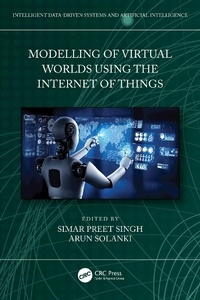
Modelling of Virtual Worlds Using the Internet of Things
1st Edition
Published on 31. July 2024
336 pages
978-1-040-02912-1 (ISBN)
Description

The text presents aspects of virtual worlds and highlights the emerging trends in simulation and modeling, comprising machine learning, artificial intelligence, deep learning, robotics, cloud computing, and data mining algorithms. It further discusses concepts including multimedia for the Internet of Things, graphical modeling using emerging technologies, and securing communication with secure data transmission in the modeling of virtual worlds.
This book:
Discusses secure data transmission in the modeling of virtual worlds in the Internet of Things environment.
Covers the integration of concepts and technical know-how about multiple technologies in visual world modeling, system configurations, and hardware issues.
Explores the use of next-generation technologies such as deep learning, blockchain, and artificial intelligence in visual world modeling scenarios.
Presents architectures and system models for the Internet of Things based visual world modeling systems.
Provides real-time case scenarios, highlighting emerging challenges and issues.
The text is primarily written for senior undergraduate students, graduate students, and academic researchers in the fields of electrical engineering, electronics, communications engineering, computer engineering, and information technology.
This book:
Discusses secure data transmission in the modeling of virtual worlds in the Internet of Things environment.
Covers the integration of concepts and technical know-how about multiple technologies in visual world modeling, system configurations, and hardware issues.
Explores the use of next-generation technologies such as deep learning, blockchain, and artificial intelligence in visual world modeling scenarios.
Presents architectures and system models for the Internet of Things based visual world modeling systems.
Provides real-time case scenarios, highlighting emerging challenges and issues.
The text is primarily written for senior undergraduate students, graduate students, and academic researchers in the fields of electrical engineering, electronics, communications engineering, computer engineering, and information technology.
More details
Series
Edition
1. Auflage
Language
English
Place of publication
London
United Kingdom
Publishing group
Taylor & Francis Ltd
Target group
College/higher education
Professional and scholarly
Illustrations
21 Tables, black and white; 19 Line drawings, black and white; 47 Halftones, black and white; 66 Illustrations, black and white
ISBN-13
978-1-040-02912-1 (9781040029121)
Copyright in bibliographic data and cover images is held by Nielsen Book Services Limited or by the publishers or by their respective licensors: all rights reserved.
Schweitzer Classification
Other editions
Additional editions
Simar Preet Singh | Arun Solanki
Modelling of Virtual Worlds Using the Internet of Things
Book
05/2026
1st Edition
CRC Press
€73.50
Shipment within 10-20 days
Simar Preet Singh | Arun Solanki
Modelling of Virtual Worlds Using the Internet of Things
Book
07/2024
1st Edition
CRC Press
€232.40
Shipment within 10-20 days
Persons
Simar Preet Singh is an associate professor at the School of Computer Science Engineering and Technology (SCSET), Bennett University, Greater Noida, Uttar Pradesh, India. He was previously affiliated with GNA University, Phagwara, and Chandigarh Engineering College, Ajitgarh, India. He also previously worked with Infosys Limited and DAV University, Jalandhar, India, and has worked on international projects. He has published papers in SCI/SCIE/Scopus-indexed journals and has presented many research papers at various national and international conferences in India and abroad. His areas of interest include cloud computing, fog computing, IoT, big data, and machine learning. He earned his doctoral degree at Thapar Institute of Engineering and Technology, Patiala, India, and also holds several specialized certifications, including like Microsoft Certified System Engineer (MCSE), Microsoft Certified Technology Specialist (MCTS), and Core Java. He has also undergone a training program for VB.Net and Cisco Certified Network Associates (CCNA). For more information, please visit: www.simarpreetsingh.com.
Arun Solanki is currently working as an assistant professor in the Department of Computer Science and Engineering, Gautam Buddha University, Greater Noida, India. He is also Co-Convener of the Center of Excellence in Artificial Intelligence. Dr. Solanki has worked as Time Table Coordinator, member examination, admission, sports council, digital information cell, and other university teams from time to time. He has received his M.Tech Degree in computer engineering from YMCA University, Faridabad, Haryana, India. He has received his Ph.D. in computer science and engineering from Gautam Buddha University in 2014. He has supervised more than 70 M.Tech dissertations. Currently, he is guiding 5 Ph.D. students in the area of artificial intelligence. His research interests span expert systems, machine learning, and search engines. He has published more than 70 research articles in SCI/Scopus-indexed international journals/conferences like IEEE, Elsevier, Springer, etc. He has physically participated in many national and international conferences. He has been a technical and advisory committee member of many international conferences. He has organized several FDP, conferences, workshops, and seminars. He has chaired many sessions at international conferences. He is working as Associate Editor in International Journal of Web-Based Learning and Teaching Technologies (IJWLTT) (Scopus indexed). He worked as Guest Editor for special issues in Recent Patents on Computer Science.
Arun Solanki is currently working as an assistant professor in the Department of Computer Science and Engineering, Gautam Buddha University, Greater Noida, India. He is also Co-Convener of the Center of Excellence in Artificial Intelligence. Dr. Solanki has worked as Time Table Coordinator, member examination, admission, sports council, digital information cell, and other university teams from time to time. He has received his M.Tech Degree in computer engineering from YMCA University, Faridabad, Haryana, India. He has received his Ph.D. in computer science and engineering from Gautam Buddha University in 2014. He has supervised more than 70 M.Tech dissertations. Currently, he is guiding 5 Ph.D. students in the area of artificial intelligence. His research interests span expert systems, machine learning, and search engines. He has published more than 70 research articles in SCI/Scopus-indexed international journals/conferences like IEEE, Elsevier, Springer, etc. He has physically participated in many national and international conferences. He has been a technical and advisory committee member of many international conferences. He has organized several FDP, conferences, workshops, and seminars. He has chaired many sessions at international conferences. He is working as Associate Editor in International Journal of Web-Based Learning and Teaching Technologies (IJWLTT) (Scopus indexed). He worked as Guest Editor for special issues in Recent Patents on Computer Science.
Content
1 Modeling Virtual Worlds Using IoT: Applications and Challenges; 2 Securing the Future: Comprehensive Strategies for IoT Security in Industry 4.0 and Beyond; 3 Smart Home Environment for Society: An Overview of IoT-Enabled Air Conditioners; 4 Intelligent Traffic Management and Identification of Emergency Vehicles; 5 Semantic Based Emotional Voice Coding Using Feed Forward Artificial Neural Network for Smart Home Devices; 6 A State-of-the-Art 360 degrees Run-Down of Cloud, Edge, Dew, and Fog Computing; 7 Millimetre Wave V2X Communications in 5G for Achieving Reliability in Vehicle Drive; 8 Managing and Controlling the COVID-19 Pandemic: The Role of Humanoid Robots; 9 Role of Robotic Healthcare Technologies during the COVID-19 Pandemic; 10 Innovating Healthcare Delivery: Harnessing Drones for Medical Services; 11 Development, Deployment, and Management of IoT Systems: A Software Hypothesis; 12 Software-Defined Network's Security Concerns: A Meticulous Synopsis; 13 Analyzing the Internet of Things and Cloud Computing: Multimedia Integration on the Internet of Things (IoT)
