

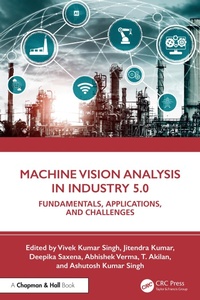
Machine Vision Analysis in Industry 5.0
Fundamentals, Applications, and Challenges
1st Edition
Published on 25. September 2025
190 pages
978-1-040-41363-0 (ISBN)
Description

This book is an introduction to fundamental techniques of image analysis with machine vision and their applicability in Industry 5.0. It provides basic and emerging techniques in the field of image analysis and machine vision in Industry 5.0. It also covers an extensive study of recent related work and research challenges in the field. Further, it discusses some effective solutions to address the challenges of digitally transforming industrial activities and improving their efficiency.
Provides effective and robust machine vision-enabled methods across different industrial fields, emphasizing their applicability and reliability
Covers the emerging concepts of image analysis and machine vision utilized in the digital transformation of manufacturing activities under Industry 5.0
Discusses conceptual methodologies of image analysis and machine vision tailored for various industrial applications, providing insights into their practical implementation
Practical issues on implementing machine vision applications with image analysis techniques in Industry 5.0 are addressed, offering guidance on method implementation
Includes case studies of various industrial processes, highlighting current challenges and presenting effective solutions, offering real-world insights into the application of machine vision
It is a reference book for research students, scientists, and professionals working in the fields of image processing, computer vision, and the Internet of Things.
Provides effective and robust machine vision-enabled methods across different industrial fields, emphasizing their applicability and reliability
Covers the emerging concepts of image analysis and machine vision utilized in the digital transformation of manufacturing activities under Industry 5.0
Discusses conceptual methodologies of image analysis and machine vision tailored for various industrial applications, providing insights into their practical implementation
Practical issues on implementing machine vision applications with image analysis techniques in Industry 5.0 are addressed, offering guidance on method implementation
Includes case studies of various industrial processes, highlighting current challenges and presenting effective solutions, offering real-world insights into the application of machine vision
It is a reference book for research students, scientists, and professionals working in the fields of image processing, computer vision, and the Internet of Things.
More details
Edition
1. Auflage
Language
English
Place of publication
London
United Kingdom
Publishing group
Taylor & Francis Ltd
Target group
College/higher education
Professional and scholarly
Illustrations
14 Tables, black and white; 30 Line drawings, black and white; 6 Halftones, black and white; 36 Illustrations, black and white
File size
7,64 MB
ISBN-13
978-1-040-41363-0 (9781040413630)
Copyright in bibliographic data and cover images is held by Nielsen Book Services Limited or by the publishers or by their respective licensors: all rights reserved.
Schweitzer Classification
Other editions
Additional editions
Vivek Kumar Singh | Jitendra Kumar | Deepika Saxena
Machine Vision Analysis in Industry 5.0
Fundamentals, Applications, and Challenges
Book
09/2025
1st Edition
Chapman & Hall/CRC
€176.70
Shipment within 10-20 days
Persons
Dr. Vivek Kumar Singh is currently working as Assistant Professor in the Department of Computer Science and Engineering, School of Engineering and Technology at Sharda University, India. He received Ph.D. in Computer Science and Engineering from National Institute of Technology, Uttarakhand, M. Tech in Software Engineering from Motilal Nehru National Institute of Technology Allahabad and B. E. in Computer Science and Engineering from Rajiv Gandhi Proudyogiki Vishwavidyalaya, Bhopal. He has published good quality research articles in reputed international journals and conferences including seven SCI and SCI-E indexed journals and 11 conferences out of which two are awarded best paper. He has edited a book that has been published by CRC Press. His areas of interest are Computer Vision, Artificial Intelligence, Machine Learning and Visual Attention Modeling. He is involved in reviewing process in different reputed journals and conferences.
Dr. Jitendra Kumar is with the Department of Mathematics, Bioinformatics, and Computer Applications at Maulana Azad National Institute of Technology Bhopal, India. Prior to this, he was with National Institute of Technology Tiruchirappalli, Tamilnadu, India (An Institution of National Importance). Dr. Kumar obtained his doctorate degree in Machine Learning from National Institute of Technology Kurukshetra, Haryana, India. He has published more than 35 research papers in reputed SCI indexed Journals and conferences. Dr. Kumar is a proud recipient of Best Paper and Best PhD Thesis awards. He is actively involved in editing books and special issues for journals of high repute including IEEE Journal of Biomedical and Healthcare Informatics. He is a senior member of IEEE and a member of ACM and MIAENG. He also serves as a review board member of various journals of repute like 'IEEE Transactions on Parallel and Distributed Systems', 'IEEE Systems Journal', 'Future Generation Computer Systems', 'IEEE Access' etc.
Dr. Deepika Saxena is working as an Associate Professor in the Division of Information Systems at the University of Aizu, Japan. She received her Ph.D. degree in Computer Science from the National Institute of Technology, Kurukshetra, India, and completed her Post Doctorate from the Department of Computer Science at Goethe University, Frankfurt, Germany. She is the recipient of the prestigious IEEE TCSC 2024 Early Career Researcher Award, IEEE TCSC 2023 Outstanding Ph.D. Dissertation Award, EUROSIM 2023 Best Ph.D. Thesis Award, and the 2022 Best Paper Award from IEEE Transactions on Cloud Computing Journal. She is the recipient of the prestigious JSPS KAKENHI Early Career Young Scientist Research Grant FY2024. She served as a visiting researcher at CERN in Geneva, Switzerland. With over 60 publications, she has made impactful contributions to cloud computing, cybersecurity, neural networks, quantum machine learning, and more. She has served as a Visiting Researcher at CERN, Switzerland, and is currently a Guest Editor for Elsevier CEE journal and IEEE JBHI. Dr. Saxena actively reviews for high-ranking journals and conferences.
Dr. Abhishek Verma is currently working as an Assistant Professor in the Department of Information Technology at Babasaheb Bhimrao Ambedkar University (A Central University), Lucknow, India. Previously, he served as an Assistant Professor in the Department of Computer Science & Engineering at IIITDM Jabalpur, India. He earned his Ph.D. (2020) in IoT Security from the NIT Kurukshetra, India. He completed his B.Tech. (2014) in Computer Science & Engineering from UPTU, Lucknow, India, and his M.Tech. (2016) in Computer Engineering from NIT Kurukshetra, India. Dr. Verma has published more than 30 research articles in prestigious international journals and conferences. He has edited three books, which have been published by CRC Press. He is a member of the editorial board for Research Reports on Computer Science (RRCS) and serves as an active review board member for several reputed journals. His current research interests include Information Security, Intrusion Detection, Software-Defined Networking, and the IoT.
Dr. T. Akilan (Ph.D., P.Eng., SMIEEE) received his Ph.D. in Electrical and Computer Engineering from the University of Windsor, Canada. He is an Associate Professor in the Department of Software Engineering at Lakehead University, Thunder Bay, ON, Canada. His research interests include object/action recognition, image/video processing, image segmentation, information fusion, and large-data analysis using statistical techniques, artificial intelligence, machine learning, and deep learning. He is a recipient of the 2015-2016 Golden Key's premier Graduate Scholar Award and the 2013-2014 His Majesty the King's Scholarship of the Royal Thai Government. Currently, he serves as the director of the Engineering Co-op at Lakehead University, a reviewer for several journals, including IEEE Transactions on Multimedia, IEEE Transactions on Pattern Analysis and Machine Intelligence, IEEE Transactions on Intelligent Transportation Systems, and IEEE Transactions on Industrial Informatics, and an associate editor for IEEE Transactions on Circuits and Systems for Video Technology.
Prof. (Dr.) Ashutosh Kumar Singh received the Ph.D. degree in Electronics Engineering from Indian Institute of Technology (BHU) Varanasi, India. He was a Post- Doctoral Researcher with the Department of Computer Science, University of Bristol, U.K. He is currently a Professor and the Director of Indian Institute of Information Technology Bhopal, India. Also, he is an Adjunct Professor with the University of Economics and Human Sciences, Warsaw, Poland. He has research and teaching experience in various Universities in India, the U.K., and Malaysia. He has published more than 400 research papers in different journals and conferences of high repute. Some of his research findings are published in top cited journals, such as IEEE Transactions on Services Computing, IEEE Transactions on Computers, IEEE Transactions on Systems, Man, and Cybernetics, IEEE Transactions on Parallel and Distributed Systems, IEEE Transactions on Industrial Informatics, IEEE Transactions on Cloud Computing, IEEE Communications Letters, IEEE Networking Letters, IEEE Design and Test, IEEE Systems Journal, IEEE Wireless Communication Letters, IEEE Transactions on Network and Service Management, IEEE Transactions on Green Communications and Networking, IET Electronics Letters, FGCS, Neurocomputing, Information Sciences, and Information Processing Letters. His research interests include the design and testing of digital circuits, data science, cloud computing, machine learning, and security. His research paper, published in IEEE Transactions on Cloud Computing Journal was honoured with the 2022 Best Paper Award by the IEEE Computer Society Publications Board.
Dr. Jitendra Kumar is with the Department of Mathematics, Bioinformatics, and Computer Applications at Maulana Azad National Institute of Technology Bhopal, India. Prior to this, he was with National Institute of Technology Tiruchirappalli, Tamilnadu, India (An Institution of National Importance). Dr. Kumar obtained his doctorate degree in Machine Learning from National Institute of Technology Kurukshetra, Haryana, India. He has published more than 35 research papers in reputed SCI indexed Journals and conferences. Dr. Kumar is a proud recipient of Best Paper and Best PhD Thesis awards. He is actively involved in editing books and special issues for journals of high repute including IEEE Journal of Biomedical and Healthcare Informatics. He is a senior member of IEEE and a member of ACM and MIAENG. He also serves as a review board member of various journals of repute like 'IEEE Transactions on Parallel and Distributed Systems', 'IEEE Systems Journal', 'Future Generation Computer Systems', 'IEEE Access' etc.
Dr. Deepika Saxena is working as an Associate Professor in the Division of Information Systems at the University of Aizu, Japan. She received her Ph.D. degree in Computer Science from the National Institute of Technology, Kurukshetra, India, and completed her Post Doctorate from the Department of Computer Science at Goethe University, Frankfurt, Germany. She is the recipient of the prestigious IEEE TCSC 2024 Early Career Researcher Award, IEEE TCSC 2023 Outstanding Ph.D. Dissertation Award, EUROSIM 2023 Best Ph.D. Thesis Award, and the 2022 Best Paper Award from IEEE Transactions on Cloud Computing Journal. She is the recipient of the prestigious JSPS KAKENHI Early Career Young Scientist Research Grant FY2024. She served as a visiting researcher at CERN in Geneva, Switzerland. With over 60 publications, she has made impactful contributions to cloud computing, cybersecurity, neural networks, quantum machine learning, and more. She has served as a Visiting Researcher at CERN, Switzerland, and is currently a Guest Editor for Elsevier CEE journal and IEEE JBHI. Dr. Saxena actively reviews for high-ranking journals and conferences.
Dr. Abhishek Verma is currently working as an Assistant Professor in the Department of Information Technology at Babasaheb Bhimrao Ambedkar University (A Central University), Lucknow, India. Previously, he served as an Assistant Professor in the Department of Computer Science & Engineering at IIITDM Jabalpur, India. He earned his Ph.D. (2020) in IoT Security from the NIT Kurukshetra, India. He completed his B.Tech. (2014) in Computer Science & Engineering from UPTU, Lucknow, India, and his M.Tech. (2016) in Computer Engineering from NIT Kurukshetra, India. Dr. Verma has published more than 30 research articles in prestigious international journals and conferences. He has edited three books, which have been published by CRC Press. He is a member of the editorial board for Research Reports on Computer Science (RRCS) and serves as an active review board member for several reputed journals. His current research interests include Information Security, Intrusion Detection, Software-Defined Networking, and the IoT.
Dr. T. Akilan (Ph.D., P.Eng., SMIEEE) received his Ph.D. in Electrical and Computer Engineering from the University of Windsor, Canada. He is an Associate Professor in the Department of Software Engineering at Lakehead University, Thunder Bay, ON, Canada. His research interests include object/action recognition, image/video processing, image segmentation, information fusion, and large-data analysis using statistical techniques, artificial intelligence, machine learning, and deep learning. He is a recipient of the 2015-2016 Golden Key's premier Graduate Scholar Award and the 2013-2014 His Majesty the King's Scholarship of the Royal Thai Government. Currently, he serves as the director of the Engineering Co-op at Lakehead University, a reviewer for several journals, including IEEE Transactions on Multimedia, IEEE Transactions on Pattern Analysis and Machine Intelligence, IEEE Transactions on Intelligent Transportation Systems, and IEEE Transactions on Industrial Informatics, and an associate editor for IEEE Transactions on Circuits and Systems for Video Technology.
Prof. (Dr.) Ashutosh Kumar Singh received the Ph.D. degree in Electronics Engineering from Indian Institute of Technology (BHU) Varanasi, India. He was a Post- Doctoral Researcher with the Department of Computer Science, University of Bristol, U.K. He is currently a Professor and the Director of Indian Institute of Information Technology Bhopal, India. Also, he is an Adjunct Professor with the University of Economics and Human Sciences, Warsaw, Poland. He has research and teaching experience in various Universities in India, the U.K., and Malaysia. He has published more than 400 research papers in different journals and conferences of high repute. Some of his research findings are published in top cited journals, such as IEEE Transactions on Services Computing, IEEE Transactions on Computers, IEEE Transactions on Systems, Man, and Cybernetics, IEEE Transactions on Parallel and Distributed Systems, IEEE Transactions on Industrial Informatics, IEEE Transactions on Cloud Computing, IEEE Communications Letters, IEEE Networking Letters, IEEE Design and Test, IEEE Systems Journal, IEEE Wireless Communication Letters, IEEE Transactions on Network and Service Management, IEEE Transactions on Green Communications and Networking, IET Electronics Letters, FGCS, Neurocomputing, Information Sciences, and Information Processing Letters. His research interests include the design and testing of digital circuits, data science, cloud computing, machine learning, and security. His research paper, published in IEEE Transactions on Cloud Computing Journal was honoured with the 2022 Best Paper Award by the IEEE Computer Society Publications Board.
Content
1. Machine Vision Analysis in Industry 5.0: Fundamentals, Applications, and Challenges 2. Fundamentals of Image Analysis and Machine Vision: Application in Sustainability Practices Adopted by Marketing Professionals in Indian MNCs as Part of Industry 5.0 3. Machine Learning for Image Analysis and Machine Vision in Industry 5.0 4. Optimization Approaches in Feature Integration in Machine Vision 5. Machine Learning- based Image Analysis for Industrial Waste Management: Issues and Future Scope 6. Fundamentals of Image Analysis and Machine Vision: Application in Industry 5.0 7. 3D Skeleton based action recognition using learning technique 8. An ensemble learning model for smoke classification and localization based on fractional order optical flow 9. Comprehensive Study of Machine Vision and Image Analysis in Industry 5.0 10. Pixel to Harvest: Cultivating Agriculture with Image Analysis and Machine Vision in Industry5.0
INDEX
INDEX
