

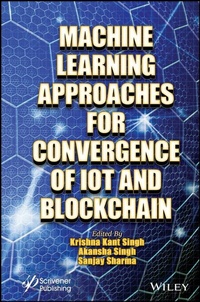
Machine Learning Approaches for Convergence of IoT and Blockchain
Description

The unique aspect of this book is that its focus is the convergence of machine learning, IoT, and blockchain in a single publication.
Blockchain technology and the Internet of Things (IoT) are two of the most impactful trends to have emerged in the field of machine learning. Although there are a number of books available solely on the subjects of machine learning, IoT and blockchain technology, no such book has been available which focuses on machine learning techniques for IoT and blockchain convergence until now. Thus, this book is unique in terms of the topics it covers. Designed as an essential guide for all academicians, researchers, and those in industry who are working in related fields, this book will provide insights into the convergence of blockchain technology and the IoT with machine learning.
Highlights of the book include:
* Examines many industries such as agriculture, manufacturing, food production, healthcare, the military, and IT
* Security of the Internet of Things using blockchain and AI
* Developing smart cities and transportation systems using machine learning and IoT
Audience
The target audience of this book is professionals and researchers (artificial intelligence specialists, systems engineers, information technologists) in the fields of machine learning, IoT, and blockchain technology.
More details
Other editions
Additional editions
Persons
Krishna Kant Singh is an associate professor in the Faculty of Engineering & Technology, Jain (Deemed-to-be University), Bengaluru, India. Dr. Singh has acquired BTech, MTech, and PhD (IIT Roorkee) in the area of machine learning and remote sensing. He has authored more than 50 technical books and research papers in international conferences and SCIE journals.
Akansha Singh is an associate professor in the Department of Computer Science Engineering in Amity University, Noida, India. Dr. Singh has acquired BTech, MTech, and PhD (IIT Roorkee) in the area of neural networks and remote sensing. She has authored more than 40 technical books and research papers in international conferences and SCIE journals. Her area of interest includes mobile computing, artificial intelligence, machine learning, digital image processing.
Sanjay Kumar Sharma PhD is professor and Head in the Department of Electronics and Communication Engineering at KIET Group of Institutions. Dr. Sanjay Sharma has a total of 24 years of teaching and research experience. He has more than 45 publications in journals and international conferences.
Content
Preface xi
1 Blockchain and Internet of Things Across Industries 1
Ananya Rakhra, Raghav Gupta and Akansha Singh
1.1 Introduction 1
1.2 Insight About Industry 3
1.2.1 Agriculture Industry 5
1.2.2 Manufacturing Industry 5
1.2.3 Food Production Industry 6
1.2.4 Healthcare Industry 7
1.2.5 Military 7
1.2.6 IT Industry 8
1.3 What is Blockchain? 8
1.4 What is IoT? 11
1.5 Combining IoT and Blockchain 14
1.5.1 Agriculture Industry 15
1.5.2 Manufacturing Industry 17
1.5.3 Food Processing Industry 18
1.5.4 Healthcare Industry 20
1.5.5 Military 21
1.5.6 Information Technology Industry 24
1.6 Observing Economic Growth and Technology's Impact 25
1.7 Applications of IoT and Blockchain Beyond Industries 28
1.8 Conclusion 32
References 33
2 Layered Safety Model for IoT Services Through Blockchain 35
Anju Malik and Bharti Sharma
2.1 Introduction 36
2.1.1 IoT Factors Impacting Security 38
2.2 IoT Applications 39
2.3 IoT Model With Communication Parameters 40
2.3.1 RFID (Radio Frequency Identification) 40
2.3.2 WSH (Wireless Sensor Network) 40
2.3.3 Middleware (Software and Hardware) 40
2.3.4 Computing Service (Cloud) 41
2.3.5 IoT Software 41
2.4 Security and Privacy in IoT Services 41
2.5 Blockchain Usages in IoT 44
2.6 Blockchain Model With Cryptography 44
2.6.1 Variations of Blockchain 45
2.7 Solution to IoT Through Blockchain 46
2.8 Conclusion 50
References 51
3 Internet of Things Security Using AI and Blockchain 57
Raghav Gupta, Ananya Rakhra and Akansha Singh
3.1 Introduction 58
3.2 IoT and Its Application 59
3.3 Most Popular IoT and Their Uses 61
3.4 Use of IoT in Security 63
3.5 What is AI? 64
3.6 Applications of AI 65
3.7 AI and Security 66
3.8 Advantages of AI 68
3.9 Timeline of Blockchain 69
3.10 Types of Blockchain 70
3.11 Working of Blockchain 72
3.12 Advantages of Blockchain Technology 74
3.13 Using Blockchain Technology With IoT 74
3.14 IoT Security Using AI and Blockchain 76
3.15 AI Integrated IoT Home Monitoring System 78
3.16 Smart Homes With the Concept of Blockchain and AI 79
3.17 Smart Sensors 81
3.18 Authentication Using Blockchain 82
3.19 Banking Transactions Using Blockchain 83
3.20 Security Camera 84
3.21 Other Ways to Fight Cyber Attacks 85
3.22 Statistics on Cyber Attacks 88
3.23 Conclusion 90
References 90
4 Amalgamation of IoT, ML, and Blockchain in the Healthcare Regime 93
Pratik Kumar, Piyush Yadav, Rajeev Agrawal and Krishna Kant Singh
4.1 Introduction 93
4.2 What is Internet of Things? 95
4.2.1 Internet of Medical Things 97
4.2.2 Challenges of the IoMT 97
4.2.3 Use of IoT in Alzheimer Disease 99
4.3 Machine Learning 100
4.3.1 Case 1: Multilayer Perceptron Network 101
4.3.2 Case 2: Vector Support Machine 102
4.3.3 Applications of the Deep Learning in the Healthcare Sector 103
4.4 Role of the Blockchain in the Healthcare Field 104
4.4.1 What is Blockchain Technology? 104
4.4.2 Paradigm Shift in the Security of Healthcare Data Through Blockchain 105
4.5 Conclusion 106
References 106
5 Application of Machine Learning and IoT for Smart Cities 109
Nilanjana Pradhan, Ajay Shankar Singh, Shrddha Sagar, Akansha Singh and Ahmed A. Elngar
5.1 Functionality of Image Analytics 110
5.2 Issues Related to Security and Privacy in IoT 112
5.3 Machine Learning Algorithms and Blockchain Methodologies 114
5.3.1 Intrusion Detection System 116
5.3.2 Deep Learning and Machine Learning Models 118
5.3.3 Artificial Neural Networks 118
5.3.4 Hybrid Approaches 119
5.3.5 Review and Taxonomy of Machine Learning 120
5.4 Machine Learning Open Source Tools for Big Data 121
5.5 Approaches and Challenges of Machine Learning Algorithms in Big Data 123
5.6 Conclusion 127
References 127
6 Machine Learning Applications for IoT Healthcare 129
Neha Agarwal, Pushpa Singh, Narendra Singh, Krishna Kant Singh and Rohit Jain
6.1 Introduction 130
6.2 Machine Learning 130
6.2.1 Types of Machine Learning Techniques 131
6.2.1.1 Unsupervised Learning 131
6.2.1.2 Supervised Learning 131
6.2.1.3 Semi-Supervised Learning 132
6.2.1.4 Reinforcement Learning 132
6.2.2 Applications of Machine Learning 132
6.2.2.1 Prognosis 132
6.2.2.2 Diagnosis 134
6.3 IoT in Healthcare 135
6.3.1 IoT Architecture for Healthcare System 135
6.3.1.1 Physical and Data Link Layer 136
6.3.1.2 Network Layer 137
6.3.1.3 Transport Layer 137
6.3.1.4 Application Layer 137
6.4 Machine Learning and IoT 138
6.4.1 Application of ML and IoT in Healthcare 138
6.4.1.1 Smart Diagnostic Care 138
6.4.1.2 Medical Staff and Inventory Tracking 139
6.4.1.3 Personal Care 139
6.4.1.4 Healthcare Monitoring Device 139
6.4.1.5 Chronic Disease Management 139
6.5 Conclusion 140
References 140
7 Blockchain for Vehicular Ad Hoc Network and Intelligent Transportation System: A Comprehensive Study 145
Raghav Sharma, Anirudhi Thanvi, Shatakshi Singh, Manish Kumar and Sunil Kumar Jangir
7.1 Introduction 146
7.2 Related Work 149
7.3 Connected Vehicles and Intelligent Transportation System 152
7.3.1 VANET 153
7.3.2 Blockchain Technology and VANET 153
7.4 An ITS-Oriented Blockchain Model 155
7.5 Need of Blockchain 156
7.5.1 Food Track and Trace 159
7.5.2 Electric Vehicle Recharging 160
7.5.3 Smart City and Smart Vehicles 161
7.6 Implementation of Blockchain Supported Intelligent Vehicles 164
7.7 Conclusion 165
7.8 Future Scope 166
References 167
8 Applications of Image Processing in Teleradiology for the Medical Data Analysis and Transfer Based on IOT 175
S. N. Kumar, A. Lenin Fred, L. R. Jonisha Miriam, Parasuraman Padmanabhan, Balázs Gulyás and Ajay Kumar H.
8.1 Introduction 176
8.2 Pre-Processing 178
8.2.1 Principle of Diffusion Filtering 178
8.3 Improved FCM Based on Crow Search Optimization 183
8.4 Prediction-Based Lossless Compression Model 184
8.5 Results and Discussion 188
8.6 Conclusion 202
Acknowledgment 202
References 203
9 Innovative Ideas to Build Smart Cities with the Help of Machine and Deep Learning and IoT 205
ShylajaVinaykumar Karatangi, Reshu Agarwal, Krishna Kant Singh and Ivan Izonin
9.1 Introduction 206
9.2 Related Work 207
9.3 What Makes Smart Cities Smart? 208
9.3.1 Intense Traffic Management 208
9.3.2 Smart Parking 209
9.3.3 Smart Waste Administration 210
9.3.4 Smart Policing 211
9.3.5 Shrewd Lighting 211
9.3.6 Smart Power 211
9.4 In Healthcare System 212
9.5 In Homes 213
9.6 In Aviation 213
9.7 In Solving Social Problems 213
9.8 Uses of AI-People 214
9.8.1 Google Maps 214
9.8.2 Ridesharing 214
9.8.3 Voice-to-Text 215
9.8.4 Individual Assistant 215
9.9 Difficulties and Profit 215
9.10 Innovations in Smart Cities 216
9.11 Beyond Humans Focus 217
9.12 Illustrative Arrangement 217
9.13 Smart Cities with No Differentiation 218
9.14 Smart City and AI 219
9.15 Further Associated Technologies 221
9.15.1 Model Identification 221
9.15.2 Picture Recognition 221
9.15.3 IoT 222
9.15.4 Big Data 223
9.15.5 Deep Learning 223
9.16 Challenges and Issues 224
9.16.1 Profound Learning Models 224
9.16.2 Deep Learning Paradigms 225
9.16.3 Confidentiality 226
9.16.4 Information Synthesis 226
9.16.5 Distributed Intelligence 227
9.16.6 Restrictions of Deep Learning 228
9.17 Conclusion and Future Scope 228
References 229
Index 233
1
Blockchain and Internet of Things Across Industries
Ananya Rakhra*, Raghav Gupta and Akansha Singh
Department of CSE, ASET, Amity University, Noida, Uttar Pradesh, India
Abstract
In this chapter, we will come across different kinds of industries and how Internet of Things and blockchain technologies are applied to them. We commence with an overview about what an industry is and the nature of various industries, followed by knowledge about the technologies of IoT and blockchain. These technologies have facilitated advancement and ease in one's day-to-day life, the industrial sector being one among many where its impact is prevalent notably. Further, incorporation of these technologies across various sectors of industry and their scope has been focused upon. The advancements brought about, especially in fields such as that of healthcare sector, have revolutionized the previously existing methods, helping us attain better care and improved life expectancy. Also, the scope of these technologies beyond the industrial sector has been discussed. These technologies have facilitated specialization, so much so that its positive imprint can clearly be seen onto the nation's economy. This text on the whole allows the readers to attain a clear understanding and also unveils the great scope for further research and development offered by this sphere.
Keywords: IoT, Internet of Things, blockchain, technology, industry, smart devices
1.1 Introduction
Through the course of this chapter, we will come across various types of industries and how implementing IoT and blockchain through these industries will help facilitate the achievement of enormous endeavors beyond the scope one could think of a few years ago. These technologies have widened prospective and enhanced scope across varied fields; we will attempt to obtain an in-depth understanding of the same. Industries form the backbone of a country's economy. Any organization that is involved in large-scale production or providing services to a lot of customers is categorized as an industry. According to the purpose of the industry, they are classified as the primary, secondary, and tertiary sectors. Classification based on the organisational framework of an industry is done as organized and unorganized sectors of industry. Categorization may also be done according to the ownership of the firm as either public or private sector industry. Each industry has varying demands and requirements based on the nature of production or service that they intend to provide. We will explore this phenomenon through the domains of various industries, for example, the agriculture industry, manufacturing industry, food production units, healthcare, military, it sector, and banking. We will see what the goals and functions of these industries are and how the efficiency and output can be highly improved, along with reducing human effort and also increasing accuracy. Then, we will move on to learn about the blockchain technology, its mechanism, requirements, advantages, and disadvantages. Blockchain technology is basically the practice of storing data into blocks that are connected to each other in the form of a chain. The distinctive feature of this technology is that once the data is entered into this chain it is immutable, which provides a very strong system to prevent any sort of tampering with the stored data, hence ensuring high level security. The chains are also encrypted and decentralized which further enhance its security. Next, we will look into what IoT is, how it works, and how it is beneficial to us. IoT is the acronym for Internet of Things, wherein we basically connect the physical devices to each other over a network enabling them to communicate and share information among each other. Here, devices are able to gain knowledge about their surroundings with the help of sensors. Common examples of IoT that have been incorporated in daily life are smart watches, smart lighting for households, surveillance cameras, etc. After understanding the functioning and applications of these, we will further see their combined applications of these two technologies in the industry. Incorporating these technologies in the industry opens up a very broad perspective to achieve new levels of specialization. Human tasks have been eased and accuracy and precision has spiked because of these. Profits made by companies have also seen increment; hence, it has proved beneficial to industries in a lot many ways. Further through the course of this chapter, after looking into the non-industrial applications of these technologies in depth, exploring various domains of implementation we will next see the applications and scope of these technologies beyond industries as well. In particular, we will be looking into how they have helped enhance life in different possible ways. First, we will get to know what smart homes are and study the involvement of these technologies in its creation and implementation. This advancement has brought about a lot of ease and pace into one's day-to-day household tasks and also evolved one's lifestyle. Then, we will read about how security via surveillance has been technologically boosted with the coming of IoT and blockchain into this sphere. The ways of monitoring have been specialized and the security of the data thus obtained is also highly increased due the usage of blockchain. Life and property are now being better guarded with the help of these. Smart solutions such as automated street lighting have also come up which contribute toward saving energy and resources, and incorporation of security mechanisms such as surveillance along with the street lights making the equipment multi-purpose and more useful. Let us begin with introducing what an industry is and how it functions.
1.2 Insight About Industry
In today's time, the types and scope of industries are massive. Industries have met with a lot of varied applications and requirements and are serving to facilitate the same. These industries provide to serve needs of mankind, ranging from the most basic necessities to comfort and exotic offerings. Industry can be referred to as any large-scale productive activity. It is these industries that strengthen a nation's economy, fulfils its needs, and provide safety, security, etc. Most spheres around us are industries in themselves. Some sectors of industry are depicted in Figure 1.1. The main features of any industry are large-scale production, specialization, research and development, mechanization, standardization, and management. We will now look into types or classification of industries and get to know about each one of them individually [1]. Industries can broadly be classified into the sectors: primary, secondary, and tertiary. The primary sector comprises of industries that are mainly involved in the extraction of raw materials, for examples, industries extracting metals from their ore, mining, and farming.
The secondary sector is where industries perform manufacturing and packaging of goods and commodities, examples of this sector of industries include food processing industries, car part manufacturing, and other such industries. The tertiary sector is also known as the service sector; industries such as IT, defence services, judicial workforce, banking, and teaching come under this category. Other bases of classification are either as organized and unorganized sector industry or as public sector or private sector industry. Organized industry sector is such that all its employees are assured work throughout their employment and there terms for the same are fixed and regular. In contrast, the unorganized sector provides flexible employment at the discretion of the employer and there exist no regularity or guarantee of the employment term, also such institutions may not necessarily be registered with the government. Public sector industries are those which are owned, funded, and managed by the government and like most other government jobs provide benefits to its workers such as pension. Private sector industries are owned by individual or partnerships between individuals.
Figure 1.1 Industries in focus.
The main motive of the individual running the company is to earn profit and these are not state controlled. The terms of employment may vary from company to company based on the interests of the owner. In India, most of the private sector industries are known to be paying higher salaries to its employees as compared to government industries but government jobs are seen to offer more job security benefits while under employment and even after it. All these are interdependent, we may say that primary sector industries are responsible for production of raw materials, the secondary sector process these raw materials to transform them into useful goods, and the tertiary sector utilizes and makes these products available to the consumers. Let us now focus on some industries and understand their requirements and production mechanisms.
In this part, we will be discussing about all the various industries, their functioning, and the importance that they hold. Let us understand the working of a few industries.
1.2.1 Agriculture Industry
This is one of the most important sectors as it caters to resolve the hunger of the country's entire population. This industry is the source of livelihood to about 58% of India's population. Most of the agricultural plots happen to be in the rural areas where development is far behind that in the bigger towns and cities. In India, particularly, agriculture is very widely practiced and it serves...
