

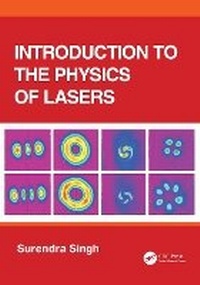
Introduction to the Physics of Lasers
Will be published approx. on 14. October 2026
458 pages
E-Book
978-1-040-54255-2 (ISBN)
Description

This textbook provides an accessible introduction to laser physics, exploring three key questions: what is special about laser light, what is the physics underlying laser light generation and how it can be used to manipulate laser light.
The material is presented in a manner that helps the reader develop an understanding of the underlying physics principles and processes without getting bogged down in mathematical details but there is enough mathematics for the understanding to be quantitative.
The book begins by describing the special properties of laser light and focuses on the physics of light-matter interaction to understand how it acquires them. It builds upon Maxwells equations for light and the classical electron oscillator model for the atoms, augmented with a quantum mechanical picture of atomic energy levels, to provide an accurate physical understanding of light-matter interaction. This approach bypasses the need for a course in quantum theory.
Derivations of key equations are included not only to help readers follow the development of the subject, but also to illustrate that to approximate, simplify, and get analytic results is integral to understanding any complex phenomenon. Subjects such as nonlinear pulse propagation and nonlinear optics are discussed, but only at a level that should help readers to get started in these fields. The choice of topics has been limited to atomic/molecular lasers to allow for their coverage in one semester long course.
Problems, references and illustrations are included throughout the book, making it an ideal textbook for advanced undergraduate and graduate physics and engineering students. Students do not require prior knowledge of physics much beyond an undergraduate-level introduction to electromagnetic theory, including Maxwell's equations, polarization in atomic media and electromagnetic wave propagation.
Key features:
? Provides a qualitative and quantitative understanding and appreciation of special properties of laser light.
? Explores quantum statistics of laser light
? Presents an analytical approach to pulse formation
The material is presented in a manner that helps the reader develop an understanding of the underlying physics principles and processes without getting bogged down in mathematical details but there is enough mathematics for the understanding to be quantitative.
The book begins by describing the special properties of laser light and focuses on the physics of light-matter interaction to understand how it acquires them. It builds upon Maxwells equations for light and the classical electron oscillator model for the atoms, augmented with a quantum mechanical picture of atomic energy levels, to provide an accurate physical understanding of light-matter interaction. This approach bypasses the need for a course in quantum theory.
Derivations of key equations are included not only to help readers follow the development of the subject, but also to illustrate that to approximate, simplify, and get analytic results is integral to understanding any complex phenomenon. Subjects such as nonlinear pulse propagation and nonlinear optics are discussed, but only at a level that should help readers to get started in these fields. The choice of topics has been limited to atomic/molecular lasers to allow for their coverage in one semester long course.
Problems, references and illustrations are included throughout the book, making it an ideal textbook for advanced undergraduate and graduate physics and engineering students. Students do not require prior knowledge of physics much beyond an undergraduate-level introduction to electromagnetic theory, including Maxwell's equations, polarization in atomic media and electromagnetic wave propagation.
Key features:
? Provides a qualitative and quantitative understanding and appreciation of special properties of laser light.
? Explores quantum statistics of laser light
? Presents an analytical approach to pulse formation
More details
Language
English
Place of publication
London
United Kingdom
Publishing group
Taylor & Francis Ltd
Target group
College/higher education
Illustrations
3 Tables, black and white; 176 Line drawings, black and white; 176 Illustrations, black and white
ISBN-13
978-1-040-54255-2 (9781040542552)
Copyright in bibliographic data and cover images is held by Nielsen Book Services Limited or by the publishers or by their respective licensors: all rights reserved.
Schweitzer Classification
Other editions
Additional editions
Surendra Singh
Introduction to the Physics of Lasers
Book
approx. 10/2026
1st Edition
CRC Press
€119.50
Not yet published
Person
Surendra Singh received B.Sc. (Honors) and M.Sc. degrees in Nuclear Physics from Bananas Hindu University, India, where he was awarded the Chancellor's Gold Medal (1973) and Ph.D. in Quantum Optics from the University of Rochester, USA, working under the mentorship of Professor Leonard Mandel. His Ph.D. Thesis was awarded the Dexter Prize for Outstanding Physics Thesis. After finishing his Ph.D., he joined the University of Arkansas in 1982 as an assistant professor of physics where he is currently University Professor of Physics. He was a Visiting Fellow of JILA in Professor John Hall's lab and has held honorary visiting professorships at IITMadras, India and University of Ulm, Germany. The author has taught a wide spectrum of courses ranging from large enrollment introductory physics courses to advanced graduate level courses in electrodynamics, quantum mechanics, laser physics, classical, quantum and nonlinear optics and developed lab-based courses in lasers and optics. He has also co-authored a graduate-level textbook on quantum mechanics. His research has made experimental and theoretical contributions to advancing the knowledge of quantum and classical noise in lasers and nonlinear optical systems and phase and polarization properties of laser beams. The author served as Chair of the Physics Department at the University of Arkansas for thirteen years. The department made multifaceted progress during his tenure as department chair. He is a Fellow of the American Physical Society and was designated an Outstanding Referee by the APS journals.
Content
1. Laser Light. 2. Maxwell's Equations, Waves, and Rays. 3.Paraxial Beam Solutions of Wave Equation. 4. Laser Resonators. 5. Electron Oscillator Model of Light-Matter Interaction . 6. Quantum Mechanics of Atomic Response . 7. Population Inversion, Saturation, and Laser Systems. 8: Laser Threshold and Oscillations . 9.Buildup of Oscillations and Quantum Statistics of Laser Light . 10. Laser Transients and Q-switched Operation . 11. Mode-locking and Short Pulse Generation in Lasers. 12. Nonlinear Optics.
