

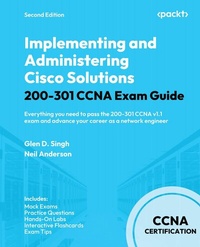
Implementing and Administering Cisco Solutions 200-301 CCNA Exam Guide
Description

Key Features
Complete coverage of all CCNA 200-301 v1.1 exam objectives aligned with Cisco's official blueprint
Build foundational skills in switching, routing, IP services, security, wireless, and automation
Configure networks with through 30+ hands-on labs using Cisco Packet Tracer scenarios
Test your exam readiness with 2 mocks, 170+ review questions, and detailed explanations
Book DescriptionKickstart your networking career with confidence by acing the CCNA exam on your first try. The Cisco Certified Network Associate (CCNA) certification opens doors to high-demand roles in networking and security. This fully updated second edition makes exam success achievable, even if you're just starting out. Aligned with the latest 200-301 CCNA v1.1 blueprint, it combines real-world examples, step-by-step labs, and clear explanations to help you master all six exam domains. You'll build a solid foundation in switching, routing, IP addressing, network services, wireless technologies, security, and automation. Along the way, you'll sharpen your skills with hands-on configuration tasks, visual diagrams, and simulation exercises using Cisco Packet Tracer. Each chapter includes review questions that reflect actual exam difficulty, helping you stay on track and gauge your readiness. You'll also get access to online extras: over 170 practice questions, two full-length mock exams, interactive flashcards, exam tips from Cisco experts, and more than 30 practice labs. From exam strategies to high-demand skills, this guide offers everything you need to get certified, hired, or grow in your network engineering and security administration roles.What you will learn
Understand how switching, routing, and IP addressing work in network environments
Create VLANs and configure static and dynamic routing using Cisco CLI commands
Set up IP services including DHCP, NAT, DNS, and NTP across network devices
Apply wireless settings, security features, and access control to secure networks
Use Cisco Packet Tracer to build, test, and troubleshoot network configurations
Solve realistic practice questions that mirror the actual CCNA 200-301 format
Who this book is forThis exam guide is for IT professionals looking to advance their network engineering and security administration careers. If you're aiming to earn your Cisco CCNA certification and launch a career as a network security professional, this book is the perfect resource. While no prior knowledge of Cisco technologies is required, a basic understanding of industry-standard networking fundamentals will help you easily grasp the topics covered.
All prices
More details
Other editions
Additional editions
Persons
Glen loves teaching and mentoring others while sharing his wealth of knowledge and experience as an author. He has written many books, which focus on vulnerability discovery and exploitation, threat detection, intrusion analysis, incident response, network security, and enterprise networking. As an aspiring game changer, Glen is passionate about increasing cybersecurity awareness in his homeland, Trinidad and Tobago. Neil Anderson has been passionate about IT for over 20 years.
Since 2007, Neil has specialized in developing and delivering technical training while also offering consultancy services and mentoring IT professionals. He has trained engineers responsible for designing and implementing some of the largest Cloud and Data Center deployments across the Asia Pacific region and beyond.
Neil's commitment to quality training and personalized support has earned him the trust of leading companies and countless IT professionals. He takes pride in hearing how his training has helped others advance their careers and achieve industry-recognized certifications.
Having experienced the challenges of the IT industry firsthand, Neil understands what it takes to succeed. His mission is to empower IT professionals with the skills and confidence they need to reach the next level in their careers.
Content
Introduction to Networking
Getting Started with Cisco IOS Devices
Network Architectures and Physical Infrastructure
IPv4 and IPv6 Addresses
Practical Subnetting
Wireless Architectures and Virtualization
Implementing VLANs and Interswitch Connectivity
EtherChannels and Layer 2 Discovery Protocols
Understanding and Configuring Spanning Tree
Interpreting Routing Components
Understanding Static and Dynamic Routing
Network Address Translation
Network Services and IP Operations
Exploring Network Security
Device Access Controls and VPNs
Implementing Access Controls Lists (ACLs)
Implementing Layer 2 and Wireless Security
Network Automation and Programmability Techniques
Preface
Implementing and Administering Cisco Solutions 200-301 CCNA Exam Guide, Second Edition, focuses on a range of Cisco technologies that will help you gain a firm understanding of networking, IP connectivity, IP services, security, network programmability, and automation.
Throughout this book, you will be exposed to various networking components and discover how they all work together in an enterprise network. You will also learn how to configure Cisco devices using the command-line interface (CLI) to provide network access, services, security, connectivity, and management.
During the course of this book, you will come across different hands-on labs with real-world scenarios that are designed to help you gain essential on-the-job skills and experience. Furthermore, this book will teach you networking technologies and solutions to implement and administer enterprise networks and infrastructure using Cisco solutions.
By the end of this book, you will have gained the confidence to pass the 200-301 CCNA examination and be well versed in a variety of network administration and security engineering solutions.
Who This Book Is For
This book is designed for beginners who are interested in starting a career in the field of networking and students who are pursuing the Cisco Certified Network Associate (CCNA) 200-301 v1.1 certification. In addition, this book is also for any IT professional who is interested in gaining a career boost and learning how to implement and administer Cisco solutions in small to medium-sized networks.
What This Book Covers
Chapter 1, Introduction to Networking, introduces the concepts of network models and the role and function of common networking devices.
Chapter 2, Getting Started with Cisco IOS Devices, demonstrates how to set up a small Cisco environment, perform basic device configurations, and set up remote access.
Chapter 3, Network Architectures and Physical Infrastructure, covers the fundamentals of common network architectures such as the 2-Tier, 3-Tier, and Spine-Leaf models. In addition, this chapter covers common cabling types and interface issues.
Chapter 4, IPv4 and IPv6 Addressing, explores the fundamentals of IPv4 and IPv6 addresses, types of addresses, and how to convert an IPv4 address between binary and decimal.
Chapter 5, Practical Subnetting, provides an in-depth and practical discussion on how to get started with designing an IPv4 address scheme for an organization and demonstrates how to perform subnetting.
Chapter 6, Wireless Architectures and Virtualization, covers the fundamentals of Cisco wireless architectures and common operating modes of access points. Additionally, this chapter explores the importance of using virtualization within an IT environment.
Chapter 7, Implementing VLANs and Interswitch Connectivity, introduces the concepts of creating virtual local area networks and the importance of logically segmenting a physical network. This chapter also covers how to extend VLANs over a Layer 2 network and how to set up inter-VLAN routing.
Chapter 8, EtherChannels and Layer 2 Discovery Protocols, explores the importance of using link aggregation between switches such as EtherChannels. This chapter also covers common Layer 2 protocols used by network professionals to discover connected networking devices.
Chapter 9, Understanding and Configuring Spanning Tree, covers the role and function of Spanning Tree within a network and demonstrates how to configure and troubleshoot Spanning Tree within a Cisco environment.
Chapter 10, Interpreting Routing Components, explains the fundamentals of routing and the various components of a routing table within a Cisco router.
Chapter 11, Understanding Static Routing, Dynamic Routing, and First Hop Redundancy, explains how to configure static routing and dynamic routing within a Cisco environment. In addition, this chapter explains the importance and use cases of first-hop redundancy on a network.
Chapter 12, Configuring Network Address Translation (NAT), explains the importance of NAT within an organization and provides the hands-on skills needed to administer and troubleshoot various NAT implementations.
Chapter 13, Implementing Network Services and IP Operations, explains and demonstrates how to set up common network services such as Dynamic Host Configuration Protocol (DHCP), Domain Name System (DNS), Simple Network Management Protocol (SNMP), and Syslog on a Cisco network.
Chapter 14, Exploring Network Security, explores the fundamentals and importance of network security concepts.
Chapter 15, Configuring Device Access Controls and VPNs, demonstrates how to secure Cisco IOS devices and establish site-to-site and remote access VPNs using Cisco devices.
Chapter 16, Implementing Access Control Lists (ACLs), covers the importance of using ACLs on a network to perform Layer 3 and Layer 4 traffic filtering between networks using Cisco IOS routers.
Chapter 17, Implementing Layer 2 and Wireless Security, covers how to set up common Layer 2 security features on Cisco IOS switches to prevent common attacks such as man-in-the-middle, CAM table flooding, MAC address spoofing, and rogue DHCP on a network.
Chapter 18, Network Automation and Programmability, broaches the fact that the world of networking is moving toward automation, and network engineers will now need to learn how automation can improve efficiency in network deployment and management. This chapter introduces you to network automation techniques and programmability.
How to Get the Most Out of This Book
This book is crafted to equip you with the knowledge and skills necessary to excel in the 200-301 CCNA v1.1 exam through memorable explanations of major domain topics. It covers the five critical core domains for implementing and administering Cisco solutions that candidates must be proficient in to pass the exam. For each domain, you'll work through content that reflects real-world network administration challenges. At certain points in the book, you will assess your understanding by taking chapter-specific quizzes. This not only prepares you for the 200-301 CCNA v1.1 exam but also allows you to dive deeper into a topic as needed based on your results.
Online Practice Resources
With this book, you will unlock unlimited access to our online exam-prep platform (Figure 0.1). This is your place to practice everything you learn in the book.
How to Access These Materials
To learn how to access the online resources, refer to Chapter 19, Accessing the Online Practice Resources, at the end of this book.
Figure 0.1: Online exam-prep platform on a desktop device
Sharpen your knowledge of CCNA concepts with multiple sets of mock exams, interactive flashcards, and exam tips accessible from all modern web browsers.
Download the practice lab files
You can download the practice lab files for this book from GitHub at https://github.com/PacktPublishing/Implementing-and-Administering-Cisco-Solutions-200-301-CCNA-Exam-Guide-Second-Edition. If there's an update to the lab files, it will be updated in the GitHub repository.
We also have other code bundles from our rich catalog of books and videos available at https://github.com/PacktPublishing/. Check them out!
Conventions Used
There are several text conventions used throughout this book.
Code in text: Indicates code words in text, database table names, folder names, filenames, file extensions, pathnames, dummy URLs, user input, and X (formerly Twitter) handles. Here is an example: "Assign DHCP snooping for either a single VLAN or a range of VLANs by using the ip dhcp snooping vlan vlan-id command in global configuration mode.
A block of code is set as follows:
GigabitEthernet0/1 is up, line protocol is up (connected) Description: Connected to Wide Area Network (WAN) Internet address is 172.16.1.1/24Bold: Indicates a new term or an important word. Here is an example: "Since DHCP clients are expected to send only DHCP Discover and DHCP Request messages into an untrusted port, if an...
