

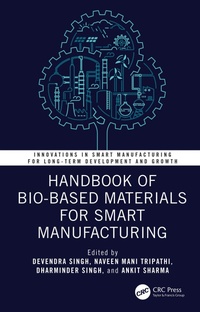
Handbook of Bio-Based Materials for Smart Manufacturing
Published on 23. December 2025
415 pages
978-1-040-59309-7 (ISBN)
Description

In recent years, the convergence of biotechnology and manufacturing has ushered in a new era of sustainable innovation and efficiency. Incorporating bio-based materials into smart manufacturing processes has become a crucial strategy to minimize environmental impact, promote circularity, and propel technological advancements across various industries. This handbook, divided into four key sections, is a comprehensive overview and a holistic approach to the principles, applications, challenges, and opportunities associated with integrating bio-based materials into modern manufacturing practices.
Handbook of Bio-Based Materials for Smart Manufacturing begins with an exploration of fundamental characteristics, properties, and processing techniques. From bio-based polymers to composites and blends, readers will gain insights into the diverse array of materials derived from renewable biomass sources and their potential applications in smart manufacturing environments. The handbook illustrates the role of bio-based materials in additive manufacturing, coatings, packaging, energy applications, automotive, aerospace, construction, biomedical, textiles, electronics, and more, showcasing the versatility and adaptability of these materials across various sectors.
By examining emerging trends, future directions, and the vision for sustainable manufacturing practices, readers will gain valuable insights into the changing landscape of bio-based materials and their potential impact on the future of smart manufacturing. This handbook is a valuable resource for researchers, engineers, industry professionals, and students seeking to deepen their understanding of bio-based materials and their role in driving sustainable innovation in manufacturing.
Handbook of Bio-Based Materials for Smart Manufacturing begins with an exploration of fundamental characteristics, properties, and processing techniques. From bio-based polymers to composites and blends, readers will gain insights into the diverse array of materials derived from renewable biomass sources and their potential applications in smart manufacturing environments. The handbook illustrates the role of bio-based materials in additive manufacturing, coatings, packaging, energy applications, automotive, aerospace, construction, biomedical, textiles, electronics, and more, showcasing the versatility and adaptability of these materials across various sectors.
By examining emerging trends, future directions, and the vision for sustainable manufacturing practices, readers will gain valuable insights into the changing landscape of bio-based materials and their potential impact on the future of smart manufacturing. This handbook is a valuable resource for researchers, engineers, industry professionals, and students seeking to deepen their understanding of bio-based materials and their role in driving sustainable innovation in manufacturing.
More details
Series
Language
English
Place of publication
London
United Kingdom
Publishing group
Taylor & Francis Ltd
Target group
Professional and scholarly
Illustrations
44 Tables, black and white; 89 Line drawings, black and white; 22 Halftones, black and white; 111 Illustrations, black and white
File size
25,63 MB
ISBN-13
978-1-040-59309-7 (9781040593097)
Copyright in bibliographic data and cover images is held by Nielsen Book Services Limited or by the publishers or by their respective licensors: all rights reserved.
Schweitzer Classification
Other editions
Additional editions
Devendra Singh | Naveen Mani Tripathi | Dharminder Singh
Handbook of Bio-Based Materials for Smart Manufacturing
Book
approx. 12/2025
1st Edition
CRC Press
€234.30
Not yet published
Persons
Dr. Devendra Singh is an Assistant Professor in the Institute of Biosciences and Technology at Shri Ramswaroop Memorial University, Barabanki, Uttar Pradesh, India. With a remarkable academic background and extensive research experience, Dr. Singh has established himself as a prominent figure in the biotechnology field. His academic journey began with a Master of Technology (M.Tech.) from Amity University, where he laid the foundation for his future research endeavors. He further pursued his Doctor of Philosophy (Ph.D.) in Biotechnology from the Department of Biotechnology, Motilal Nehru National Institute of Technology Allahabad, where he delved deeper into the intricacies of biotechnology.
Following his Ph.D., Dr. Singh gained valuable research experience through a postdoctoral fellowship in the Department of Biotechnology at the National Institute of Technology, Warangal, Telangana, India. This experience honed his research skills and gave him a deeper understanding of the latest advancements in the field. With over three years of teaching experience, Dr. Singh has developed a unique ability to effectively communicate complex scientific concepts to students, making him an exceptional educator.
Dr. Singh's research output is remarkable, with over 51 research papers published in esteemed journals of national and international repute, boasting a cumulative impact factor of more than 71. His contributions to the biotechnology field are further amplified by his numerous book chapters, with over 33 chapters published to date. Furthermore, Dr. Singh has been granted 3 patent and has had the technology of two patents transferred, demonstrating his innovative approach to biotechnology. Dr. Singh currently runs one CSTUP project and one In-house project under his name. His research interests span various areas, including additive, environmental biotechnology, microbiology, pharmaceutical biotechnology, intellectual property rights (IPR), and biomedical applications.
Dr. Naveen Mani Tripathi is currently working as an Assistant Professor in the Mechanical Engineering Department of Rajiv Gandhi Institute of Petroleum Technology, Jais, Ministry of Petroleum and Natural Gas, Government of India. He completed his PhD from the Mechanical Engineering Department of the Ben-Gurion University of the Negev, Israel. After PhD, he worked as a Particle Scientist in Belgium. His post-doctoral research is from the Chair of Process System Engineering of the Technical University of Munich, Germany. He is awarded with many fellowships, such as GATE, GRE, Kreitman, TUM University Foundation Fellow, and Alexander von Humboldt Fellow. His diversified research areas are Powder Rheology, Additive and Smart Manufacturing, Renewable Energy, and Thermo-Fluid. He has more than 10 years or teaching and research experience. It also includes 5 patents and more than 50 Journals/conference/book chapters publications. He is also an editor of a book, titled: Advances in Pre- and Post-Additive Manufacturing Processes, CRC press. He is voluntarily working as an editorial board member and review editor for more than 20 journals. He is the Editor of special issue of the Scopus indexed journals i.e. Recent Patents on Mechanical Engineering, Betham Science. He also works as mentor and advisor for different institutional bodies.
Dr Dharminder Singh is currently working as an Assistant Professor in the Department of Mechanical Engineering at Glasgow Caledonian University, UK. He completed his PhD in 2017 from Glasgow Caledonian University, following which he worked as a Research and Development Engineer on a Knowledge Transfer Partnership between the University of Huddersfield and Trillium Flow Technologies for three years, where he conducted research on the condition monitoring of control valves and the development of Smart valves. He has published his research in many conferences and journal papers. Dr. Singh's research interests are in the field of Additive Manufacturing, Thermo-fluids, CFD modelling of flow handling equipment, and application of Machine Learning.
Dr. Ankit Sharma presently holds the Associate Director (Research) position at the Centre for Research Impact & Outcome (CRIO) Department of Chitkara University, Punjab, India. He is also heading/publisher of the international peer-reviewed Chitkara journals/Chitkara University Publications. His admiring communication and relationship-building capabilities have always focused on the progress of his organization. He received his doctorate in Mechanical Engineering from the Thapar Institute of Engineering and Technology, Punjab, India. He is a passionate researcher with diversified research interests in manufacturing, medical devices, modern machining processes, additive manufacturing, tissue engineering, and not limited to that. He has published more than 55 scientific articles in various peer-reviewed reputed top-notch journals, conferences, and books in Manufacturing and Materials. Dr. Sharma is the founder and General Chair-Convenor of the annual flagship international conference-ICEMSMCI (International Conference on Emerging Materials, Smart Manufacturing, Computational Intelligence 2023, 2024 & 2025. He has also been organizing several other international Conferences such as the International Conference on Advanced Materials Sustainable Future (ICAMSF) 2025. He has chaired various international conferences in the domain of advanced manufacturing & materials. He has delivered several seminars, and keynote talks on international (USA, China, India) platforms and awarded with best research paper awards. He is currently doing consultancy with the health industry by developing biomedical device manufacturing machines. He has also delivered numerous invited industrial keynotes while addressing various topics related to smart manufacturing. Dr. Sharma is working on research commercialization and filed more than 30 patents. He also granted 4 international patents in his account along with 18+ granted patents. He contributed to interdisciplinary research, particularly where engineering and global burning issues related to the health, and manufacturing sectors intersect. Dr. Sharma edited/authored 5 books, serving as a Series editor of Taylor and Francis, Elsevier and ASME books. He is also serving as a guest editor and editorial bodies of several reputed SCI, ESCI, Scopus indexed international peer-reviewed Journals.
Following his Ph.D., Dr. Singh gained valuable research experience through a postdoctoral fellowship in the Department of Biotechnology at the National Institute of Technology, Warangal, Telangana, India. This experience honed his research skills and gave him a deeper understanding of the latest advancements in the field. With over three years of teaching experience, Dr. Singh has developed a unique ability to effectively communicate complex scientific concepts to students, making him an exceptional educator.
Dr. Singh's research output is remarkable, with over 51 research papers published in esteemed journals of national and international repute, boasting a cumulative impact factor of more than 71. His contributions to the biotechnology field are further amplified by his numerous book chapters, with over 33 chapters published to date. Furthermore, Dr. Singh has been granted 3 patent and has had the technology of two patents transferred, demonstrating his innovative approach to biotechnology. Dr. Singh currently runs one CSTUP project and one In-house project under his name. His research interests span various areas, including additive, environmental biotechnology, microbiology, pharmaceutical biotechnology, intellectual property rights (IPR), and biomedical applications.
Dr. Naveen Mani Tripathi is currently working as an Assistant Professor in the Mechanical Engineering Department of Rajiv Gandhi Institute of Petroleum Technology, Jais, Ministry of Petroleum and Natural Gas, Government of India. He completed his PhD from the Mechanical Engineering Department of the Ben-Gurion University of the Negev, Israel. After PhD, he worked as a Particle Scientist in Belgium. His post-doctoral research is from the Chair of Process System Engineering of the Technical University of Munich, Germany. He is awarded with many fellowships, such as GATE, GRE, Kreitman, TUM University Foundation Fellow, and Alexander von Humboldt Fellow. His diversified research areas are Powder Rheology, Additive and Smart Manufacturing, Renewable Energy, and Thermo-Fluid. He has more than 10 years or teaching and research experience. It also includes 5 patents and more than 50 Journals/conference/book chapters publications. He is also an editor of a book, titled: Advances in Pre- and Post-Additive Manufacturing Processes, CRC press. He is voluntarily working as an editorial board member and review editor for more than 20 journals. He is the Editor of special issue of the Scopus indexed journals i.e. Recent Patents on Mechanical Engineering, Betham Science. He also works as mentor and advisor for different institutional bodies.
Dr Dharminder Singh is currently working as an Assistant Professor in the Department of Mechanical Engineering at Glasgow Caledonian University, UK. He completed his PhD in 2017 from Glasgow Caledonian University, following which he worked as a Research and Development Engineer on a Knowledge Transfer Partnership between the University of Huddersfield and Trillium Flow Technologies for three years, where he conducted research on the condition monitoring of control valves and the development of Smart valves. He has published his research in many conferences and journal papers. Dr. Singh's research interests are in the field of Additive Manufacturing, Thermo-fluids, CFD modelling of flow handling equipment, and application of Machine Learning.
Dr. Ankit Sharma presently holds the Associate Director (Research) position at the Centre for Research Impact & Outcome (CRIO) Department of Chitkara University, Punjab, India. He is also heading/publisher of the international peer-reviewed Chitkara journals/Chitkara University Publications. His admiring communication and relationship-building capabilities have always focused on the progress of his organization. He received his doctorate in Mechanical Engineering from the Thapar Institute of Engineering and Technology, Punjab, India. He is a passionate researcher with diversified research interests in manufacturing, medical devices, modern machining processes, additive manufacturing, tissue engineering, and not limited to that. He has published more than 55 scientific articles in various peer-reviewed reputed top-notch journals, conferences, and books in Manufacturing and Materials. Dr. Sharma is the founder and General Chair-Convenor of the annual flagship international conference-ICEMSMCI (International Conference on Emerging Materials, Smart Manufacturing, Computational Intelligence 2023, 2024 & 2025. He has also been organizing several other international Conferences such as the International Conference on Advanced Materials Sustainable Future (ICAMSF) 2025. He has chaired various international conferences in the domain of advanced manufacturing & materials. He has delivered several seminars, and keynote talks on international (USA, China, India) platforms and awarded with best research paper awards. He is currently doing consultancy with the health industry by developing biomedical device manufacturing machines. He has also delivered numerous invited industrial keynotes while addressing various topics related to smart manufacturing. Dr. Sharma is working on research commercialization and filed more than 30 patents. He also granted 4 international patents in his account along with 18+ granted patents. He contributed to interdisciplinary research, particularly where engineering and global burning issues related to the health, and manufacturing sectors intersect. Dr. Sharma edited/authored 5 books, serving as a Series editor of Taylor and Francis, Elsevier and ASME books. He is also serving as a guest editor and editorial bodies of several reputed SCI, ESCI, Scopus indexed international peer-reviewed Journals.
Content
Chapter 1 Introduction to Bio-Based Materials. Chapter 2 Fundamental of Bio-Based Polymers. Chapter 3 Bio-Based Coating and Surface Treatment Chapter 4. Bio-Based Materials in Additive Manufacturing: Sonication of Sheep Wool Fiber for Feedstock Production for 3D Printing. Chapter 5 Regulatory Framework and Standards for Bio Based Materials. Chapter 6 Bio-Based Materials in Packeging and Consumer Goods. Chapter 7 Lightweight and Sustainable: The Evolution of Natural Fiber Reinforced Composites in Automotive and Aerospave Sectors. Chapter 8 Bio-Based Materials in Biomedical Applications. Chapter 9 Bio-Based Materials for Sustainable Energy Applications. Chapter 10 Bio-Based Materials for Water Treatment and Purification Chapter 11 Challenges and Future Directions in Bio-Based Materials. Chapter 12 Reinforcing Sustainable Bio-Based Material for Smart Manufacturing. Chapter 13 Optimizing Bio-Based Processes for Sustainable Development. Chapter 14 Innovative Processing and Functional Enhancements in Bio-Based Polymers. Chapter 15 Cost and Complexity of Implementation of Bio-Based Materials. Chapter 16 Case Studies and Success Stories of Bio-Based Materials for Smart Manufacturing. Chapter 17 Challenges of Predictive Analytics Adoption in Supply Chain Management: A Case from the Healthcare Industry. Chapter 18 Nanotechnology and Biomaterials in Smart Manufacturing. Chapter 19 Integration of Artificial Intelligence and Biomaterials. Chapter 20 Future Trends in Smart Manufacturing. Chapter 21 Advanced Manufacturing and Industry 4.0: Transforming Manufacturing Systems.
