

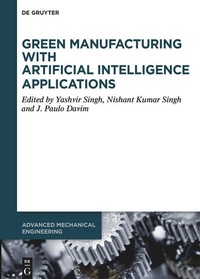
Green Manufacturing with Artificial Intelligence Applications
Description

Green Manufacturing with Artificial Intelligence Applications serves as a comprehensive textbook designed for students, researchers, and educators in mechanical, production, and industrial engineering. The book integrates principles of sustainable manufacturing with cutting-edge artificial intelligence tools to promote eco-efficient and smart production systems. It explains concepts such as energy optimization, waste minimization, intelligent process control, and digital manufacturing with real-world examples and case studies. Emphasizing both theoretical foundations and practical implementation, this text prepares learners to understand and apply AI-driven approaches for achieving greener, cleaner, and more efficient manufacturing aligned with Industry 4.0 and 5.0 goals.
More details
Other editions
Additional editions
Persons
__ Dr. Yashvir Singh is presently working as an Associate Professor at Mechanical Engineering Department, Harcourt Butler Technical University, Kanpur, Uttar Pradesh, India. He has published more than 150 research papers in SCI/Scopus/Web of Science Journals with high impact factors. He has written 8 books with International Publishers - CRC Press, De-Gruyter, River Publishers.
__ Dr. Nishant Kumar Singh is presently working as Associate Professor at Mechanical Engineering Department, Harcourt Butler Technical University, Kanpur, Uttar Pradesh, India. He has edited book, contributed book chapters, published patents and successfully guided various students. His area of research includes Manufacturing, Materials, and Optimization techniques. He has managed to publish more than 100 research papers in international journals of repute.
__ Prof. J. Paulo Davim is a Full Professor at the University of Aveiro, Portugal. He is also distinguished as honorary professor in several universities/colleges/institutes in China, He has more than 35 years of teaching and research experience in Manufacturing, Materials, Mechanical and Industrial Engineering, with special emphasis in Machining, Tribology & Surface Engineering.
Content
- Intro
- Preface
- Contents
- List of Contributing Authors
- Green Synthesis: Pathways to Sustainable Manufacturing
- 1 Introduction to Green Synthesis and Sustainable Manufacturing
- 1.1 Historical Development and Evolution of Green Manufacturing
- 1.2 Objectives and Scope of the Chapter
- 2 Principles and Techniques of Green Synthesis
- 2.1 Core Principles of Green Chemistry in Synthesis
- 2.2 Physical and Biological Green Synthesis Methods
- 2.3 Emerging Solvents and Sustainable Reaction Media
- 3 Green Synthesis of Nanomaterials for Sustainable Manufacturing
- 3.1 Carbon-Based Nanomaterials: Carbon Dots and Nanotubes
- 3.2 Metal and Metal Oxide Nanoparticles
- 3.3 Microbial and Fungal Routes in Green Nanoparticle Synthesis
- 4 Applications of Green Synthesis in Pharmaceutical Manufacturing
- 4.1 Sustainable Routes for Pharmaceutical Compound Synthesis
- 4.2 Catalyst Recycling and Process Economy
- 4.3 Regulatory and Policy Implications for Green Pharmaceutical Manufacturing
- 5 Green Synthesis in Polymer and Composite Materials
- 5.1 Eco-friendly Polymer Synthesis and Modification
- 5.2 Green Manufacturing of Polymer-Based Membranes
- 5.3 Graphene and Carbon Nanocomposite Green Synthesis
- 6 Green Synthesis for Agricultural and Environmental Applications
- 6.1 Nanofertilizers and Agroecosystem Enhancement
- 6.2 Environmental Remediation using Green Synthesized Nanoparticles
- 6.3 Antimicrobial and Biocidal Properties
- 7 Comparative Analysis: Traditional Versus Green Synthesis Approaches
- 7.1 Environmental and Toxicological Considerations
- 7.2 Economic and Scalability Aspects
- 7.3 Technical Performance and Functional Properties
- 8 Challenges and Limitations of Green Synthesis
- 8.1 Standardization and Reproducibility Issues
- 8.2 Scale-Up and Commercialization Barriers
- 8.3 Knowledge Gaps and Future Research Directions
- 9 Case Studies Highlighting Successful Green Synthesis Pathways
- 9.1 CQDs from Biomass and Waste Materials
- 9.2 Iron-Catalyzed Conjugate Addition in Biobased Solvents
- 9.3 Green Synthesis of ZnO and Mn-Doped ZnO Nanoparticles
- 10 Conclusions and Future Outlook
- 10.1 Summary of Key Findings
- 10.2 Integration of Green Synthesis with Circular Economy
- 10.3 Prospects for Research and Industrial Implementation
- References
- Green Manufacturing Through Clean Energy Supply
- 1 Introduction to Green Manufacturing and Clean Energy
- 1.1 Definition and Principles of Green Manufacturing
- 1.2 The Environmental Impact of Conventional Manufacturing
- 1.3 Importance of Clean Energy in Sustainable Development
- 1.4 International Policies and Climate Goals That Are Relocating the Change
- 2 Overview of Clean Energy Sources for Manufacturing
- 2.1 Solar Energy: PVs and Solar Thermal in Industrial Use
- 2.2 Wind Energy: Integration into Industrial Zones
- 2.3 Hydropower: Small-Scale Hydro for Localized Industries
- 2.4 Biomass and Biogas: Using Farm and Industrial Refuses
- 2.5 Green Hydrogen: Emerging Applications and Challenges
- 3 Integration Strategies for Clean Energy in Manufacturing Systems
- 3.1 Energy Sourcing Models: Onsite Versus Grid purchase
- 3.1.1 Onsite Generation of Energy
- 3.2 Hybrid Energy Systems: Combining Multiple Clean Sources
- 3.3 Infrastructure Requirements: Transmission, Distribution, and Connectivity
- 3.4 Industrial Symbiosis and Energy Cascading Techniques
- 4 Technological Enablers for Clean Energy Adoption
- 4.1 Smart Grids and Demand-Side Management
- 4.2 Advanced Energy Storage Systems
- 4.3 IoT and Sensor-Based Energy Monitoring
- 4.4 Energy Management Systems (EMS) and Digital Twins
- 5 Role of AI in Clean Energy Optimization
- 5.1 AI for Energy Forecasting and Demand Prediction
- 5.2 Fault Detection and Optimization of the System through ML
- 5.3 Real-Time Energy Flow Control Using Intelligent Algorithms
- 5.4 Energy Purchasing and Load Scheduling AI-Driven Decision Support
- 6 Benefits of Clean Energy in Manufacturing Economic and Environmental
- 6.1 Reduction in Carbon Footprint and Emissions
- 6.2 Operational Cost Savings and Energy Independence
- 6.3 Incentives, Carbon Credits, and Government Subsidies
- 7 Case Studies of Clean Energy-Driven Green Manufacturing
- 7.1 Automotive Industry: Solar-Powered Manufacturing Units
- 7.2 Electronics Industry: Smart Energy Management in Chip Production
- 7.3 Food and Beverage Industry: Biomass Integration in Production Lines
- 7.4 Heavy Industry: Green Hydrogen in Steel and Cement Production
- 8 Barriers and Challenges to Clean Energy Adoption
- 8.1 High Initial Capital Investment
- 8.2 Technological Maturity and Scalability Issues
- 8.3 Energy Supply Intermittency and Grid Limitations
- 8.4 Regulatory and Policy Bottlenecks
- 8.5 Workforce Skill Gaps
- 9 Policy Frameworks and Global Initiatives Supporting the Transition
- 9.1 National Clean Energy Mandates and Industrial Policies
- 9.2 Role of International Organizations
- 9.3 Public-Private Partnerships and Funding Mechanisms
- 9.4 Case Examples from Leading Green Economies
- 10 Future Trends and Roadmap for Clean Energy-Based Manufacturing
- 10.1 Electrification of Industrial Processes
- 10.2 Hydrogen Economy and Sector Coupling
- 10.3 Digitalization and Predictive Energy Analytics
- 10.4 Vision for Carbon-Neutral Manufacturing
- References
- Soft Computing Theory and Applications Related to Green Manufacturing
- 1 Introduction
- 1.1 Background: The Imperative of Green Manufacturing
- 1.2 Pillars of Sustainability in Manufacturing
- 1.3 Role of Artificial Intelligence and Soft Computing
- 1.4 Chapter Objectives and Structure
- 2 Green Manufacturing: Concepts, Principles, and Challenges
- 2.1 Core Principles of Green Manufacturing
- 2.2 Methodologies and Tools for Green Manufacturing
- 2.3 Current Challenges in Green Manufacturing Implementation
- 3 Soft Computing Fundamentals: An Overview
- 3.1 Introduction to Soft Computing
- 3.2 Fuzzy Logic Systems
- 3.3 Artificial Neural Networks (ANNs)
- 3.4 Evolutionary Algorithms (EAs)
- 3.5 Hybrid Soft Computing Approaches
- 4 Applications of Soft Computing in Green Manufacturing
- 4.1 Energy Efficiency Optimization
- 4.1.1 Smart Energy Management Systems
- 4.1.2 Renewable Energy Integration
- 4.2 Waste Minimization and Resource Utilization
- 4.2.1 Predictive Maintenance for Equipment
- 4.2.2 Optimal Material Selection and Recycling
- 4.3 Process Optimization and Control
- 4.3.1 Green Process Parameter Optimization
- 4.3.2 Quality Control with Reduced Defects
- 4.4 Sustainable Product Design and Life Cycle Management
- 4.4.1 Eco-design Support Systems
- 4.4.2 Remanufacturing and End-of-Life Planning
- 4.5 Green Supply Chain Management
- 4.5.1 Route Optimization for Logistics
- 4.5.2 Supplier Selection Based on Environmental Criteria
- 5 Challenges and Future Directions
- 5.1 Data Requirements and Integration
- 5.2 Model Interpretability and Transparency
- 5.3 Scalability and Real-Time Implementation
- 5.4 Emerging Soft Computing Techniques
- 5.5 Policy and Regulatory Considerations
- 6 Conclusion
- 6.1 Summary of Key Contributions
- 6.2 Implications for Researchers and Industry Professionals
- 6.3 Final Remarks on the Future of Sustainable Manufacturing
- References
- Green Nanomaterials in Sensing Applications: Enabling Smart and Sustainable Manufacturing
- 1 Introduction
- 1.1 The Role of Sensors in Green Manufacturing
- 1.2 Introduction to Green Nanomaterials and Green Chemistry
- 1.3 Sustainable Manufacturing: Need for Eco-friendly Sensing Technologies
- 1.4 Objectives and Chapter Roadmap
- 2 Green Nanomaterials and Their Relevance in Manufacturing
- 2.1 Sustainability Advantages Over Traditional Nanomaterials
- 2.2 Green Nanomaterials as Building Blocks for Smart Factories
- 3 Eco-friendly Synthesis of Nanomaterials
- 3.1 Plant and Microbe-Mediated Synthesis Techniques
- 3.1.1 Plant-Mediated Synthesis
- 3.1.2 Microbial Synthesis
- 3.1.3 Waste-Derived Nanomaterials: Valorizing Industrial Byproducts
- 3.2 Low-Energy and Solvent-Free Fabrication Approaches
- 3.3 Impact on Carbon Footprint and Process Sustainability
- 4 Sensor Platforms Supporting Green Manufacturing (Manaswini)
- 4.1 Types of Sensors: Optical, Electrochemical, Biosensors
- 4.2 Integration of Green Nanomaterials in Sensor Systems
- 4.3 Real-Time Environmental Monitoring in Factories
- 4.3.1 Key Environmental Metrics Monitored
- 4.3.1.1 Air Quality Monitoring
- 4.3.1.2 Water Quality Monitoring
- 4.3.1.3 Soil and Sludge Monitoring
- 4.4 Smart Monitoring Features
- 4.4.1 Key Contributions of Smart Sensors
- 5 Application Areas in Sustainable Manufacturing
- 5.1 Emission Monitoring and Air Quality Sensors
- 5.2 Water Quality Sensors for Effluent Control
- 5.3 Biosensors for Worker Safety and Health
- 5.4 IoT-Enabled Sensor Networks in Industry 4.0 Factories [86]
- 6 Performance and Environmental Impact
- 6.1 Sensitivity, Strength, and Ability to Break Down Metrics
- 6.2 Life Cycle Assessment (LCA)
- 6.3 Comparing Costs and Benefits and Environmental Effects
- 6.4 Future Trends in Green Manufacturing with Smart Sensors
- 7 Conclusion
- References
- Green Manufacturing for Composites
- 1 Introduction
- 2 Green Composites
- 2.1 Reinforcement (Natural Fibre)
- 2.2 Matrix Elements (Biopolymers)
- 3 Green Manufacturing of Lignocellulosic Polymer Composites
- 3.1 Primary Processing
- 3.1.1 Selection Criterion
- 3.1.2 Challenges
- 3.1.3 Processing Techniques
- 3.2 Secondary Processing
- 4 Mechanical Performance of Green Composites
- 4.1 Tensile Properties
- 4.2 Bending Properties
- 4.3 Impact Strength
- 4.4 Hardness
- 5 Conclusion and Future Scope
- References
- A Review on Artificial Intelligence in Defect Analysis of Lightweight Composite Structural Components
- 1 Introduction
- 2 Fatigue Analysis of Composites Using ML Models
- 3 Damage Analysis of Composites Using ML Models
- 4 Nondestructive Inspection of Composites Using AI/ML
- 5 Conclusions and Future Scope
- References
- Progress and Prospects of Green Manufacturing
- 1 Introduction
- 2 Evolution of Green Manufacturing
- 2.1 Evolution of Green Manufacturing: Pre-industrial to Industrial Era
- 2.2 Emergence of Sustainable Practices
- 3 Core Principles of Green Manufacturing
- 3.1 Resource Efficiency
- 3.2 Pollution Prevention
- 3.3 Life Cycle Thinking
- 3.4 Circular Economy
- 4 Technologies Enabling Green Manufacturing
- 4.1 Renewable Energy Integration
- 4.2 Energy-Efficient Machinery
- 4.3 Additive Manufacturing (3D Printing)
- 4.4 Artificial Intelligence (AI) and Internet of Things (IoT)
- 4.5 Green Chemistry
- 5 Industry-Wise Progress in Green Manufacturing
- 5.1 Automotive Sector
- 5.2 Electronics Industry
- 5.3 Textile Industry
- 5.4 Cement and Steel Industry
- 6 Case Studies
- 6.1 Case Study 1: Siemens Electronics Works, Amberg - A Global Benchmark in Green Manufacturing
- 6.2 Tata Steel Kalinganagar: India's Green Manufacturing Pioneer
- 7 Global Trends
- 7.1 United Nations Sustainable Development Goals (SDGs)
- 7.2 European Union Green Deal
- 7.3 Carbon Border Adjustment Mechanisms (CBAMs)
- 8 Future Prospects
- 8.1 Digital Green Manufacturing: Enabling "Green 4.0"
- 8.2 Circular Economy Integration
- 8.3 Green Financing
- 8.4 Decentralized Production
- 9 Conclusion
- References
- Hybrid Intelligent System Applications in Green Manufacturing
- 1 Introduction to Hybrid Intelligent Systems in Green Manufacturing
- 1.1 Definition and Concepts of Hybrid Intelligent Systems
- 1.2 Green Manufacturing Overview and Sustainability Challenges
- 1.3 Integration of Hybrid Intelligence in Green Manufacturing Context
- 2 Design Principles and Architectures of Hybrid Intelligent Systems in Manufacturing
- 2.1 Core Components and Technologies in Hybrid Systems
- 2.2 Hybrid Intelligence Models for Sustainable Manufacturing Decisions
- 2.3 System Engineering and Implementation Challenges
- 3 Hybrid Intelligence-Driven Green Technology Innovation
- 3.1 Driving Green Energy Technology Innovation in Manufacturing
- 3.2 Hybrid Systems Optimizing Energy Efficiency and Resource Management
- 3.3 Enhancing Environmental Performance Through Hybrid Intelligence
- 4 Applications in Sustainable Production and Process Optimization
- 4.1 Hybrid Optimization Approaches in Intelligent Manufacturing
- 4.2 Digital Twin and Real-Time Monitoring Systems
- 4.3 Zero-Defect and Quality Assurance in Green Production
- 5 Human-in-the-Loop and Collaborative Human-AI Synergies
- 5.1 Enhancing Productivity with Human-AI Collaboration
- 5.2 Training and Literacy for Effective Hybrid Intelligence Use
- 5.3 User-Centered Design and Explainability
- 6 Case Studies and Sector-Specific Implementations
- 6.1 Manufacturing Enterprises and Green Energy Innovation
- 6.2 Automotive Industry Applications
- 6.3 Plastic Injection Molding and Precision Machining
- 7 Technological Enablers and Tools in Hybrid Intelligent Green Manufacturing
- 7.1 Artificial Neural Networks and Evolutionary Algorithms
- 7.2 Fuzzy Logic and Hybrid Fuzzy Systems
- 7.3 Ontology-Based Knowledge Representation
- 8 Environmental and Economic Benefits of Hybrid Intelligent Systems
- 8.1 Reduction of Emissions and Resource Consumption
- 8.2 Cost Savings and Operational Efficiency
- 8.3 Market Competitiveness and Brand Reputation
- 9 Challenges and Future Directions
- 9.1 Technical and Integration Barriers
- 9.2 Individual and Organizational Elements
- 9.3 Research Gaps and Emerging Opportunities
- 10 Conclusion and Recommendations
- 10.1 Hybrid Intelligent Systems' Role in Green Manufacturing
- 10.2 Strategic Recommendations for Industry Adoption
- 10.3 Outlook on the Future of Hybrid Intelligence in Sustainable Manufacturing
- References
- Additives in Green Manufacturing: Mechanisms, Applications, and Performance
- 1 Introduction
- 1.1 Green Manufacturing: A Shift in Industrial Paradigms
- 1.2 Role of Additives in Sustainable Practices
- 1.3 Industrial Significance of Additive-Aided Sustainable Manufacturing
- 1.4 Research Trends and Challenges
- 2 Types of Additives in Green Manufacturing
- 2.1 Categories of Additives in Sustainable Manufacturing
- 2.2 Lubrication Additives
- 2.3 Cooling Additives
- 2.4 Additives for Surface Modification
- 2.5 Additives Based on Nanoparticles
- 2.6 Bio-based Additives
- 3 Mechanisms of Additive Action in Sustainable Manufacturing
- 3.1 Formation of Boundary Films
- 3.2 Rolling or Ball-Bearing Phenomenon of Nanoparticles
- 3.3 Repairing and Surface Refinement
- 3.4 Augmented Thermal Transfer
- 3.5 Chemical and Tribochemical Reactions
- 3.6 Enhancement of Wettability and Dispersion
- 3.7 Synergistic Hybrid Mechanisms
- 4 Utilization of Additives in Sustainable Manufacturing Processes
- 4.1 Machining Operations
- 4.2 Formation and Configuration
- 4.3 Additive Fabrication
- 4.4 Coating and Surface Treatment
- 5 Assessment of Additives in Sustainable Manufacturing
- 5.1 Assessment Criteria
- 5.1.1 Tribological Efficacy
- 5.1.2 Thermal Efficiency
- 5.1.3 Surface Integrity
- 5.1.4 Energy Efficiency and Tool Longevity
- 5.1.5 Ecological Performance
- 5.2 Comparative Assessment
- 6 Challenges and Future Directions
- 7 Conclusions
- References
- Green Energy's Role in Green Manufacturing Processes and Their Proper Utilization Toward Industrial Progress
- 1 Introduction
- 2 Role of Clean Energy in Green Manufacturing
- 2.1 Renewable Energy Sources and Their Integration
- 3 Clean Energy Technologies in Manufacturing Processes
- 4 Energy Management and Optimization
- 5 Environmental and Economic Impact Assessment
- 6 Conclusion
- References
- Index
- De Gruyter Series in Advanced MechanicalEngineering
