

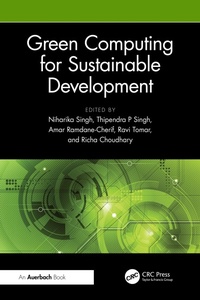
Green Computing for Sustainable Development
1st Edition
Published on 30. June 2025
286 pages
978-1-040-37943-1 (ISBN)
Description

Green computing is a revolutionary technique that addresses environmental sustainability. It uses an eco-friendly approach to the design, manufacture, and use of computing resources. This is achieved by cutting down on electronic waste, using renewable energy sources, and consuming less energy. Recyclable materials with minimal environmental impact, software engineering techniques that are optimized, and energy-efficient hardware are examples of many approaches. Advanced technologies such as low-power processors, smart grids, and virtualized computing environments contribute to energy efficiency and waste reduction. Furthermore, integrating green computing with renewable energy sources amplifies its positive impact on the environment. The adoption of green computing practices promotes a circular economy, encourages resource conservation, and supports climate action.
Green Computing for Sustainable Development features chapters that explore issues that are concerned with furthering sustainability and green computing. Highlights include the following:
Neuro-symbolic green computing combining neural networks' learning abilities with symbolic AI's logical reasoning while promoting environmentally friendly practices
Energy-efficient data management, resource provisioning, and the importance of monitoring carbon footprints
The intersection of green computing and wildlife conservation, highlighting how energy-efficient technologies can revolutionize conservation efforts
The integration of geospatial information systems (GIS) and remote sensing (RS) as innovative solutions for sustainable development
The role of information and communication technology (ICT) in promoting health and well-being
The importance of green computing due to growing environmental concerns related to information technology
The integration of AI in sustainable farming practices
The synergy between green computing practices and economic growth in achieving sustainable development
The integration of green computing with e-waste management to tackle environmental challenges in the IT sector
How the "green Internet of Things" (IoT) is transforming smart city development by integrating ecological awareness and sustainability into urban planning
This book covers the wide range of principles essential for achieving long-term sustainability. It is a step toward fostering a balanced relationship between technological advancement and environmental stewardship.
Green Computing for Sustainable Development features chapters that explore issues that are concerned with furthering sustainability and green computing. Highlights include the following:
Neuro-symbolic green computing combining neural networks' learning abilities with symbolic AI's logical reasoning while promoting environmentally friendly practices
Energy-efficient data management, resource provisioning, and the importance of monitoring carbon footprints
The intersection of green computing and wildlife conservation, highlighting how energy-efficient technologies can revolutionize conservation efforts
The integration of geospatial information systems (GIS) and remote sensing (RS) as innovative solutions for sustainable development
The role of information and communication technology (ICT) in promoting health and well-being
The importance of green computing due to growing environmental concerns related to information technology
The integration of AI in sustainable farming practices
The synergy between green computing practices and economic growth in achieving sustainable development
The integration of green computing with e-waste management to tackle environmental challenges in the IT sector
How the "green Internet of Things" (IoT) is transforming smart city development by integrating ecological awareness and sustainability into urban planning
This book covers the wide range of principles essential for achieving long-term sustainability. It is a step toward fostering a balanced relationship between technological advancement and environmental stewardship.
More details
Edition
1. Auflage
Language
English
Place of publication
London
United Kingdom
Publishing group
Taylor & Francis Ltd
Target group
College/higher education
Illustrations
10 Tables, black and white; 32 Line drawings, black and white
File size
2,76 MB
ISBN-13
978-1-040-37943-1 (9781040379431)
Copyright in bibliographic data and cover images is held by Nielsen Book Services Limited or by the publishers or by their respective licensors: all rights reserved.
Schweitzer Classification
Other editions
Additional editions
Niharika Singh | Thipendra P. Singh | Amar Ramdane-Cherif
Green Computing for Sustainable Development
Book
06/2025
1st Edition
Auerbach
€232.00
Shipment within 10-20 days
Persons
Dr. Thipendra P. Singh is a Professor and Head of Department at School of Computer Science, University of Petroleum & Energy Studies, Dehradun, India. He holds Doctorate in Computer Science from Jamia Millia Islamia University, New Delhi.
Dr. Niharika Singh is an an Assistant Professor with the Department of Informatics, School of Computer Science, University of Petroleum and Energy Studies.
Dr. Amar Ramdane-Cherif is a Full Professor at University of Versailles, Paris-Saclay, France, where he works in the systems engineering laboratory.
Dr. Ravi Tomar is a Senior Architect at Persistent Systems, India.
Richa Choudhary holds a masters' degree in computer science and engineering and is working towards a doctoral degree in the field of game theory and machine learning.
Dr. Niharika Singh is an an Assistant Professor with the Department of Informatics, School of Computer Science, University of Petroleum and Energy Studies.
Dr. Amar Ramdane-Cherif is a Full Professor at University of Versailles, Paris-Saclay, France, where he works in the systems engineering laboratory.
Dr. Ravi Tomar is a Senior Architect at Persistent Systems, India.
Richa Choudhary holds a masters' degree in computer science and engineering and is working towards a doctoral degree in the field of game theory and machine learning.
Content
1. Neuro-Symbolic Green Computing and Its Integration with UN Sustainability Goals2. Software Approach for Green Computing3. Green Computing and Wildlife Conservation4. Role of Remote Sensing and GIS in Sustainable Computing Practices5. Role of ICT in Good Health and Well-Being6. Green Computing and Sustainability 7. Sustainable Agriculture8. ICT in Education: A Bibliometric Analysis 9. Integration of Green Computing and Economic Growth10. Mobile Android-Based Applications Learning for Educating Women and Children for Law and Rights11. ICT in Peace and Justice, Women and Children12. Integration of Green Computing and E-Waste Management13. Green IoT: Paving the Way for Eco-Friendly Smart Cities - Future Avenues and Opportunities for Sustainability
