

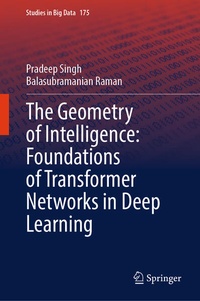
The Geometry of Intelligence: Foundations of Transformer Networks in Deep Learning
Description

This book offers an in-depth exploration of the mathematical foundations underlying transformer networks, the cornerstone of modern AI across various domains. Unlike existing literature that focuses primarily on implementation, this work delves into the elegant geometry, symmetry, and mathematical structures that drive the success of transformers. Through rigorous analysis and theoretical insights, the book unravels the complex relationships and dependencies that these models capture, providing a comprehensive understanding of their capabilities. Designed for researchers, academics, and advanced practitioners, this text bridges the gap between practical application and theoretical exploration. Readers will gain a profound understanding of how transformers operate in abstract spaces, equipping them with the knowledge to innovate, optimize, and push the boundaries of AI. Whether you seek to deepen your expertise or pioneer the next generation of AI models, this book is an essential resource on the mathematical principles of transformers.
More details
Other editions
Additional editions
Persons
Dr. Balasubramanian Raman received his Ph.D. from IIT Madras and his B.Sc. and M.Sc. in Mathematics from the University of Madras. He is a Professor and the Head of the Department of Computer Science and Engineering at IIT Roorkee, as well as the iHUB Divyasampark Chair Professor. He is also a Joint Faculty member in the Mehta Family School of Data Science and Artificial Intelligence at IIT Roorkee. With over 200 research papers published in reputed journals and conferences, his research interests span Machine Learning, Image and Video Processing, Computer Vision, and Pattern Recognition. Dr. Raman has served as a Guest Professor and Visiting Researcher at prestigious institutions such as Osaka Metropolitan University, Curtin University, the University of Cyberjaya, and the University of Windsor. He has held postdoctoral positions at Rutgers University and the University of Missouri-Columbia. Under his coaching, teams have achieved notable rankings in the ACM International Collegiate Programming Contest (ICPC) World Finals. He has been recognized with several awards, including the BOYSCAST Fellowship and the Ramkumar Prize for Outstanding Teaching and Research.
Content
Foundations of Representation Theory in Transformers.- Word Embeddings and Positional Encoding.- Attention Mechanisms.- Transformer Architecture: Encoder and Decoder.- Transformers in Natural Language Processing.- Transformers in Computer Vision.- Time Series Forecasting with Transformers.- Signal Analysis and Transformers.- Advanced Topics and Future Directions.- Convergence of Transformer Models: A Dynamical Systems Perspective.
