

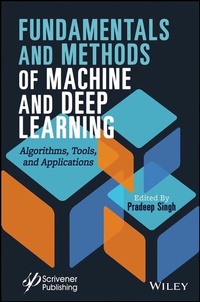
Fundamentals and Methods of Machine and Deep Learning
Description

The book provides a practical approach by explaining the concepts of machine learning and deep learning algorithms, evaluation of methodology advances, and algorithm demonstrations with applications.
Over the past two decades, the field of machine learning and its subfield deep learning have played a main role in software applications development. Also, in recent research studies, they are regarded as one of the disruptive technologies that will transform our future life, business, and the global economy. The recent explosion of digital data in a wide variety of domains, including science, engineering, Internet of Things, biomedical, healthcare, and many business sectors, has declared the era of big data, which cannot be analysed by classical statistics but by the more modern, robust machine learning and deep learning techniques. Since machine learning learns from data rather than by programming hard-coded decision rules, an attempt is being made to use machine learning to make computers that are able to solve problems like human experts in the field.
The goal of this book is to present a??practical approach by explaining the concepts of machine learning and deep learning algorithms with applications. Supervised machine learning algorithms, ensemble machine learning algorithms, feature selection, deep learning techniques, and their applications are discussed. Also included in the eighteen chapters is unique information which provides a clear understanding of concepts by using algorithms and case studies illustrated with applications of machine learning and deep learning in different domains, including disease prediction, software defect prediction, online television analysis, medical image processing, etc. Each of the chapters briefly described below provides both a chosen approach and its implementation.
Audience
Researchers and engineers in artificial intelligence, computer scientists as well as software developers.
Pradeep Singh PhD, is an assistant professor in the Department of Computer Science Engineering, National Institute of Technology, Raipur, India. His current research interests include machine learning, deep learning, evolutionary computing, empirical studies on software quality, and software fault prediction models. He has more than 15 years of teaching experience with many publications in reputed international journals, conferences, and book chapters.
More details
Other editions
Additional editions
Person
Pradeep Singh PhD, is an assistant professor in the Department of Computer Science Engineering, National Institute of Technology, Raipur, India. His current research interests include machine learning, deep learning, evolutionary computing, empirical studies on software quality, and software fault prediction models. He has more than 15 years of teaching experience with many publications in reputed international journals, conferences, and book chapters.
Content
Preface xix
1 Supervised Machine Learning: Algorithms and Applications 1
Shruthi H. Shetty, Sumiksha Shetty, Chandra Singh and Ashwath Rao
1.1 History 2
1.2 Introduction 2
1.3 Supervised Learning 4
1.4 Linear Regression (LR) 5
1.4.1 Learning Model 6
1.4.2 Predictions With Linear Regression 7
1.5 Logistic Regression 8
1.6 Support Vector Machine (SVM) 9
1.7 Decision Tree 11
1.8 Machine Learning Applications in Daily Life 12
1.8.1 Traffic Alerts (Maps) 12
1.8.2 Social Media (Facebook) 13
1.8.3 Transportation and Commuting (Uber) 13
1.8.4 Products Recommendations 13
1.8.5 Virtual Personal Assistants 13
1.8.6 Self-Driving Cars 14
1.8.7 Google Translate 14
1.8.8 Online Video Streaming (Netflix) 14
1.8.9 Fraud Detection 14
1.9 Conclusion 15
References 15
2 Zonotic Diseases Detection Using Ensemble Machine Learning Algorithms 17
Bhargavi K.
2.1 Introduction 18
2.2 Bayes Optimal Classifier 19
2.3 Bootstrap Aggregating (Bagging) 21
2.4 Bayesian Model Averaging (BMA) 22
2.5 Bayesian Classifier Combination (BCC) 24
2.6 Bucket of Models 26
2.7 Stacking 27
2.8 Efficiency Analysis 29
2.9 Conclusion 30
References 30
3 Model Evaluation 33
Ravi Shekhar Tiwari
3.1 Introduction 34
3.2 Model Evaluation 34
3.2.1 Assumptions 36
3.2.2 Residual 36
3.2.3 Error Sum of Squares (Sse) 37
3.2.4 Regression Sum of Squares (Ssr) 37
3.2.5 Total Sum of Squares (Ssto) 37
3.3 Metric Used in Regression Model 38
3.3.1 Mean Absolute Error (Mae) 38
3.3.2 Mean Square Error (Mse) 39
3.3.3 Root Mean Square Error (Rmse) 41
3.3.4 Root Mean Square Logarithm Error (Rmsle) 42
3.3.5 R-Square (R2) 45
3.3.5.1 Problem With R-Square (R2) 46
3.3.6 Adjusted R-Square (R2) 46
3.3.7 Variance 47
3.3.8 AIC 48
3.3.9 BIC 49
3.3.10 ACP, Press, and R2-Predicted 49
3.3.11 Solved Examples 51
3.4 Confusion Metrics 52
3.4.1 How to Interpret the Confusion Metric? 53
3.4.2 Accuracy 55
3.4.2.1 Why Do We Need the Other Metric Along With Accuracy? 56
3.4.3 True Positive Rate (TPR) 56
3.4.4 False Negative Rate (FNR) 57
3.4.5 True Negative Rate (TNR) 57
3.4.6 False Positive Rate (FPR) 58
3.4.7 Precision 58
3.4.8 Recall 59
3.4.9 Recall-Precision Trade-Off 60
3.4.10 F1-Score 61
3.4.11 F-Beta Sore 61
3.4.12 Thresholding 63
3.4.13 AUC - ROC 64
3.4.14 AUC - PRC 65
3.4.15 Derived Metric From Recall, Precision, and F1-Score 67
3.4.16 Solved Examples 68
3.5 Correlation 70
3.5.1 Pearson Correlation 70
3.5.2 Spearman Correlation 71
3.5.3 Kendall's Rank Correlation 73
3.5.4 Distance Correlation 74
3.5.5 Biweight Mid-Correlation 75
3.5.6 Gamma Correlation 76
3.5.7 Point Biserial Correlation 77
3.5.8 Biserial Correlation 78
3.5.9 Partial Correlation 78
3.6 Natural Language Processing (NLP) 78
3.6.1 N-Gram 79
3.6.2 BELU Score 79
3.6.2.1 BELU Score With N-Gram 80
3.6.3 Cosine Similarity 81
3.6.4 Jaccard Index 83
3.6.5 ROUGE 84
3.6.6 NIST 85
3.6.7 SQUAD 85
3.6.8 MACRO 86
3.7 Additional Metrics 86
3.7.1 Mean Reciprocal Rank (MRR) 86
3.7.2 Cohen Kappa 87
3.7.3 Gini Coefficient 87
3.7.4 Scale-Dependent Errors 87
3.7.5 Percentage Errors 88
3.7.6 Scale-Free Errors 88
3.8 Summary of Metric Derived from Confusion Metric 89
3.9 Metric Usage 90
3.10 Pro and Cons of Metrics 94
3.11 Conclusion 95
References 96
4 Analysis of M-SEIR and LSTM Models for the Prediction of COVID-19 Using RMSLE 101
Archith S., Yukta C., Archana H.R. and Surendra H.H.
4.1 Introduction 101
4.2 Survey of Models 103
4.2.1 SEIR Model 103
4.2.2 Modified SEIR Model 103
4.2.3 Long Short-Term Memory (LSTM) 104
4.3 Methodology 106
4.3.1 Modified SEIR 106
4.3.2 LSTM Model 108
4.3.2.1 Data Pre-Processing 108
4.3.2.2 Data Shaping 109
4.3.2.3 Model Design 109
4.4 Experimental Results 111
4.4.1 Modified SEIR Model 111
4.4.2 LSTM Model 113
4.5 Conclusion 116
4.6 Future Work 116
References 118
5 The Significance of Feature Selection Techniques in Machine Learning 121
N. Bharathi, B.S. Rishiikeshwer, T. Aswin Shriram, B. Santhi and G.R. Brindha
5.1 Introduction 122
5.2 Significance of Pre-Processing 122
5.3 Machine Learning System 123
5.3.1 Missing Values 123
5.3.2 Outliers 123
5.3.3 Model Selection 124
5.4 Feature Extraction Methods 124
5.4.1 Dimension Reduction 125
5.4.1.1 Attribute Subset Selection 126
5.4.2 Wavelet Transforms 127
5.4.3 Principal Components Analysis 127
5.4.4 Clustering 128
5.5 Feature Selection 128
5.5.1 Filter Methods 129
5.5.2 Wrapper Methods 129
5.5.3 Embedded Methods 130
5.6 Merits and Demerits of Feature Selection 131
5.7 Conclusion 131
References 132
6 Use of Machine Learning and Deep Learning in Healthcare-A Review on Disease Prediction System 135
Radha R. and Gopalakrishnan R.
6.1 Introduction to Healthcare System 136
6.2 Causes for the Failure of the Healthcare System 137
6.3 Artificial Intelligence and Healthcare System for Predicting Diseases 138
6.3.1 Monitoring and Collection of Data 140
6.3.2 Storing, Retrieval, and Processing of Data 141
6.4 Facts Responsible for Delay in Predicting the Defects 142
6.5 Pre-Treatment Analysis and Monitoring 143
6.6 Post-Treatment Analysis and Monitoring 145
6.7 Application of ML and DL 145
6.7.1 ML and DL for Active Aid 145
6.7.1.1 Bladder Volume Prediction 147
6.7.1.2 Epileptic Seizure Prediction 148
6.8 Challenges and Future of Healthcare Systems Based on ML and DL 148
6.9 Conclusion 149
References 150
7 Detection of Diabetic Retinopathy Using Ensemble Learning Techniques 153
Anirban Dutta, Parul Agarwal, Anushka Mittal, Shishir Khandelwal and Shikha Mehta
7.1 Introduction 153
7.2 Related Work 155
7.3 Methodology 155
7.3.1 Data Pre-Processing 155
7.3.2 Feature Extraction 161
7.3.2.1 Exudates 161
7.3.2.2 Blood Vessels 161
7.3.2.3 Microaneurysms 162
7.3.2.4 Hemorrhages 162
7.3.3 Learning 163
7.3.3.1 Support Vector Machines 163
7.3.3.2 K-Nearest Neighbors 163
7.3.3.3 Random Forest 164
7.3.3.4 AdaBoost 164
7.3.3.5 Voting Technique 164
7.4 Proposed Models 165
7.4.1 AdaNaive 165
7.4.2 AdaSVM 166
7.4.3 AdaForest 166
7.5 Experimental Results and Analysis 167
7.5.1 Dataset 167
7.5.2 Software and Hardware 167
7.5.3 Results 168
7.6 Conclusion 173
References 174
8 Machine Learning and Deep Learning for Medical Analysis-A Case Study on Heart Disease Data 177
Swetha A.M., Santhi B. and Brindha G.R.
8.1 Introduction 178
8.2 Related Works 179
8.3 Data Pre-Processing 181
8.3.1 Data Imbalance 181
8.4 Feature Selection 182
8.4.1 Extra Tree Classifier 182
8.4.2 Pearson Correlation 183
8.4.3 Forward Stepwise Selection 183
8.4.4 Chi-Square Test 184
8.5 ML Classifiers Techniques 184
8.5.1 Supervised Machine Learning Models 185
8.5.1.1 Logistic Regression 185
8.5.1.2 SVM 186
8.5.1.3 Naive Bayes 186
8.5.1.4 Decision Tree 186
8.5.1.5 K-Nearest Neighbors (KNN) 187
8.5.2 Ensemble Machine Learning Model 187
8.5.2.1 Random Forest 187
8.5.2.2 AdaBoost 188
8.5.2.3 Bagging 188
8.5.3 Neural Network Models 189
8.5.3.1 Artificial Neural Network (ANN) 189
8.5.3.2 Convolutional Neural Network (CNN) 189
8.6 Hyperparameter Tuning 190
8.6.1 Cross-Validation 190
8.7 Dataset Description 190
8.7.1 Data Pre-Processing 193
8.7.2 Feature Selection 195
8.7.3 Model Selection 196
8.7.4 Model Evaluation 197
8.8 Experiments and Results 197
8.8.1 Study 1: Survival Prediction Using All Clinical Features 198
8.8.2 Study 2: Survival Prediction Using Age, Ejection Fraction and Serum Creatinine 198
8.8.3 Study 3: Survival Prediction Using Time, Ejection Fraction, and Serum Creatinine 199
8.8.4 Comparison Between Study 1, Study 2, and Study 3 203
8.8.5 Comparative Study on Different Sizes of Data 204
8.9 Analysis 206
8.10 Conclusion 206
References 207
9 A Novel Convolutional Neural Network Model to Predict Software Defects 211
Kumar Rajnish, Vandana Bhattacharjee and Mansi Gupta
9.1 Introduction 212
9.2 Related Works 213
9.2.1 Software Defect Prediction Based on Deep Learning 213
9.2.2 Software Defect Prediction Based on Deep Features 214
9.2.3 Deep Learning in Software Engineering 214
9.3 Theoretical Background 215
9.3.1 Software Defect Prediction 215
9.3.2 Convolutional Neural Network 216
9.4 Experimental Setup 218
9.4.1 Data Set Description 218
9.4.2 Building Novel Convolutional Neural Network (NCNN) Model 219
9.4.3 Evaluation Parameters 222
9.4.4 Results and Analysis 224
9.5 Conclusion and Future Scope 230
References 233
10 Predictive Analysis on Online Television Videos Using Machine Learning Algorithms 237
Rebecca Jeyavadhanam B., Ramalingam V.V., Sugumaran V. and Rajkumar D.
10.1 Introduction 238
10.1.1 Overview of Video Analytics 241
10.1.2 Machine Learning Algorithms 242
10.1.2.1 Decision Tree C4.5 243
10.1.2.2 J48 Graft 243
10.1.2.3 Logistic Model Tree 244
10.1.2.4 Best First Tree 244
10.1.2.5 Reduced Error Pruning Tree 244
10.1.2.6 Random Forest 244
10.2 Proposed Framework 245
10.2.1 Data Collection 246
10.2.2 Feature Extraction 246
10.2.2.1 Block Intensity Comparison Code 247
10.2.2.2 Key Frame Rate 248
10.3 Feature Selection 249
10.4 Classification 250
10.5 Online Incremental Learning 251
10.6 Results and Discussion 253
10.7 Conclusion 255
References 256
11 A Combinational Deep Learning Approach to Visually Evoked EEG-Based Image Classification 259
Nandini Kumari, Shamama Anwar and Vandana Bhattacharjee
11.1 Introduction 260
11.2 Literature Review 262
11.3 Methodology 264
11.3.1 Dataset Acquisition 264
11.3.2 Pre-Processing and Spectrogram Generation 265
11.3.3 Classification of EEG Spectrogram Images With Proposed CNN Model 266
11.3.4 Classification of EEG Spectrogram Images With Proposed Combinational CNN+LSTM Model 268
11.4 Result and Discussion 270
11.5 Conclusion 272
References 273
12 Application of Machine Learning Algorithms With Balancing Techniques for Credit Card Fraud Detection: A Comparative Analysis 277
Shiksha
12.1 Introduction 278
12.2 Methods and Techniques 280
12.2.1 Research Approach 280
12.2.2 Dataset Description 282
12.2.3 Data Preparation 283
12.2.4 Correlation Between Features 284
12.2.5 Splitting the Dataset 285
12.2.6 Balancing Data 285
12.2.6.1 Oversampling of Minority Class 286
12.2.6.2 Under-Sampling of Majority Class 286
12.2.6.3 Synthetic Minority Over Sampling Technique 286
12.2.6.4 Class Weight 287
12.2.7 Machine Learning Algorithms (Models) 288
12.2.7.1 Logistic Regression 288
12.2.7.2 Support Vector Machine 288
12.2.7.3 Decision Tree 290
12.2.7.4 Random Forest 292
12.2.8 Tuning of Hyperparameters 294
12.2.9 Performance Evaluation of the Models 294
12.3 Results and Discussion 298
12.3.1 Results Using Balancing Techniques 299
12.3.2 Result Summary 299
12.4 Conclusions 305
12.4.1 Future Recommendations 305
References 306
13 Crack Detection in Civil Structures Using Deep Learning 311
Bijimalla Shiva Vamshi Krishna, Rishiikeshwer B.S., J. Sanjay Raju, N. Bharathi, C. Venkatasubramanian and G.R. Brindha
13.1 Introduction 312
13.2 Related Work 312
13.3 Infrared Thermal Imaging Detection Method 314
13.4 Crack Detection Using CNN 314
13.4.1 Model Creation 316
13.4.2 Activation Functions (AF) 317
13.4.3 Optimizers 322
13.4.4 Transfer Learning 322
13.5 Results and Discussion 322
13.6 Conclusion 323
References 323
14 Measuring Urban Sprawl Using Machine Learning 327
Keerti Kulkarni and P. A. Vijaya
14.1 Introduction 327
14.2 Literature Survey 328
14.3 Remotely Sensed Images 329
14.4 Feature Selection 331
14.4.1 Distance-Based Metric 331
14.5 Classification Using Machine Learning Algorithms 332
14.5.1 Parametric vs. Non-Parametric Algorithms 332
14.5.2 Maximum Likelihood Classifier 332
14.5.3 k-Nearest Neighbor Classifiers 334
14.5.4 Evaluation of the Classifiers 334
14.5.4.1 Precision 334
14.5.4.2 Recall 335
14.5.4.3 Accuracy 335
14.5.4.4 F1-Score 335
14.6 Results 335
14.7 Discussion and Conclusion 338
Acknowledgements 338
References 338
15 Application of Deep Learning Algorithms in Medical Image Processing: A Survey 341
Santhi B., Swetha A.M. and Ashutosh A.M.
15.1 Introduction 342
15.2 Overview of Deep Learning Algorithms 343
15.2.1 Supervised Deep Neural Networks 343
15.2.1.1 Convolutional Neural Network 343
15.2.1.2 Transfer Learning 344
15.2.1.3 Recurrent Neural Network 344
15.2.2 Unsupervised Learning 345
15.2.2.1 Autoencoders 345
15.2.2.2 GANs 345
15.3 Overview of Medical Images 346
15.3.1 MRI Scans 346
15.3.2 CT Scans 347
15.3.3 X-Ray Scans 347
15.3.4 PET Scans 347
15.4 Scheme of Medical Image Processing 348
15.4.1 Formation of Image 348
15.4.2 Image Enhancement 349
15.4.3 Image Analysis 349
15.4.4 Image Visualization 349
15.5 Anatomy-Wise Medical Image Processing With Deep Learning 349
15.5.1 Brain Tumor 352
15.5.2 Lung Nodule Cancer Detection 357
15.5.3 Breast Cancer Segmentation and Detection 362
15.5.4 Heart Disease Prediction 364
15.5.5 COVID-19 Prediction 370
15.6 Conclusion 372
References 372
16 Simulation of Self-Driving Cars Using Deep Learning 379
Rahul M. K., Praveen L. Uppunda, Vinayaka Raju S., Sumukh B. and C. Gururaj
16.1 Introduction 380
16.2 Methodology 380
16.2.1 Behavioral Cloning 380
16.2.2 End-to-End Learning 380
16.3 Hardware Platform 381
16.4 Related Work 382
16.5 Pre-Processing 382
16.5.1 Lane Feature Extraction 382
16.5.1.1 Canny Edge Detector 383
16.5.1.2 Hough Transform 383
16.5.1.3 Raw Image Without Pre-Processing 384
16.6 Model 384
16.6.1 CNN Architecture 385
16.6.2 Multilayer Perceptron Model 385
16.6.3 Regression vs. Classification 385
16.6.3.1 Regression 386
16.6.3.2 Classification 386
16.7 Experiments 387
16.8 Results 387
16.9 Conclusion 394
References 394
17 Assistive Technologies for Visual, Hearing, and Speech Impairments: Machine Learning and Deep Learning Solutions 397
Shahira K. C., Sruthi C. J. and Lijiya A.
17.1 Introduction 397
17.2 Visual Impairment 398
17.2.1 Conventional Assistive Technology for the VIP 399
17.2.1.1 Way Finding 399
17.2.1.2 Reading Assistance 402
17.2.2 The Significance of Computer Vision and Deep Learning in AT of VIP 403
17.2.2.1 Navigational Aids 403
17.2.2.2 Scene Understanding 405
17.2.2.3 Reading Assistance 406
17.2.2.4 Wearables 408
17.3 Verbal and Hearing Impairment 410
17.3.1 Assistive Listening Devices 410
17.3.2 Alerting Devices 411
17.3.3 Augmentative and Alternative Communication Devices 411
17.3.3.1 Sign Language Recognition 412
17.3.4 Significance of Machine Learning and Deep Learning in Assistive Communication Technology 417
17.4 Conclusion and Future Scope 418
References 418
18 Case Studies: Deep Learning in Remote Sensing 425
Emily Jenifer A. and Sudha N.
18.1 Introduction 426
18.2 Need for Deep Learning in Remote Sensing 427
18.3 Deep Neural Networks for Interpreting Earth Observation Data 427
18.3.1 Convolutional Neural Network 427
18.3.2 Autoencoder 428
18.3.3 Restricted Boltzmann Machine and Deep Belief Network 429
18.3.4 Generative Adversarial Network 430
18.3.5 Recurrent Neural Network 431
18.4 Hybrid Architectures for Multi-Sensor Data Processing 432
18.5 Conclusion 434
References 434
Index 439
1
Supervised Machine Learning: Algorithms and Applications
Shruthi H. Shetty*, Sumiksha Shetty┼, Chandra Singh╬ and Ashwath Rao§
Department of ECE, Sahyadri College of Engineering & Management, Adyar, India
Abstract
The fundamental goal of machine learning (ML) is to inculcate computers to use data or former practice to resolve a specified problem. Artificial intelligence has given us incredible web search, self-driving vehicles, practical speech affirmation, and a massively better cognizance of human genetic data. An exact range of effective programs of ML already exist, which comprises classifiers to swot e-mail messages to study that allows distinguishing between unsolicited mail and non-spam messages. ML can be implemented as class analysis over supervised, unsupervised, and reinforcement learning. Supervised ML (SML) is the subordinate branch of ML and habitually counts on a domain skilled expert who "teaches" the learning scheme with required supervision. It also generates a task that maps inputs to chosen outputs. SML is genuinely normal in characterization issues since the aim is to get the computer, familiar with created descriptive framework. The data annotation is termed as a training set and the testing set as unannotated data. When annotations are discrete in the value, they are called class labels and continuous numerical annotations as continuous target values. The objective of SML is to form a compact prototype of the distribution of class labels in terms of predictor types. The resultant classifier is then used to designate class labels to the testing sets where the estimations of the predictor types are known, yet the values of the class labels are unidentified. Under certain assumptions, the larger the size of the training set, the better the expectations on the test set. This motivates the requirement for numerous area specialists or even different non-specialists giving names to preparing the framework. SML problems are grouped into classification and regression. In Classification the result has discrete value and the aim is to predict the discrete values fitting to a specific class. Regression is acquired from the Labeled Datasets and continuous-valued result are predicted for the latest data which is given to the algorithm. When choosing an SML algorithm, the heterogeneity, precision, excess, and linearity of the information ought to be examined before selecting an algorithm. SML is used in a various range of applications such as speech and object recognition, bioinformatics, and spam detection. Recently, advances in SML are being witnessed in solid-state material science for calculating material properties and predicting their structure. This review covers various algorithms and real-world applications of SML. The key advantage of SML is that, once an algorithm swots with data, it can do its task automatically.
Keywords: Supervised machine learning, solid state material science, artificial intelligence, deep learning, linear regression, logistic regression, SVM, decision tree
1.1 History
The historical background of machine learning (ML), in the same way as other artificial intelligence (AI) concepts, started with apparently encouraging works during the 1950s and 1960s, trailed by a significant stretch of accumulation of information known as the "winter of AI" [9]. As of now, there has been an explosive concern essentially in the field related to deep learning. The start of the primary decade of the 21st century ended up being a defining moment throughout the entire existence of ML, and this is clarified by the three simultaneous patterns, which together gave an observable synergetic impact. The first pattern is big data and the second one is the reduction in the expense of equal processing and memory, and the third pattern is acquiring and building up the possibility of perceptron using deep learning algorithms. The investigation of ML has developed from the actions of a modest bunch of engineers investigating whether a machine could figure out how to solve the problem and impersonate the human mind, and a field of insights that generally overlooked computational reviews, to a wide control that has delivered basic measurable computational hypotheses of learning measures.
1.2 Introduction
ML is one of the quickest developing fields in software engineering. A lot of studies have been carried out to make machines smart; learning is one of the human characters which are made as necessary aspects of the machine too. For example, we are standing at a crowded railway station waiting for a friend. As we wait, hundreds of people pass by. Each one looks different, but when our friend arrives we have no problem picking her out of the crowd. Recognizing people's faces is something we humans do effortlessly, but how would we program a computer to recognize a person? We could try to make a set of rules. For example, our friend has long black hair and brown eyes, but that could describe billions of people. What is it about her that you recognize? Is it the shape of her nose? But can we put it into words? The truth is that we can recognize people without ever really knowing how we do it. We cannot describe every detail of how we recognize someone. We just know how to do it. The trouble is that to program a computer, we need to break the task down into its little details. That makes it very difficult or even impossible to program a computer to recognize faces. Face recognition is an example of a task that people find very easy, but that is very hard for computers. These tasks are often called artificial intelligence or AI. ML is the subset of AI [1]. Earlier data was stored and handled by the companies. For example, each time we purchase a product, visit an official page, or when we walk around, we generate data. Every one of us is not just a generator yet also a buyer of information. The necessities are needed to be assumed also interests are to be anticipated. Think about a supermarket that is marketing thousands of products to millions of consumers either at stores or through the web store. What the market needs is to have the option to predict which client is probably going to purchase which item, to augment deals and benefits. Essentially every client needs to find the best suitable product. We do not know precisely which individuals are probably going to purchase which item. Client conduct changes as expected and by geological area. However, we realize that it is not arbitrary. Individuals do not go to store and purchase things irregular, they purchase frozen yogurt in summer and warm clothes in winter. Therefore, there are definite outlines in the data.
An application of AI strategies to an enormous information base is termed data mining [4, 17]. Data mining is an enormous volume of information handled to develop a basic model with significant use, for instance, having high perspective accuracy. To be insightful, a framework that is in a changing climate ought to be able to learn. If the framework can learn and receive such change, then the framework designer need not anticipate and give answers for every conceivable circumstance. An exact range of effective programs of ML already exists, which comprises classifiers to swot e-mail messages to study that allows us to distinguish between unsolicited mail and non-spam messages. For an immense size of data, the manual foreseeing gives an unpredictable task to individuals. To overthrow this issue, the machine is trained to foresee the future, with the assistance of training and test datasets. For the machine to be trained, different types of ML algorithms are accessible. The computer program is supposed to study from the experience E regarding few classes of task T from performance P extent. The estimated performance of a task improves with experience [8].
ML can be implemented as class analysis over supervised, unsupervised, and reinforcement learning (RL). These algorithms are structured into a taxonomy constructed on the estimated outcome.
Unsupervised learning (UL) is a kind of AI that searches for previously undetected samples in an informational set without prior marks and with the least human management. Cluster analysis and making data samples digestible are the two main methods of UL. SML works under defined instructions, whereas UL works for the unknown condition of the results. The UL algorithm is used in investigating the structure of the data and to identify different patterns, extract the information, and execute the task [12, 15].
R) can be an idea of a hit and a preliminary strategy of knowledge. For each activity performed, the machine is given a reward point or a penalty point. On the off chance that the alternative is right, the machine picks up the prize point or gets a penalty point if there should be an occurrence of an off-base reaction. The RL algorithm is the communication between the atmosphere and the learning specialist [14]. The learning specialist depends on exploitation and exploration. The point at which the learning specialist follows up on experimentation is called exploration, and exploitation is the point at which it plays out an activity-dependent on the information picked up from the surrounding
Supervised learning (SML) algorithms function on unidentified dependent data which is anticipated from a given arrangement of identified predictors [20, 21].
1.3 Supervised Learning
SML is genuinely normal in characterization issues since the aim is to get the computer to get familiar with a created descriptive framework. In SML, the data annotation is termed as a training set,...
