

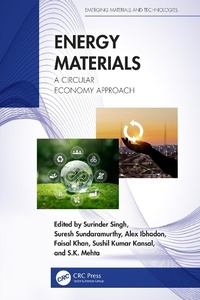
Energy Materials
A Circular Economy Approach
1st Edition
Published on 29. March 2024
398 pages
978-1-040-00002-1 (ISBN)
Description

Energy Materials: A Circular Economy Approach emphasizes the engineering scalability of a circular economy approach to development and use of energy materials. It focuses on waste minimization and its valorization, recycling and reuse, and emerging sustainable materials and technologies. It offers a view of the eco-friendly energy materials and state-of-the-art technologies required for production of these materials in the process industry and manufacturing sectors.
* Covers fundamentals, concepts, and current initiatives within the circular economy
* Outlines technologies and materials with specific applications for energy systems, sustainability aspects and societal benefits
* Focuses on detailed aspects of processing of energy materials, kinetics, their utilization, and end-of-life management and application of circular economy in waste utilization and valorization
* Discusses technologies, processing methods, and production of materials related to fuel cells, super capacitors and battery materials, carbon based hetrostructures, catalysis, functional materials, nanotechnology, biofuels, solar and wind energy, and valuable chemicals
* Details topics related to synthesis and application of energy materials, their recycle, reuse, and life cycle
This book is aimed at students, researchers and professional engineers and scientists working in chemical, materials, energy, and environmental engineering, as well as materials chemistry.
* Covers fundamentals, concepts, and current initiatives within the circular economy
* Outlines technologies and materials with specific applications for energy systems, sustainability aspects and societal benefits
* Focuses on detailed aspects of processing of energy materials, kinetics, their utilization, and end-of-life management and application of circular economy in waste utilization and valorization
* Discusses technologies, processing methods, and production of materials related to fuel cells, super capacitors and battery materials, carbon based hetrostructures, catalysis, functional materials, nanotechnology, biofuels, solar and wind energy, and valuable chemicals
* Details topics related to synthesis and application of energy materials, their recycle, reuse, and life cycle
This book is aimed at students, researchers and professional engineers and scientists working in chemical, materials, energy, and environmental engineering, as well as materials chemistry.
More details
Series
Edition
1. Auflage
Language
English
Place of publication
London
United Kingdom
Publishing group
Taylor & Francis Ltd
Target group
Professional and scholarly
Illustrations
30 Tables, black and white; 97 Line drawings, black and white; 25 Halftones, black and white; 122 Illustrations, black and white
ISBN-13
978-1-040-00002-1 (9781040000021)
Copyright in bibliographic data and cover images is held by Nielsen Book Services Limited or by the publishers or by their respective licensors: all rights reserved.
Schweitzer Classification
Other editions
Additional editions
Book
09/2025
1st Edition
CRC Press
€87.90
Shipment within 10-20 days
Book
03/2024
1st Edition
CRC Press
€215.90
Shipment within 10-20 days
Persons
Dr. Surinder Singh is Faculty Member at Dr. S. S. Bhatnagar University Institute of Chemical Engineering and Technology, Panjab University, Chandigarh. He earned his Ph.D. from GGSIPU University Delhi and Masters in Chemical Engineering from Panjab University, Chandigarh.
Dr. Suresh Sundaramurthy is Faculty & Former Head of Department, Chemical Engineering, Maulana Azad National Institute of Technology (MANIT) Bhopal, India. He received the Ph.D. in Chemical Engineering from Indian Institute of Technology Roorkee, India.
Dr. Alex Ibhadon is Professor of Decarbonization, Sustainability and Reactor Engineering at the University of Hull. Dr. Ibhadon is a Fellow of the Royal Society of Chemistry (CChem), Senior Fellow UK Higher Education Academy, and Member Institute of Materials. Dr Ibhadon was the Director, School of Environmental Sciences (2015-2016) and Programme Director, Chemical Engineering (2017-2022) University of Hull. Dr. Ibhadon graduated with a PhD in Physical Polymer Chemistry from the University of Birmingham, United Kingdom. He has received > GBP7.08M in research funding (twenty-two grant awards) from the UK Royal Society, UK Engineering and Physical Sciences Research Council (EPSRC), Newton, EU, NetZero Innovation, and the Commonwealth.
Dr. Faisal Khan is Mike O'Connor II Chair and Interim Department Head & Professor, Department of Chemical Engineering at Texas A&M University, USA. He is also the Director of Mary Kay O'Connor Process Safety Center and the Director of Ocean Energy Safety Institute. Dr. Khan is a former Professor and Canada Research Chair (Tier I) of Offshore Safety and Risk Engineering at Memorial University of Newfoundland, Canada. He is Editor-in-Chief of the Journal of Process Safety & Environmental Protection and Safety in Harsh Environments.
Prof. Sushil Kumar Kansal, Fellow Royal Society of Chemistry (FRSC), is Professor at Dr. S. S. Bhatnagar University Institute of Chemical Engineering and Technology, Panjab University, Chandigarh. He is also Dean International students at PU, Chandigarh.
Prof. S. K. Mehta, Fellow Royal Society of Chemistry (FRSC), is the Vice Chancellor of University of Ladakh, UT and Professor at the Department of Chemistry. He was the Ex-Chairman, Chemistry and Ex-Director SAIF/CIL/UCIM at Panjab University, Chandigarh. He has been a visiting scientist in the UK, Germany, Japan, USA, and France and has guided 15 postdoctoral, 48 Ph.D., and 50 Master students and handled 20 research projects.
Dr. Suresh Sundaramurthy is Faculty & Former Head of Department, Chemical Engineering, Maulana Azad National Institute of Technology (MANIT) Bhopal, India. He received the Ph.D. in Chemical Engineering from Indian Institute of Technology Roorkee, India.
Dr. Alex Ibhadon is Professor of Decarbonization, Sustainability and Reactor Engineering at the University of Hull. Dr. Ibhadon is a Fellow of the Royal Society of Chemistry (CChem), Senior Fellow UK Higher Education Academy, and Member Institute of Materials. Dr Ibhadon was the Director, School of Environmental Sciences (2015-2016) and Programme Director, Chemical Engineering (2017-2022) University of Hull. Dr. Ibhadon graduated with a PhD in Physical Polymer Chemistry from the University of Birmingham, United Kingdom. He has received > GBP7.08M in research funding (twenty-two grant awards) from the UK Royal Society, UK Engineering and Physical Sciences Research Council (EPSRC), Newton, EU, NetZero Innovation, and the Commonwealth.
Dr. Faisal Khan is Mike O'Connor II Chair and Interim Department Head & Professor, Department of Chemical Engineering at Texas A&M University, USA. He is also the Director of Mary Kay O'Connor Process Safety Center and the Director of Ocean Energy Safety Institute. Dr. Khan is a former Professor and Canada Research Chair (Tier I) of Offshore Safety and Risk Engineering at Memorial University of Newfoundland, Canada. He is Editor-in-Chief of the Journal of Process Safety & Environmental Protection and Safety in Harsh Environments.
Prof. Sushil Kumar Kansal, Fellow Royal Society of Chemistry (FRSC), is Professor at Dr. S. S. Bhatnagar University Institute of Chemical Engineering and Technology, Panjab University, Chandigarh. He is also Dean International students at PU, Chandigarh.
Prof. S. K. Mehta, Fellow Royal Society of Chemistry (FRSC), is the Vice Chancellor of University of Ladakh, UT and Professor at the Department of Chemistry. He was the Ex-Chairman, Chemistry and Ex-Director SAIF/CIL/UCIM at Panjab University, Chandigarh. He has been a visiting scientist in the UK, Germany, Japan, USA, and France and has guided 15 postdoctoral, 48 Ph.D., and 50 Master students and handled 20 research projects.
Content
1. Circular economy for energy materials-state of the art initiatives and regulatory issues. 2. Circular Economy: An Industrial Perspective for Sustainable Future. 3. Lithium as new gold for advanced energy material, availability in nature, recovery from waste, and sustainability. 4. Photo-Catalytic Materials for Production of Hydrogen from Water Using Solar Energy. 5. Valorisation of lignocellulosic biomass into high value chemicals: Forging a route towards the circular economy. 6. Sustainable electrode materials/composites for Batteries and Fuel cells for achieving supercapacitance and environmentally benign mobility. 7. Carbon-based heterostructures: A circular economy energy application towards electrochemical sensors. 8. Technologies for conversion of Biomass to valuable chemicals and Fuels. 9. Microgrid structure for tapping renewable energy. 10. Plastic Waste to Value Added Products via Recycling and Upcycling. 11. Closing the Loop: Circular Economy for Food-Based Emulsions and Films for Energy Materials. 12. MOF-Based Nanocomposites for Energy Storage and Supercapacitor Applications. 13. A Circular Economy Approach to Solar Energy. 14. Recycling Within the Chemical Industry: The Circular Economy Approach- Industrial Perspectives. 15. The Future Perspectives of Global Circular Economy Transition and Comprehensive Cost analysis.
