

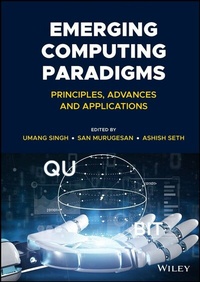
Emerging Computing Paradigms
Description

A holistic overview of major new computing paradigms of the 21st Century
In Emerging Computing Paradigms: Principles, Advances and Applications, international scholars offer a compendium of essential knowledge on new promising computing paradigms. The book examines the characteristics and features of emerging computing technologies and provides insight into recent technological developments and their potential real-world applications that promise to shape the future.
This book is a useful resource for all those who wish to quickly grasp new concepts of, and insights on, emerging computer paradigms and pursue further research or innovate new novel applications harnessing these concepts.
Key Features
* Presents a comprehensive coverage of new technologies that have the potential to shape the future of our world--quantum computing, computational intelligence, advanced wireless networks and blockchain technology
* Revisits mainstream ideas now being widely adopted, such as cloud computing, the Internet of Things (IoT) and cybersecurity
* Offers recommendations and practical insights to assist the readers in the application of these technologies
Aimed at IT professionals, educators, researchers, and students, Emerging Computing Paradigms: Principles, Advances and Applications is a comprehensive resource to get ahead of the curve in examining and exploiting emerging new concepts and technologies. Business executives will also find the book valuable and gain an advantage over competitors in harnessing the concepts examined therein.
More details
Other editions
Additional editions
Persons
Umang Singh, PhD, was an Associate Professor at the Institute of Technology & Science, Ghaziabad, India. She was an active member of various technical societies and professional bodies including IEEE and a life member of the Computer Society of India (CSI).
San Murugesan, PhD, is Director for BRITE Professional Services, Australia and former Editor in Chief of IEEE's IT Professional magazine. He is a Life Senior Member of the IEEE and Golden Core Member of IEEE Computer Society.
Ashish Seth, PhD, is Professor at the INHA University, Incheon, Korea and serves on editorial boards in reputed international journals. He is a Senior Member IEEE Society and an ACM distinguished speaker.
Content
Preface ix
Acknowledgements xiii
About the Editors xv
About the Contributors xvii
Part 1 Cloud Computing 1
1 Cloud Computing: Evolution, Research Issues, and Challenges 3
Neeraj Gupta and Asha Sohal
2 Cloud IoT: An Emerging Computing Paradigm for Smart World 19
Ruchi Bhatnagar, Prof (Dr.) Paramjeet Rawat and Dr. Amit Garg
Part 2 Quantum Computing and Its Applications 41
3 Quantum Computing: Principles and Mathematical Models 43
Arish Pitchai
4 Quantum Cryptography and Security 63
Anukriti and Vandana Niranjan
5 Quantum Machine Learning Algorithms 79
Renata Wong, Tanya Garg, Ritu Thombre, Alberto Maldonado Romo, Niranjan PN, Pinaki Sen, Mandeep Kaur Saggi and Amandeep Singh Bhatia
Part 3 Computational Intelligence and Its Applications 99
6 Computational Intelligence Paradigms in Radiological Image Processing-Recent Trends and Challenges 101
Anil B. Gavade, Rajendra B. Nerli, Ashwin Patil, Shridhar Ghagane and Venkata Siva Prasad Bhagavatula
7 Computational Intelligence in Agriculture 125
Hari Prabhat Gupta, Swati Chopade and Tanima Dutta
8 Long-and-Short-Term Memory (LSTM) Networks: Architectures and Applications in Stock Price Prediction 143
Jaydip Sen and Sidra Mehtab
Part 4 Advances in Wireless Networks 161
9 Mobile Networks: 5G and Beyond 163
Pavel Loskot
10 Advanced Wireless Sensor Networks: Research Directions 177
Richa Sharma
11 Synergizing Blockchain, IoT, and AI with VANET for Intelligent Transport Solutions 193
S.S. Zalte, V.R. Ghorpade and Rajanish K. Kamat
Part 5 Blockchain Technology and Cyber Security 211
12 Enterprise Blockchain: ICO Perspectives and Industry Use Cases 213
Ashish Seth, Kirti Seth and Himanshu Gupta
13 Blockchain and Cryptocurrencies: Techniques, Applications and Challenges 235
Snehlata Barde
14 Importance of Cybersecurity and Its Subdomains 247
Parag H. Rughani
Index 263
Preface
2021 marks the 75th anniversary of the first general purpose electronic digital computer, the 50th anniversary of the microprocessor, and the 40th anniversary of the IBM Personal Computer. These historic developments formed the foundation for amazing continuing advances in computing and IT. In a span of 75 years, from an unproven technology to one that is embedded deeply into every aspect of our work and our daily lives, computers have advanced significantly.
The history of the modern computer has its origin to ENIAC (Electronic Numerical Integrator and Computer), the first general purpose programmable electronic (vacuum-tube) computer, unveiled to public on February 14, 1946. John Mauchly and J. Presper Eckert at the University of Pennsylvania developed it secretly for the US Army to calculate ballistic trajectory tables more effectively than the mechanical differential analyzers in use at the time. Besides using it for ballistics trajectory research, ENIAC was also used for Monte Carlo simulations, weather predictions, and early hydrogen bomb research. On the eve of unveiling of ENIAC, the US War Department put out a press release hailing it as "a new machine that is expected to revolutionize the mathematics of engineering and change many of our industrial design methods." Without doubt, electronic digital computers did transform irrevocably engineering and mathematics, and also every other conceivable domain.
In 1958, Jack Kilby of Texas Instruments invented the first integrated circuit (IC). Adopting large-scale-integration, very large-scale-integration, and ultra-large-scale integration, the density of ICs continued to increase, closely following the Moore's Law-the number of transistors in a chip will approximately double every 24 months. In 1971, Intel Corporation, released the world's first microprocessor, a complete general-purpose central processor unit of a computer on a single IC. Amazing developments in hardware, software, and networking and communication followed, and changed the world irrevocably.
As computers have evolved to redefine and transform almost every area of our lives in the past 75 years, they still function on the same fundamental computational concepts envisaged at the beginning. As demands on computing, storage, and communication continue to escalate, digital computers based on silicon and conventional architecture approach their limits and face issues related to economics and reliability. Thus, certain kinds of problems in domains such as weather forecasting, bioinformatics, robotics, and autonomous systems are faced with limitations tied to the conventional computing paradigm.
Research and industry are exploring radical new computing paradigms such as quantum computing and exploring new solutions to yet unresolved problems and challenges-all of which have the potential to bring about a variety of promising new applications. Understanding, mastering, and applying them will empower us to chart the future course of computing. This book explores principles of and potential for some of these paradigms and approaches and examines their current status and future prospects.
Book Preview
The book presents 14 chapters in five parts, each focusing on an emerging area: cloud computing; quantum computing and its applications; computational intelligence and its applications; advances in wireless networks; and blockchain technology and cyber security.
Cloud Computing
Cloud computing fundamentally changed the IT industry and the ways applications are built and deployed. This computing paradigm is now being widely used for a variety of applications by individuals, business, and government. The first chapter, "Cloud Computing: Evolution, Research Issues, and Challenges" presents a brief, yet comprehensive, overview of cloud computing and outlines its key technologies and approaches. The chapter also highlights cloud's challenges and current limitations and discusses several key issues that require further study. Next chapter, "Cloud IoT: An Emerging Computing Paradigm for Smart World," outlines the role of cloud computing and IoT in the emerging smart world and describes a range of applications. It presents a cloud-IoT architecture and briefly describes supporting infrastructure such as edge computing, fog computing, and mist computing. This chapter also discusses challenges and issues in cloud-IoT integration and adoption.
Quantum Computing and Its Applications
Quantum computing is a new radical computing paradigm. It is fast evolving and attracting growing interest as it has potential to solve computationally intensive problems in a range of areas that are unsolvable even by current supercomputers. The chapter "Quantum Computing: Principles and Mathematical Models" explains the quantum phenomena, superposition and entanglement, and explains introductory mathematics that describe working of a quantum computer, such as mathematical notions of single and composite qubits, quantum measurement, and quantum gates and circuits. It also illustrates, with the help of Deutsch Algorithm, supremacy of quantum algorithms over their classical counterparts.
The next chapter, "Quantum Cryptography and Security," beginning with a brief introduction to encryption, provides a brief overview on quantum cryptography. It describes relevant protocols and their applications in cryptography and explains the use of quantum distributive encryption and generation and distribution of quantum keys. It also discusses the effect of noise and spy monitoring over the communication network and error correction through which the destination user can recover the original message from the corrupted data.
Adoption of quantum computing in machine learning presents several new opportunities to solve problems in new smart ways. The Chapter "Quantum Machine Learning Algorithms" presents an overview of recent progress in quantum machine learning and outlines and compares different quantum machine learning algorithms.
Computational Intelligence and Its Applications
In this part, we present three chapters which discuss application of computational intelligence (CI) in three domains. First, in "Computational Intelligence Paradigms in Radiological Image Processing-Recent Trends and Challenges," the authors briefly introduce CI and present an overview on radiological information processing using computational intelligence paradigm and discuss emerging trends. They also describe different stages in radiological image processing and explains the use of CI paradigms based on fuzzy logic, artificial neural networks, and evolutionary computation.
Next, "Computational Intelligence in Agriculture" discusses various uses of CI in agriculture, such estimation and improvement of crop yield, water conservation, soil and plant health monitoring, and plant disease detection. The chapter also describes various remote sensing methods and different wireless communication protocols and machine learning models used in agriculture applications.
Though recurrent neural networks (RNNs) are effective in handling sequential data, they have limitations in capturing the long-term dependencies in the data due to a problem known as vanishing and exploding gradients. Long-and-Short-Term Memory (LSTM), a variant of RNN, overcomes this problem and is very efficient and offers better performance in handling sequential data. The chapter "Long-and-Short-Term Memory (LSTM) Networks: Architectures and Applications in Stock Price Prediction" presents the basic design of LSTM networks and describes their working principles. It discusses and compares six different variants of LSTM models for stock price forecasting. The models were trained and tested on real-world data-the historical NIFTY 50 index of the National Stock Exchange (NSE) of India from December 29, 2014 to July 31, 2020.
Advances in Wireless Networks
Wireless networks are rapidly advancing and finding application in several areas. The 5G revolution aims to merge all communication networks into one ubiquitous global network with a seamless integration of communication services that are transparent to the mobile end users and devices. The chapter "Mobile Networks: 5G and Beyond" reviews main principles of mobile networks and outlines the strategies and challenges in designing 5G mobile networks. In particular, it outlines the concepts, design challenges and key developments in vehicle ad-hoc networks (VANETs) including connected cars, unmanned aerial vehicle (UAV), and low-Earth orbit (LEO) satellites.
Advanced Wireless Sensor Networks (AWSNs) are gaining growing interest among the researchers and practitioners as they have a range of applications like structural health monitoring, precision smart agriculture, smart cities, and smart parking systems. AWSNs, however, present several issues and challenges that need to be addressed. The chapter "Advanced Wireless Sensor Networks: Research Directions" identifies and discusses research areas in AWSNs. It also outlines key principles governing design of mobile networks which are now directly integrated with the 5G cellular networks.
The final chapter in this section, "Synergizing Blockchain, IoT and AI with VANET for Intelligent Transport Solutions," looks at benefits and challenges of embracing the potential of blockchain, IoT and AI with VANET in the context of facilitating intelligent transport solutions. It also examines security aspects of this synergic combination of technologies, showcases novel applications that address UN Sustainable...
