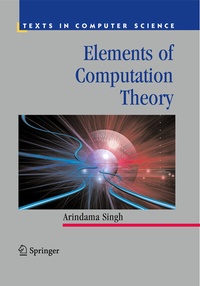
Elements of Computation Theory
Description

Reviews / Votes
From the reviews:
"This undergraduate textbook is designed for a course on the foundations of computer science (CS). . The book is divided into ten chapters, and each chapter is divided into several sections. . Overall, I recommend this book to instructors and students who are . looking for a clear, concise, and well-written introduction to the foundations of CS." (Burkhard Englert, ACM Computing Reviews, October, 2009)
"This book gathers the essential parts of computability theory that typically comprise undergraduate-level courses. . presents computability theory, which answers fundamental questions about problems that can be solved algorithmically and problems that are unsolvable. . covers formal language theory (Chomsky hierarchy), from language, grammar, and machine perspectives. . The text was written with the undergraduate in mind, and is appropriate for both computability theory and formal language theory courses. . The writing style is rather pleasant, and I recommend it to students in the field." (R. Goldberg, ACM Computing Reviews, January, 2010)
"Intended as an introduction to the theory of computation mainly for students of computer science, engineering and mathematics. It is planned as a one-semester course for undergraduate students. . The chapters contain plenty of examples, exercises, and bibliographic remarks. Many examples are thoroughly studied, and some of the exercises are challenging. . The book is well written . . At the end of the book there are answers and hints to selected problems, and a list of references." (Tero J. Harju, Zentralblatt MATH, Vol. 1182, 2010)
"Singh's book covers the standard sections of finite automata theory and regular languages/grammars/expressions, pushdown automata and context free grammars/languages, Turing machines/type 0 grammars/languages, halting problems, and complexity classes. . Each chapter has more than 100 exercises, enough to quenchthe thirst of and challenge eager students and instructors." (Mukkai Krishnamoorthy, SIAM Review, Vol. 52 (4), 2010)
More details
Other editions
Additional editions