

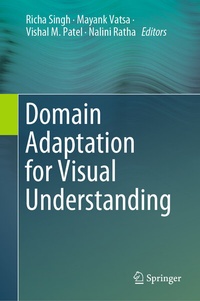
Domain Adaptation for Visual Understanding
Description

This unique volume reviews the latest advances in domain adaptation in the training of machine learning algorithms for visual understanding, offering valuable insights from an international selection of experts in the field. The text presents a diverse selection of novel techniques, covering applications of object recognition, face recognition, and action and event recognition.
Topics and features: reviews the domain adaptation-based machine learning algorithms available for visual understanding, and provides a deep metric learning approach; introduces a novel unsupervised method for image-to-image translation, and a video segment retrieval model that utilizes ensemble learning; proposes a unique way to determine which dataset is most useful in the base training, in order to improve the transferability of deep neural networks; describes a quantitative method for estimating the discrepancy between the source and target data to enhance image classification performance; presentsa technique for multi-modal fusion that enhances facial action recognition, and a framework for intuition learning in domain adaptation; examines an original interpolation-based approach to address the issue of tracking model degradation in correlation filter-based methods.
This authoritative work will serve as an invaluable reference for researchers and practitioners interested in machine learning-based visual recognition and understanding.
More details
Other editions
Additional editions
Persons
Dr. Richa Singh
is a Professor at Indraprastha Institute of Information Technology, Delhi, India.
Dr. Mayank Vatsa
is a Professor at the same institution.
Dr. Vishal M. Patel
is an Assistant Professor in the Department of Electrical and Computer Engineering at Johns Hopkins University, Baltimore, MD, USA.
Dr. Nalini Ratha
is a Research Staff Member at the IBM Thomas J. Watson Research Center, Yorktown Heights, NY, USA.
Content
Domain Adaptation for Visual Understanding.- M-ADDA: Unsupervised Domain Adaptation with Deep Metric Learning.- XGAN: Unsupervised Image-to-Image Translation for Many-to-Many Mappings.- Improving Transferability of Deep Neural Networks.- Cross Modality Video Segment Retrieval with Ensemble Learning.- On Minimum Discrepancy Estimation for Deep Domain Adaptation.- Multi-Modal Conditional Feature Enhancement for Facial Action Unit Recognition.- Intuition Learning.- Alleviating Tracking Model Degradation Using Interpolation-Based Progressive Updating.
