

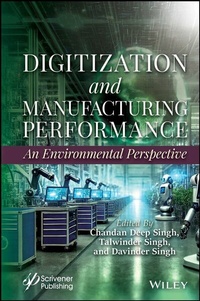
Digitization and Manufacturing Performance
Description

The book provides valuable insights into how modern production strategies can enhance quality, efficiency, and environmental sustainability, ultimately driving profit and competitive advantage in today's high-tech industry.
Today, production strategies are influenced by quality, cost, delivery, innovation, and responsiveness. Firms have traditionally pursued these goals through the adoption of production practices, such as simultaneous engineering, increasing efficiency through the elimination of defects, setup reduction, and worker empowerment. However, recent developments in industry suggest that industry regulators and professional bodies must encourage innovation in a broad range of high-tech production facilities with the environment in mind. The success of the industry depends on production facilities and the competitive advantage that the industry gains due to better quality and reliability. This advantage leads to an increase in sales and the creation of a sound customer base for greater market share, which eventually leads to more profit, growth, and expansion. A firm's processes must possess operating advantages in the form of competitive priorities to outperform its competitors, keeping in mind its influence on the environment. Digitization and Manufacturing Performance: An Environmental Perspective presents the expectations of industrialists, policymakers, and academics by evaluating the impact of production facilities.
Readers will find the book:
- Discusses emerging technologies and their role in environmental aspects in detail;
- Provides a comprehensive overview of the latest existing and emerging technologies and their environmental aspects;
- Justifies social, economic, and technical considerations of these technologies;
- Explores the relationship between advanced technologies and the environment through in-depth studies.
Audience
Researchers, scholars, faculty, professionals in research and development, and industrialists in the industrial, production, mechanical, and electronics sectors.
More details
Other editions
Additional editions
Persons
Chandan Deep Singh, PhD is an assistant professor in the Department of Mechanical Engineering at Punjabi University. He has published over 120 papers in international journals and conferences, 59 reference books, and ten book chapters. Additionally, he has been granted one international patent and filed another. His research interests include fuzzy logic, MATLAB, and structural equation modeling.
Talwinder Singh, PhD is an assistant professor in the Department of Mechanical Engineering at Punjabi University. He has published 23 research papers in national and international journals, as well as one book. His research interests include green engineering, environmentally friendly machining, and minimum quantity lubrication.
Davinder Singh, PhD is an assistant professor in the Department of Mechanical Engineering at Punjabi University. He has published over 25 papers in international journals and conferences. His research interests include production and industrial engineering, manufacturing technology, and innovation management.
Content
Preface xv
1 Green Energy Technologies 1
Chandan Deep Singh
1.1 Introduction 1
1.2 Industrial Processes 4
1.3 Overview of Renewable Energy Technologies 8
1.4 Dedicated Energy Crops 24
1.5 Agricultural Crop Residue 25
1.6 Forestry Residues 25
1.7 Algae 25
1.8 Wood Processing Residues 26
1.9 Sorted Municipal Waste 26
1.10 Wet Waste 26
1.11 What is Solar PV? 31
1.12 Solar Photovoltaic Energy Conversion 32
1.13 What is Waste to Energy? 33
1.14 Where are Nanomaterials Found? 45
2 Recent Advances in Green Energy Materials: A Review 51
Mukhtiar Singh, Maninder Singh, Jasvinder Singh, Mandeep Singh and Harjit Singh
2.1 Introduction 52
2.2 Solar Energy Materials 54
2.3 Wind Energy Materials 56
2.4 Hydroelectric Energy Materials 56
2.5 Geothermal Energy Materials 62
2.6 Biomass Energy Materials 64
2.7 Conclusion 70
3 Green Computing Technologies: Toward Sustainable Computing 73
Maninder Singh, Mukhtiar Singh, Jasvinder Singh, Harjit Singh and Mandeep Singh
3.1 Introduction 74
3.2 Virtualization and Cloud Computing 79
3.3 Sustainable Computing Practices 84
3.4 Green Computing in Industry and Society 87
3.5 Challenges and Opportunities 90
3.6 Conclusion 93
4 Application of Machine Learning Techniques for Environmental Monitoring and Conservation: A Review 97
Mukhtiar Singh, Maninder Singh, Jasvinder Singh, Harjit Singh and Mandeep Singh
4.1 Introduction 98
4.2 Machine Learning Techniques 106
4.3 Applications of Machine Learning in Environmental Aspect 109
4.4 Natural Resource Management and Conservation 113
4.5 Biodiversity Conservation 114
4.6 Waste Management and Recycling 115
4.7 Challenges and Opportunities 116
4.8 Opportunities for the Advancement of Machine Learning in Environmental Aspect 117
4.9 Ethics, Transparency, and Fairness in Machine Learning for Environmental Aspect 118
4.10 Real-World Applications of Machine Learning in Environmental Aspect 120
4.11 Case Studies 121
4.12 Success Stories and Best Practices 122
4.13 Conclusion and Recommendations 124
5 Green Engineering in IoT 129
Talwinder Singh and Davinder Singh
5.1 Introduction 130
5.2 IoT Data Types 130
5.3 What is Green IoT? 132
5.4 Benefits of Adopting Green IoT 134
5.5 Green IoT Components 135
5.6 Recommendations for Raising Awareness and Future Research Directions 145
6 Green Engineering in Product Development 149
Harpreet Sharma, Chandan Deep Singh and Kanwaljeet Singh
6.1 Introduction and Meaning 149
6.2 Principles of Green Engineering 151
6.3 Benefits of Green Engineering 157
6.4 Promoting Green Engineering Through Green Chemistry 158
6.5 Sustainability and Green Engineering Innovations That Might Just Change the World 159
6.6 Conclusion 163
7 Green Policies in Education: Fostering Environmental Stewardship and Sustainable Practices 167
Mukhtiar Singh, Maninder Singh, Jasvinder Singh, Harjit Singh and Mandeep Singh
7.1 Introduction 168
7.2 Theoretical Framework 175
7.3 Policy Development and Implementation 178
7.4 Curriculum Integration and Pedagogy 182
7.5 Infrastructure and Facilities 184
7.6 Student Engagement and Participation 189
7.7 Collaboration and Partnerships 190
7.8 Monitoring, Evaluation, and Reporting 191
7.9 Challenges and Future Directions 196
7.10 Conclusion 207
8 Green Engineering in Automobile Sector 211
Harjit Singh, Mukhtiar Singh, Jasvinder Singh and Maninder Singh
8.1 Introduction 211
8.2 Green Engineering in Automobile Design 215
8.3 Conclusion 228
9 Towards Sustainable Manufacturing: Integrating Digital Technologies on the Green Path 235
Harjit Singh, Mukhtiar Singh, Jasvinder Singh and Maninder Singh
9.1 Introduction 235
9.2 Digital Technologies for Sustainable Manufacturing with Internet of Things (IoT) 241
9.3 Digital Technologies for Sustainable Manufacturing with Artificial Intelligence 241
9.4 Digital Technologies for Sustainable Manufacturing with Digital Twins 242
9.5 Digital Technologies for Sustainable Manufacturing with Additive Manufacturing (3D Printing) 243
9.6 Digital Technologies for Sustainable Manufacturing with Augmented Reality (AR) 244
9.7 Green Path for Sustainable Manufacturing 245
9.8 Introduction to Green Manufacturing 246
9.9 Future Trends in Sustainable Manufacturing 253
9.10 Emerging Digital Technologies for Sustainable Manufacturing 254
9.11 New Trends in Green Manufacturing Practices 254
9.12 Future Directions for Sustainable Manufacturing 255
9.13 Conclusion 256
9.14 Future Scope 257
10 Smart Manufacturing for a Sustainable Future: A Review 265
Maninder Singh, Mukhtiar Singh, Jasvinder Singh and Harjit Singh
10.1 Introduction 266
10.2 Smart Manufacturing for Green Future 267
10.3 Green Supply Chain Management 269
10.4 Waste Reduction 270
10.5 Renewable Energy Integration 271
10.6 Green Product Design 272
10.7 Circular Economy 273
10.8 Water Conservation 274
10.9 Green Data Centers 275
10.10 Conclusion 276
11 Smart Manufacturing for a Greener Future 281
Harpreet Sharma, Chandan Deep Singh and Kanwaljeet Singh
11.1 Introduction and Meaning 281
11.2 Historical Background of Manufacturing 284
11.3 Characteristics and Challenges of Smart Manufacturing Systems 288
11.4 Enabling Mechanisms Toward Smart Manufacturing for Greener Future 291
11.5 Supporting Tool/Methods Toward Smart Manufacturing for Greener Future 294
11.6 Conclusions 296
References 297
Index 299
1
Green Energy Technologies
Chandan Deep Singh
Punjabi University, Patiala, Punjab, India
Abstract
Green energy is that which comes from natural sources, such as the sun. Clean energy are those types which do not release pollutants into the air, and renewable energy comes from sources that are constantly being replenished, such as hydro power, wind power or solar energy. Clean energy technologies are renewable, less environmentally invasive ways of powering the global community. Some of the most common examples of clean energy sources include solar, wind, water, geothermal, bioenergy, natural gas, and nuclear power. The key with these energy resources are that they do not harm the environment through factor, such as releasing greenhouse gases into the atmosphere.
Keywords: Green energy technologies, materials, biomass, electric power, hydro, solar, wind, geothermal
1.1 Introduction
As a source of energy, green energy often comes from renewable energy technologies such as solar energy, wind power, geothermal energy, biomass and hydroelectric power. Each of these technologies works in different ways, whether that is by taking power from the sun, as with solar panels, or using wind turbines or the flow of water to generate energy.
In order to be deemed green energy, a resource cannot produce pollution, such as is found with fossil fuels. This means that not all sources used by the renewable energy industry are green. For example, power generation that burns organic material from sustainable forests may be renewable, but it is not necessarily green, due to the CO2 produced by the burning process itself.
Green energy sources are usually naturally replenished, as opposed to fossil fuel sources like natural gas or coal, which can take millions of years to develop. Green sources also often avoid mining or drilling operations that can be damaging to eco-systems.
Types
The main sources are wind energy, solar power and hydroelectric power (including tidal energy, which uses ocean energy from the tides in the sea). Solar and wind power are able to be produced on a small scale at people's homes or alternatively, they can be generated on a larger, industrial scale.
The six most common forms are as follows:
Solar Power
This common type of renewable energy is usually produced using photovoltaic cells that capture sunlight and turn it into electricity. Solar power is also used to heat buildings and for hot water as well as for cooking and lighting. Solar power has now become affordable enough to be used for domestic purposes including garden lighting, although it is also used on a larger scale to power entire neighbourhoods.
Wind Power
Particularly suited to offshore and higher altitude sites, wind energy uses the power of the flow of air around the world to push turbines that then generate electricity.
Hydropower
Also known as hydroelectric power, this type of green energy uses the flow of water in rivers, streams, dams or elsewhere to produce electricity. Hydropower can even work on a small scale using the flow of water through pipes in the home or can come from evaporation, rainfall or the tides in the oceans.
Exactly how "green" the following three types of green energy are is dependent on how they are created.
Geothermal Energy
This type of green power uses thermal energy that has been stored just under the earth's crust. While this resource requires drilling to access, thereby calling the environmental impact into question, it is a huge resource once tapped into. Geothermal energy has been used for bathing in hot springs for thousands of years and this same resource can be used for steam to turn turbines and generate electricity. The energy stored under the United States alone is enough to produce 10 times as much electricity as coal currently can. While some nations, such as Iceland, have easy-to-access geothermal resources, it is a resource that is reliant on location for ease of use, and to be fully "green" the drilling procedures need to be closely monitored.
Biomass
This renewable resource also needs to be carefully managed in order to be truly labelled as a "green energy" source. Biomass power plants use wood waste, sawdust and combustible organic agricultural waste to create energy. While the burning of these materials releases greenhouse gas these emissions are still far lower than those from petroleum-based fuels.
Biofuels
Rather than burning biomass as mentioned above, these organic materials can be transformed into fuel such as ethanol and biodiesel. Having supplied just 2.7% of the world's fuel for transport in 2010, the biofuels are estimated to have the capacity to meet over 25% of global transportation fuel demand by 2050.
Green energy is important for the environment as it replaces the negative effects of fossil fuels with more environmentally-friendly alternatives. Derived from natural resources, green energy is also often renewable and clean, meaning that they emit no or few greenhouse gases and are often readily available.
Even when the full life cycle of a green energy source is taken into consideration, they release far less greenhouse gases than fossil fuels, as well as few or low levels of air pollutants. This is not just good for the planet but is also better for the health of people and animals that have to breathe the air.
Green energy can also lead to stable energy prices as these sources are often produced locally and are not as affected by geopolitical crisis, price spikes or supply chain disruptions. The economic benefits also include job creation in building the facilities that often serve the communities where the workers are employed.
Renewable energy saw the creation of 11 million jobs worldwide in 2018, with this number set to grow as we strive to meet targets such as net zero.
Due to the local nature of energy production through sources like solar and wind power, the energy infrastructure is more flexible and less dependent on centralized sources that can lead to disruption as well as being less resilient to weather related climate change.
Green energy also represents a low cost solution for the energy needs of many parts of the world. This will only improve as costs continue to fall, further increasing the accessibility of green energy, especially in the developing world.
Examples
There are plenty of examples of green energy in use today, from energy production through to thermal heating for buildings, off-highway and transport. Many industries are investigating green solutions and here are a few examples:
Heating and Cooling in Buildings
Green energy solutions are being used for buildings ranging from large office blocks to people's homes. These include solar water heaters, biomass fuelled boilers and direct heat from geothermal, as well as cooling systems powered by renewable sources.
1.2 Industrial Processes
Renewable heat for industrial processes can be run using biomass or renewable electricity. Hydrogen is now a large provider of renewable energy for the cement, iron, steel and chemical industries.
Transport
Sustainable biofuels and renewable electricity are growing in use for transportation across multiple industry sectors. Automotive is an obvious example as electrification advances to replace fossil fuels, but aerospace and construction are other areas that are actively investigating electrification.
Can it replace fossil fuels?
Green energy has the capacity to replace fossil fuels in the future, however it may require varied production from different means to achieve this. Geothermal, for example, is particularly effective in places where this resource is easy to tap into, while wind energy or solar power may be better suited to other geographic locations.
However, by bringing together multiple green energy sources to meet our needs, and with the advancements that are being made with regards to production and development of these resources, there is every reason to believe that fossil fuels could be phased out.
We are still some years away from this happening, but the fact remains that this is necessary to reduce climate change, improve the environment and move to a more sustainable future.
Can it be economically viable?
Understanding the economic viability of green energy requires a comparison with fossil fuels. The fact is that as easily-reached fossil resources begin to run out, the cost of this type of energy will only increase with scarcity.
At the same time as fossil fuels become more expensive, the cost of greener energy sources is falling. Other factors also work in favour of green energy, such as the ability to produce relatively inexpensive localized energy solutions, such as solar farms. The interest, investment and development of green energy solutions is bringing costs down as we continue to build up our knowledge and are able to build on past breakthroughs.
As a result, green energy can not only become economically viable but also the preferred option.
Which type is the most efficient?
Efficiency in green energy is slightly dependent on location as, if you have the right conditions, such as frequent and strong sunlight, it is easy to create a fast and efficient energy solution.
However, to truly compare different energy types it is necessary to analyze the full life cycle of an energy source. This includes assessing the energy used to create the...
