

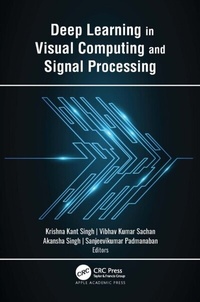
Deep Learning in Visual Computing and Signal Processing
1st Edition
Published on 20. October 2022
288 pages
978-1-000-56523-2 (ISBN)
Description

An enlightening amalgamation of deep learning concepts with visual computing and signal processing applications, this new volume covers the fundamentals and advanced topics in designing and deploying techniques using deep architectures and their application in visual computing and signal processing.
The volume first lays out the fundamentals of deep learning as well as deep learning architectures and frameworks. It goes on to discuss deep learning in neural networks and deep learning for object recognition and detection models. It looks at the various specific applications of deep learning in visual and signal processing, such as in biorobotics, for automated brain tumor segmentation in MRI images, in neural networks for use in seizure classification, for digital forensic investigation based on deep learning, and more.
The volume first lays out the fundamentals of deep learning as well as deep learning architectures and frameworks. It goes on to discuss deep learning in neural networks and deep learning for object recognition and detection models. It looks at the various specific applications of deep learning in visual and signal processing, such as in biorobotics, for automated brain tumor segmentation in MRI images, in neural networks for use in seizure classification, for digital forensic investigation based on deep learning, and more.
More details
Edition
1. Auflage
Language
English
Place of publication
London
United Kingdom
Publishing group
Taylor & Francis Ltd
Target group
College/higher education
Professional and scholarly
Illustrations
19 Tables, black and white; 76 Line drawings, black and white; 2 Halftones, black and white; 78 Illustrations, black and white
ISBN-13
978-1-000-56523-2 (9781000565232)
Copyright in bibliographic data and cover images is held by Nielsen Book Services Limited or by the publishers or by their respective licensors: all rights reserved.
Schweitzer Classification
Other editions
Additional editions
Krishna Kant Singh | Vibhav Kumar Sachan | Akansha Singh
Deep Learning in Visual Computing and Signal Processing
Book
10/2022
1st Edition
Apple Academic Press Inc.
€179.20
Shipment within 3-4 weeks
Persons
Krishna Kant Singh, PhD, is Professor and Head, Department of CSE, Faculty of Engineering and Technology, Jain (Deemed-to-be University), India. He is also the NBA coordinator for the department. He has wide teaching and research experience and has authored more than 100 research papers in Scopus and SCIE indexed journals as well as 25 technical books. He is also an associate editor and editorial board member of several journals and an active researcher in the field of machine learning, cognitive computing, and 6G and beyond networks.
Vibhav Kumar Sachan, PhD, is Professor and Additional Head of the Department of Electronics and Communication Engineering Department at the KIET Group of Institutions, India. During his academic career of 18 years, he has taught at undergraduate and postgraduate levels and has authored books, edited several conference proceedings, and written book chapters. He has published many papers in reputed national and international journals and conferences and is an editorial board member of several journals.
Akansha Singh, PhD, is Associate Professor in the School of Computer Science Engineering and Technology, Bennett University, India. She has to her credit more than 70 research papers, 20 books, and numerous conference papers. Dr. Singh has served as a reviewer and technical committee member for multiple conferences and journals and is also an associate editor and guest editor for several journals in her field.
Sanjeevikumar Padmanaban, PhD, is a senior member of IEEE and a faculty member with the Department of Energy Technology, Aalborg University, Esbjerg, Denmark. He is also affiliated with CTIF Global Capsule, Department of Business Development and Technology Aarhus University, Denmark. He was formerly affiliated with VIT University, India; the National Institute of Technology, India; Qatar University, Doha, Qatar; Dublin Institute of Technology, Ireland; and the University of Johannesburg, South Africa.
Vibhav Kumar Sachan, PhD, is Professor and Additional Head of the Department of Electronics and Communication Engineering Department at the KIET Group of Institutions, India. During his academic career of 18 years, he has taught at undergraduate and postgraduate levels and has authored books, edited several conference proceedings, and written book chapters. He has published many papers in reputed national and international journals and conferences and is an editorial board member of several journals.
Akansha Singh, PhD, is Associate Professor in the School of Computer Science Engineering and Technology, Bennett University, India. She has to her credit more than 70 research papers, 20 books, and numerous conference papers. Dr. Singh has served as a reviewer and technical committee member for multiple conferences and journals and is also an associate editor and guest editor for several journals in her field.
Sanjeevikumar Padmanaban, PhD, is a senior member of IEEE and a faculty member with the Department of Energy Technology, Aalborg University, Esbjerg, Denmark. He is also affiliated with CTIF Global Capsule, Department of Business Development and Technology Aarhus University, Denmark. He was formerly affiliated with VIT University, India; the National Institute of Technology, India; Qatar University, Doha, Qatar; Dublin Institute of Technology, Ireland; and the University of Johannesburg, South Africa.
Content
1. Deep Learning Architecture and Framework 2. Deep Learning in Neural Networks: An Overview 3. Deep Learning: Current Trends and Techniques 4. TensorFlow: Machine Learning Using Heterogeneous Edge on Distributed Systems 5. Introduction to Biorobotics: Part of Biomedical Signal Processing 6. Deep Learning-Based Object Recognition and Detection Model 7. Deep Learning: A Pathway for Automated Brain Tumor Segmentation in MRI Images 8. Recurrent Neural Networks and Their Application in Seizure Classification 9. Brain Tumor Classification Using Convolutional Neural Network 10. A Proactive Improvement Toward Digital Forensic Investigation Based on Deep Learning
