

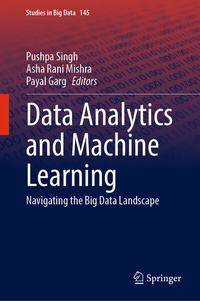
Data Analytics and Machine Learning
Description

This book presents an in-depth analysis of successful data-driven initiatives, highlighting how organizations have leveraged data to drive decision-making processes, optimize operations, and achieve remarkable outcomes. Through case studies, readers gain valuable insights and learn practical strategies for implementing data analytics, big data, and machine learning solutions in their own organizations. The book discusses the transformative power of data analytics and big data in various industries and sectors and how machine learning applications have revolutionized exploration by enabling advanced data analysis techniques for mapping, geospatial analysis, and environmental monitoring, enhancing our understanding of the world and its dynamic processes. This book explores how big data explosion, the power of analytics and machine learning revolution can bring new prospects and opportunities in the dynamic and data-rich landscape. It highlights the future research directions in data analytics, big data, and machine learning that explores the emerging trends, challenges, and opportunities in these fields by covering interdisciplinary approaches such as handling and analyzing real-time and streaming data.
More details
Other editions
Additional editions
Persons
Dr. Pushpa Singh is working as an associate professor at the GL Bajaj Institute of Technology & Management, India. Her current areas of research include performance evaluation of heterogeneous wireless networks, machine learning and blockchain technology.
Dr. Asha Rani Mishra is working as an associate professor at the GL Bajaj Institute of Technology & Management, India. Her current areas of research include machine learning, AI, NLP, and deep learning.
Dr. Payal Garg is working as an assistant professor at the GL Bajaj Institute of Technology & Management, India. Her current areas of research include image processing and machine learning techniques.
Content
Chapter 1. Introduction to Data Analytics, Big Data, and Machine Learning.- Chapter 2. Fundamentals of Data Analytics and Lifecycle.- Chapter 3. Building Predictive Models with Machine Learning.- Chapter 4. Stream data model and architecture.- Chapter 5. Leveraging Big Data for Data Analytics.- Chapter 6. Advanced Techniques in Data Analytics.- Chapter 7. Scalable Machine Learning with Big Data.- Chapter 8. Big Data Analytics Framework using Machine Learning on Massive Datasets.- Chapter 9. Deep-learning Techniques in Big-Data analytics.- Chapter 10. Data Privacy and Ethics in Data Analytics.- Chapter 11. Practical Implementation of Machine Learning Techniques & data analytics using R.- Chapter 12. Real-World Applications of Data Analytics, Big Data, and Machine Learning.- Chapter 13. Implementing Data-Driven Innovation in Organizations.- Chapter 14. Business Transformation using Big Data Analytics and Machine Learning.- Chapter 15. Future Trends and Emerging Opportunities in HealthAnalytics.- Chapter 16. Future Trends in Data Analytics and Machine Learning.
