

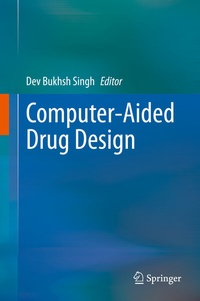
Computer-Aided Drug Design
Description

This book provides up-to-date information on bioinformatics tools for the discovery and development of new drug molecules. It discusses a range of computational applications, including three-dimensional modeling of protein structures, protein-ligand docking, and molecular dynamics simulation of protein-ligand complexes for identifying desirable drug candidates. It also explores computational approaches for identifying potential drug targets and for pharmacophore modeling.
Moreover, it presents structure- and ligand-based drug design tools to optimize known drugs and guide the design of new molecules. The book also describes methods for identifying small-molecule binding pockets in proteins, and summarizes the databases used to explore the essential properties of drugs, drug-like small molecules and their targets. In addition, the book highlights various tools to predict the absorption, distribution, metabolism, excretion (ADME) and toxicity (T) of potential drug candidates. Lastly, it reviews in silico tools that can facilitate vaccine design and discusses their limitations.
More details
Other editions
Additional editions
Person
Dr. Dev Bukhsh Singh is an Assistant Professor at the Department of Biotechnology, Chhatrapati Shahu Ji Maharaj University, Kanpur, India. He received his B.Sc. and M.Sc. degrees from the University of Allahabad, Prayagraj, and his M.Tech. from the Indian Institute of Information Technology, Prayagraj. Holding a Ph.D. in Biotechnology with specialization in Bioinformatics from Gautam Buddha University, he has been actively involved in teaching and research since 2009, and his focus areas include molecular modeling, chemoinformatics, inhibitor/drug design, and in silico evaluation. He has authored numerous research articles and book chapters in the fields of medicinal research, molecular modeling, drug design, and systems biology. He is a member of various national and international academic bodies, and is a reviewer for several international journals.
Content
1 Computational Approaches in Drug Discovery and Design.- 2 Molecular Modeling of Proteins: Methods, Recent Advances and Future Prospects.- 3 Cavity/Binding Site Prediction Approaches, and their Applications.- 4 Role of ADMET Tools in Current Scenario; Application and Limitations.- 5 Database Resources for Drug Discovery.- 6 Molecular Docking and Structure-Based Drug Design.- 7 Molecular Dynamics Simulation of Protein and Protein-Ligand Complexes.- 8 Computational Approaches for Drug Target Identification.- 9 Computational Screening Techniques for Lead Design and Development.- 10 Advances in Pharmacophore Modeling and its Role in Drug Designing.- 11 In Silico Designing of Vaccines: Methods, Tools and Their Limitations.- 12 Machine learning Approaches to Rational Drug Design.
