

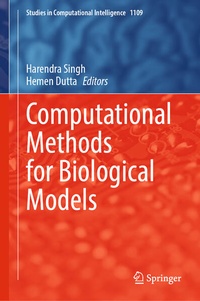
Computational Methods for Biological Models
Description

This book discusses computational methods related to biological models using mathematical tools and techniques. The book chapters concentrate on numerical and analytical techniques that provide a global solution for biological models while keeping long-term benefits in mind. The solutions are useful in closely understanding biological models, and the results will be very useful for mathematicians, engineers, doctors, scientists and researchers working on real-life biological models. This book provides significant and current knowledge of biological models related to real-life applications. The book covers both methods and applications.
More details
Other editions
Additional editions
Persons
Dr. Harendra Singh is an assistant professor in the Department of Mathematics, Post-Graduate College, Ghazipur-233001, Uttar Pradesh, India. He has listed in top 2% scientist list published by Stanford University. His area of interest is mathematical modelling, fractional differential equations, integral equations, calculus of variations, analytical and numerical methods. His works have been published in applied mathematics and computations, applied mathematical modelling, applied numerical mathematics, Chaos Solitons & Fractals, numerical methods for partial differential equations, physica A, astrophysics and space science, Electronic Journal of Differential Equations, Few Body-system and several other peer-reviewed international journals. His 50 research papers have been published in various journals of repute with h-index of 22 and i10 index 31. He has delivered lectures in a number of national and international conferences and workshop. He has also attended short-terms programsand workshops.
Dr. Hemen Dutta is serving Gauhati University, India, regularly as a faculty member since 2010. Prior to joining Gauhati University, he served three other academic institutions in different capacities. He is currently interested in applied analysis and mathematical modelling. He has over 170 publications in the forms of research papers, book chapters and proceedings papers and serving as an editor of several SCI/SCIE and Scopus indexed journals as well as book series editor of top-class publishers like Elsevier and Taylor & Francis. He has to his credit several authored and edited books and conference proceedings published by reputed publishers like Springer, Birkhauser, Wiley, Taylor & Francis, Elsevier, etc. He is a selected member as well as life member of some academies and societies. He is the recipient of several grants, research projects and holding some honorary positions at foreign and national university/institution.
Content
1. Exponential time-differencing method for the solution of diffusive HIV model.- 2. An effective technique for solving a model describing biological species living together.- 3. Neuro-Swarming Integrated Heuristic with an Interior-Point Scheme for Novel design of Lane-Emden Nonlinear Prediction Singular Differential Model.- 4. A fitted operator method for a system of delay model of tumor cells dynamics within their micro-environment.- 5. A Mathematical Model to Study Regulatory Properties and Dynamical Behaviour of Glycolytic Pathway using Bifurcation Analysis.- 6. On solutions of fractional biological models using reproducing kernel Hilbert space method.- 7. An operational matrix based method to find the solution of the fractional tumour immune vitamins model.- 8. Analysis of a fractional stage-structured model with Crowley-Martin type functional response by Lagrange polynomial based method.- 9. Qualitative Theory and Approximate Solution to Typhoid Fever Model Subject to Non Singular Kernel Type Derivative.- 10. Study of the SIRI epidemic model described by the Caputo derivative.- 11. Unlocking Biological systems through mathematical Modelling.- 12. Implementation of vaccination in epidemic model for COVID-19.
