

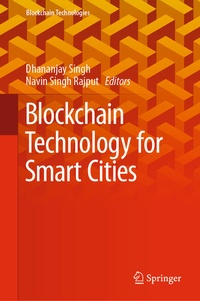
Blockchain Technology for Smart Cities
Description

This book provides a comprehensive overview of various aspects of the development of smart cities from a secure, trusted, and reliable data transmission perspective. It presents theoretical concepts and empirical studies, as well as examples of smart city programs and their capacity to create value for citizens. The contributions offer a panorama of the most important aspects of smart city evolution and implementation within various frameworks, such as healthcare, education, and transportation. Comparing current advanced applications and best practices, the book subsequently explores how smart environments and programs could help improve the quality of life in urban spaces and promote cultural and economic development.
More details
Other editions
Additional editions
Persons
Dhananjay Singh is an Associate Professor at the Department of Electronics Engineering and Director of the ReSENSE Lab at Hankuk University of Foreign Studies (HUFS), Seoul. He is also Chief Technical Officer (CTO) at MtoV & Vestella, South Korea. He received his M. Tech. in IT with a specialization in Wireless Communication & Computing from the IIIT-Allahabad, India, and his Ph.D. in Ubiquitous IT from Dongseo University (DSU), Busan, South Korea. He has three books, seven book chapters, and seven patents to his credit, and has delivered more than 50 invited/keynote talks at major IEEE, ACM, and Springer conferences. He is the author of over 100 reviewed articles and serves as an editor for five journals. His current research interests are in IoT/WSN, smart cities, blockchain technologies, artificial intelligence/machine learning, and cognitive computing.
Navin Singh Rajput is an Associate Professor of Electronics Engineering at the IIT (BHU), Varanasi, and holds a Ph.D. in Neural Processing Systems from the same university. His main area of interest concerns the applications of neural networks and artificial intelligence in communication and computational networks. He has recently established an R&D and Technology Extension Laboratory for Networked Communication and Computation (NCCL) at the IIT (BHU), which hosts institute-level IT services such as advanced proxies, academic automation servers, HPC clusters using Hadoop, and the Sun Grid Engine. His additional research interests include IoT, cyber security, cloud computing, smart cities, and machine learning.Content
1. Introducing Blockchain for Smart City Technologies and Applications.- 2. Chain of Antichains: An E?cient and Secure Distributed Ledger.- 3. Blockchain for intelligent gas monitoring in smart city scenario.- 4. Commodity Ecology: from Smart Cities to Smart Regions via a Blockchain-Based Virtual Community Platform for Ecological Design in Choosing All Materials and Wastes.- 5. Toward Multiple Layered Blockchain Structure for Tracking of Private Contents and Right to be Forgotten.- 6. Smart City Transportation Technologies: Automatic No-Helmet Penalizing System.- 7. An Overview of Smart City: Observation, Technologies, Challenges and Blockchain Applications.- 8. An Architecture for e-Health Recommender Systems based on Similarity of Patients' Symptoms.
